When Opera Theatre of St. Louis (OSTSL)
concluded its al fresco 2021 season with the “New Works, Bold Voices
Lab,” I opined that they had saved the best for last. The three
20-minute operas by emerging young composers and librettists were a
reminder that opera is alive and well and ready for the next
generation.
The project was back again this year. Retitled the “New Works
Collective,” it ran for three performances March 16 through 18 at
the Berges Theatre at COCA. OTSL promotional material described it
as “three genre-bending world premiere operas by BIPOC creators” by
“multi-disciplinary artists who are new, fresh, and exciting voices
in opera.” That they certainly were, but they were also richly
imagined, skillfully performed, and hugely entertaining. If this is
what the future of opera will look like, all I can say is “bring it
on!”
 |
Cook Shack
Photo: Phillip Hamer |
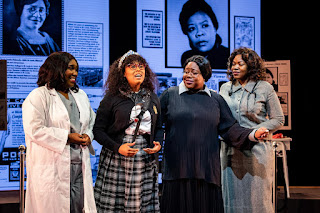
The program opened with “Cook Shack,” with music by Del’Shawn Taylor
and a libretto by Samiya Bashir. It’s the story of 11-year-old Dayo
(soprano Flora Hawk. Bullied by her schoolmates
because of her insecurity, she takes refuge in an exhibit at the St. Louis Griot Museum of Black History
on black female “Superheroes of Invention”: entrepreneur (and the
first Black woman millionaire) Annie Turnbo Malone (soprano Ardeen Pierre), nurse and inventor of
the first closed-circuit TV security system Marie Van Brittan Brown
(soprano Kimwana Doner-Chandler),
and ophthalmologist Dr. Patricia E. Bath (mezzo Olivia Johnson), whose patented Laserphaco Probe was a
major advance in cataract surgery.
As she reads about their remarkable lives, their waxwork figures
come to life and tell their stories. Their tales of triumph against
the odds give Dayo the strength to stand up and recognize her own
inner superhero.
Pierre, Doner-Chandler, and Johnson were all vocal powerhouses who
imbued their characters with passion, assurance, and in
Doner-Chandler’s case, righteous anger at injustice. Hawk made
Dayo’s journey from self-effacement to self-assurance completely
credible and was quite convincing as a gawky preteen.
Taylor has provided his three protagonists with music that reflects
their personalities and their times. It’s not always a good fit for
the realistic speech rhythms of Bashir’s libretto, though, making
comprehension of that libretto difficult. Projected text would have
been a big help here.
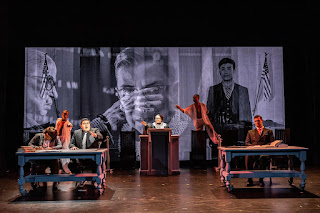
Up next was “Slanted: An American Rock Opera” by musician-activists
Simon Tam and Joe X. Jiang, founding members of the
Asian-American rock band The Slants. The opera
is a somewhat surreal depiction of the 2017 Supreme Court case Matal
v. Tam in which, without a trace of irony, Tam and his band were
accused of engaging in hate speech by using an anti-Asian racial
slur as the name for their band. Tam maintained that, as an Asian
man himself, he had every right to re-appropriate the word and so
defuse it.
 |
Slanted: An American Rock Opera
Photo: Phillip Hamer |
The opera follows the simple “ABA” structure of a standard pop song,
with opening and closing courtroom arguments bracketing “That’s Not
Me,” a long aria in which Tam (tenor Matthew Pearce) laments the way he and
his band are being misrepresented by strangers. “Isn’t it just pure
irony,” he sings, "That in this court, I’m fighting for freedom of
speech / but no / no one can hear me.” Pearce’s clarion-clear head
voice added a poignant edge to the character’s plea.
The return to the courtroom brings a repeat of the same rigid,
declamatory rhymed couplets from the first section, punctuated by
chants of “Free Speech, Hate Speech” by members of the court.
Bass-baritone Keith Klein was an
imposing Solicitor General here in the opening scene, potently
matched by Ardeen Pierre as Tam’s lawyer.
Suddenly Ruth Bader Ginsburg (soprano Dorothy Gal), who has been seated
upstage with her back to the audience, swings around. Illuminated by
a spotlight, she begins a tender, lyrical solo. “Does it not
matter,” Ginsburg asks, “that they’re taking the sting from
the word?... If you think that their speech is a problem, censorship
is not the cure.” It was your classic Star Turn, and beautifully
sung.
It soon turns into a duet with Tam (“I think I’m in love with a
supreme court justice”), which builds into a massive if somewhat
didactic hymn in praise of free speech and equal justice: “The
constitution protects us all / It doesn’t matter who wrote it.”
Finally, Tam is left alone on the stage for a last soliloquy that is
both a warning and call to action: “If you only leave your rights to
nine / Our books and bodies are on the line.”
Ultimately “Slanted” is agitprop but, as Marc Blitzstein proved
decades ago, agitprop can make for powerful musical theatre. It
certainly did with “Slanted,” and its message is one that needs to
be heard.
The evening concluded with what was, for my money, the strongest of
the three works: “Madison Lodge” by St. Louis’s own Tre’von Griffith. Set in 1928
Harlem—the time of the Harlem Renaissance—the
story is best summarized by quoting from the program:
“X has just arrived in Harlem after a long trip from their home
state of Alabama. When they reach their sister’s house, X explains
that they left to find freedom and live their truth. Sister assures
X that Harlem is the perfect place to realize those dreams, and
hands X an address.”
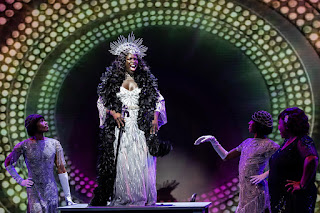
That address turns out to be the titular Madison Lodge, a
“modest-but-grand” drag club where preparations are underway for a
masquerade ball. There X (Namarea Randolph-Yosea)
meets the flamboyant Club Owner (a bravura performance by baritone Kyle Oliver) and finds out that Sister
(Olivia Johnson) is the Drag King, complete with a spectacular white
tux, top hat, and cane.
 |
Madison Lodge
Photo: Phillip Hamer |
The club is raided by bigoted cops before the show gets off the
ground and Sister is arrested. The experience inspires X to find
their own identity, and when Sister is finally bailed out by the
Club Owner, they discover X performing in a sparkling white gown
that parallels Sister’s own outfit. X has embraced Harlem “and even
more importantly, has embraced themselves.”
Of the three operas, “Madison Lodge” is the one that most cries out
for expansion into a full-length work. The characters have a
richness and back stories that could easily be fleshed out in more
detail. And it addresses themes of racial and gender identity that
are both timely and completely relevant to the Harlem of a century
ago. “Black queer folx have felt unseen, unheard, and unprotected,”
writes Griffith. “I feel very fortunate to collaborate with our
brilliant cast…to share this beautiful story with you.”
How right he is. Randolph-Yosea’s transformation from conflicted
teen to confident drag queen was nicely done, and Johnson was a
strong, confident presence as Sister. The ensemble of performers
from the other two operas was solid dramatically and vocally, while
Drag Artists Teonia M. Steele and Vontez Williams added a touch of
sinuous authenticity. Congratulations to all.
Darwin Aquino conducted the small but versatile orchestra with
assurance and Rajendra Ramoon Maharaj’s direction kept the action
clear and focused. Tom Ontiveros’s video designs did a splendid job
setting the scenes, although there were times at which the flood of
moving images in the background distracted from the drama more than
it amplified it.
The same was true of dancers Ka Thomas and Kelly Marsh. Their
graceful presence on stage often added visual emphasis but at other
times just pulled focus from the singers. Minor quibbles, these,
which is why they’re at the end of the review.
Finally: if OTSL plans to present additional shows at the Berges, it
should seriously consider dispensing with wireless body microphones
and adding projected text capability. It’s even possible that
dispensing with the mics might be enough. The kind of singers OTSL
employs don’t need them and they just add distortion.
Performances of the “New Works Collective” are history now, of
course, but I expect to see more from the talented and innovative
team responsible for these three operas. Hope for the future often
seems elusive these days. But for a couple of hours last Friday, at
least, it felt like it just might be possible.
Opera Theatre’s 2023 season kicks off with "The Road to Freedom,"
special concert that celebrates the 61st anniversary of the Freedom
Riders, followed by a new production of Joplin’s “Treemonisha” on
May 20. For season information, visit the OTSL web site.


.jpg)
%20(1).jpg)