[Being the third in a series of dispatches from the 2023 Bravo! Vail Music Festival,
attended by yours truly as part of a delegation from the Music
Critics Association of North America (MCANA)]
For most of my fellow music critics, Thursday July 13th began around
9:30 am watching Yannick Nézet-Séguin, the Philadelphia Orchestra,
and piano soloist Bruce Liu in their first and only rehearsal of
Rachmaninoff’s Piano Concerto No. 2 in C minor, Op. 18, which was
performed that evening. I don’t arise that early, though, so I
didn’t manage to join the group until the 12:30 meet and greet with
Nézet-Séguin.
.jpg) |
Yannick Nézet-Séguin, his bobblehead, and
the MCANA crowd |
We didn’t have much time with him, but what we had was lively and
informative. Offstage Nézet-Séguin radiated the same kind of
enthusiasm and charm he dispenses on stage, happily answering
questions from our group and posing for a selfie. He also told an
amusing anecdote about the festival’s first foray into opera,
Puccini’s political drama “Tosca.” “The audiences were so new to the
opera,” he recalled, “that when Scarpia [one of opera’s more
repellent villains] came to take a bow nobody applauded and they all
booed. But they all loved it, and that’s our mission—building
audiences everywhere.”
He also noted that “you’re getting the best of the weather here. It
can be very unpredictable but this week it’s predictably beautiful.”
Each of us also got an official Yannick Nézet-Séguin bobblehead
(complete with a tiny version of his characteristic red-tipped
baton). Mine currently resides next to my only other bobblehead,
Harry Houdini. “The head is OK,” quipped Nézet-Séguin, whose podium
style is very physically active, “but the body doesn’t move enough.”
All of this did, however, make us late for our next event, a free
Community Concert at the Vail Interfaith Chapel by the Viano String Quartet (violinists Lucy
Wang and Hao Zhou, violist Aiden Kane, and cellist Tate Zawadiuk).
As a result we missed all of the opening piece, Reena Esmail’s
“Zeher” (“Poison”), along with over half of Bartók’s String Quartet
No. 3 Sz. 85. What we did hear was pretty impressive, though.
Happily, we did get to enjoy all of Smetana’s String Quartet No. 1
in E minor (“From My Life”). Violist Kane jokingly referred to it as
“Smetana’s Viola Concerto” because of the prominent part for her
instrument, but the music itself is serious stuff.
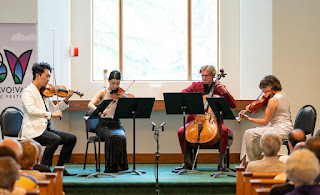 |
The Viano Quartet
Photo courtesy of Bravo! Vail |
Smetana wrote his first and only string quartet near the end of his
life as his hearing and health were failing. It’s overtly
programmatic, tracing the composer’s life from his initial delight
in his art (first movement), his love of his native Bohemia’s folk
music and dances (second movement), his happy marriage to his first
wife, Kateřina (third movement), and in the last movement, his
tinnitus (graphically illustrated by a sustained E in the violin),
subsequent hearing loss, and the decline in his health.
That’s a lot of emotional territory to cover, and the Viano Quartet
covered it thoroughly, displaying a strong connection with the
work’s wide emotional range.
The concert concluded with an arrangement of “In Other Words” (the
1954 jazz standard better known these days as “Fly Me to the Moon”)
by violinist Zhou. A lively mix of mainstream jazz with just a touch
of vintage Quintette du Hot Club de
France and a slick cello solo, it was the perfect contrast to
the tragedy of the Smetana quartet.
Thursday evening found us back at the Ford Amphitheater for a mostly
Rachmaninoff evening. I say “mostly” because the concert opened with
the brief (six minutes) “Fanfare Ritmico” written at the turn of the
millennium by American composer Jennifer Higdon (b. 1962). Quoted in
the program, the composer says that the piece “celebrates the rhythm
and speed (tempo) of life…This fanfare celebrates that rhythmic
motion of man and machine, and the energy that permeates every
moment of our being.”
Energy the fanfare has aplenty, to be sure. Scored for orchestra and
a massive percussion battery (four percussionists playing 26
instruments plus tympani), it sometimes felt less like a work for
percussion and orchestra and one for percussion vs. orchestra. It
essentially consists of a five-note motif that dashes around the
stage at breakneck pace, sometimes in massive sonic blasts,
sometimes in delicate moments for a handful of instruments.
Higdon’s orchestration is inventive and the performance by the
Philadelphians was quite the feat of virtuosity. You couldn’t call
it great music, but it was fun while it lasted.
Up next was a work that has become a favorite of mine over the
years, Rachmaninoff's "Symphonic Dances." I have found it oddly
compelling since I first heard it during my undergraduate days on a
1961 LP recording by the Philadelphia Orchestra under Eugene
Ormandy, who conducted the work's first performance in 1941. I was
immediately struck by the "late night" feel of the piece—and not
just because of the chimes in the last movement. It was only later
that I learned that Rachmaninoff had, in fact, originally titled the
three sections "Noon," "Twilight," and "Midnight." The composer
dropped the titles, preferring to let the music speak for itself,
and it does so eloquently.
The work is filled with evidence of Rachmaninoff's genius as an
orchestrator, with elaborate and complex string writing, inventive
use of brasses and winds (including a short but poignant solo for
alto sax), and an effective but never overwhelming use of the large
percussion battery. The final movement is a struggle between the
“Dies Irae” and the “Resurrection” theme from Rachmaninoff’s 1915
“All-night Vigil,” which while emphatically resolved in favor of the
latter, still seems to carry the sense of a life approaching its
conclusion.
Nézet-Séguin’s approach leaned heavily on the melancholy and
emotional extremes of the music, with strong contrasts in dynamics
and tempi and, of course, lots of rubato. This was particularly
effective in the second dance, Andante con moto (Tempo di valse),
which swelled and swooned as it built slowly to a forceful
restatement of the main theme and an energetic coda. Orchestral
details were very clear throughout, allowing us to hear more of that
exceptional skill the band displayed in Higdon’s “Fanfare.”
 |
André Watts in 1971
Photo: James Kriegsmann, New York
Public Domain, |
The Lento assai sections of the final dance were unusually
slow, creating a strong sense of yearning—perhaps for the life that
was departing, perhaps for the one that the deeply religious
composer no doubt felt was to come. It added to the impact of the
final moments in any case.
This was not a “Symphonic Dances” reading that was much to my taste,
but it must be acknowledged that Nézet-Séguin made a persuasive case
for it. And the audience loved it.
In program notes for a 2019
performance, St. Louis Symphony Orchestra Music Director
Stéphane Denève described the “Symphonic Dances” as “redeeming—it's
a piece of hope. The ending is an Alleluia, a triumph over death. It
was his last work, and maybe, because he composed this piece, he
felt he could die." That was the feeling I got from this
performance.
After intermission, Rachmaninoff’s wildly popular Piano Concerto No.
2 in C minor Op. 18, concluded the concert. But first, “Old
Mortality” was back among us again.
“One shining light has gone now into the sky; a new star is coming.”
That’s how Nézet-Séguin introduced piano soloist Bruce Liu to the audience. The light in
question was that of legendary pianist André Watts, who had
died the previous day at the age of 77.
Those of us d'un certain âge (sounds more classy than “old”)
remember Watts well. As someone who was born only two years later
than him, I remember him as being around my entire life—because he
was. When he made his famous debut playing the Liszt Piano Concerto
No. 1 with Bernstein and the New York Philharmonic, he was only 16
and I, at age 14, was just beginning to seriously love “classical”
music. Watts went on to become a star and I went on to become,
eventually, a music critic. And so it goes.
Although much younger than either of us, Nézet-Séguin also remembers
Watts well because when the conductor made his Philadelphia
Orchestra debut in 2008, he was accompanying Watts in, of all
things, the Rachmaninoff Second. “The coincidence is almost
overwhelming emotionally,” he recalled. “So, this resonates very
personally and as you can understand, in this entire concert and
especially this performance, we all have André on our hearts.”
It's a beautiful sentiment. I wish I could say the performance of
the concerto that followed was a fitting tribute to the late
pianist, but honesty forbids me from doing so. From the famous
seven-chord introduction, with its evocation of tolling bells, until
nearly the end of the last movement, this was a performance that
pushed the limits of the concept of “slow” and generally lacked
energy.
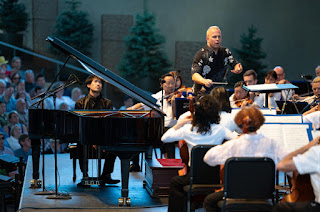 |
Bruce Liu and Yannick Nézet-Séguin
Photo courtesy of Bravo! Vail |
The opening of the first movement was so ponderous that there was
little room for contrast with the more romantic second theme.
Soloist Liu’s voicing brought out some inner details of the piano
part that I hadn’t heard before, but otherwise it felt oddly
passionless and affected.
The second movement (marked Adagio sostenuto) felt more Lento,
if not downright Larghissimo, making it a serious test of
the principal clarinet’s breath control in their long solo. On the
positive side, Liu’s playing had a crystalline clarity. Still, this
was easily the slowest I have ever heard this movement played, and
the tempo sucked the life out of it.
The Allegro scherzando finale got off to a good start, but
the entry of the familiar second theme (the basis for the 1945 Frank
Sinatra hit “Full Moon and Empty Arms”) slowed it all to a crawl
once again. Still, the final restatement of that theme at the end
was tremendously effective.
My opinion aside, the performance was received with wild approval by
the audience and led to an encore. Liu didn’t announce the title,
but I think it was Rameau’s “Les tendres plaintes” (from the Suite
in D Major in the Premier Livre de Pièces de Clavecin, in
case you’re keeping score), which he recorded in 2022 for Deutsche
Gramophon.
Next: Anna Clyne and Wolfgang Mozart, together again for the first
time.


.jpg)


