Showing posts with label Jean-Yves Thibaudet. Show all posts

Tuesday, March 22, 2022

Symphony Review: Elegant Gershwin and persuasive Rachmaninoff highlight a St. Louis Symphony concert

In his comments from the podium at the beginning of the St. Louis Symphony Orchestra (SLSO) concert last Saturday (March 19), Music Director Stéphane Denève talked about the Zoom conference he had with composer James Lee III, whose tone poem “Chuphshah! Harriet's Drive to Canaan” opened the evening. Lee noted that this memorial to Harriet Tubman—the legendary abolitionist, suffragist, and creator of the Underground Railroad—is ultimately “about the freedom, love, and respect that any human deserves.”

[Find out more about the music with my symphony preview.]

That’s certainly a message that needs to be heard these days. That said, I’m not sure it really comes across in this dramatically charged but rather clangorous work. The opening section, which depicts Tubman’s escape from slavery with an agitated four-note figure on the marimba, xylophones, and English horn is certainly attention grabbing in an action movie way, but it wears out its welcome rather quickly. The English horn also gets remarkably few solo passages, given its stated status as a musical protagonist. Overall, “Chuphshah! Harriet's Drive to Canaan” lacks the kind of emotional impact that was so apparent in Lee’s 2018 “Emotive Transformations” in its SLSO premiere last November.

Still, Denève and the band did an outstanding job with it. Cally Banham’s English horn sang beautifully and the percussion section displayed their versatility on everything from gong to glockenspiel. Like so many newer scores, “Chuphshah!” demands a lot from the orchestra, and it got it.
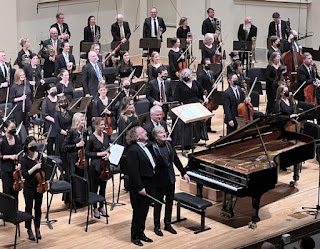
L-R: Stéphane Denève and Jean-Yves Thibaudet

Up next was Gershwin’s Concerto in F, written in 1925. Coming just a year after the somewhat rough-hewn “Rhapsody in Blue,” the concerto displays how Gershwin’s development as a serious composer and orchestrator proceeded with supernatural rapidity. It’s a beautifully crafted piece: lean, powerful, without a spare note.

Denève often describes Soloist Jean-Yves Thibaudet as “the most American of the French pianists,” and his performance demonstrated the truth of that appellation. Although he and Denève sounded a bit out of synch at times during the first movement, Thibaudet nevertheless showed the same impressive technique that we heard last week in Saint-Saëns’s “Egyptian” Concerto, especially in the dynamic third movement. He was also elegant and understated when necessary, most notable in the blues-infused second movement. It was a finely balanced combination of American drive and French élégance.

The same was true of Denève’s interpretation. As is so often the case with his work, there were levels of finesse and subtle variations in tone and emphasis that added depth to the performance. The orchestra played with its customary perfection, including outstanding solos by Associate Principal Trumpet Tom Drake in the gritty and elegiac second movement and Principal Flute Andrea Kaplan in the Allegro Agitato finale.

The concert concluded with Rachmaninoff’s Symphony No. 3 from 1936, when the composer was living in exile in Switzerland. Cut off from his Russian roots and taking up a form he had abandoned two decades earlier, Rachmaninoff produced a symphony of striking originality. His melancholy romanticism and melodic gift are there, but they are infused with an element of harmonic and structural modernism. The second movement, for example, embeds a spiky, almost-Prokofiev scherzo in the middle of a lyrical Adagio, and the symphony itself is cast in three movements rather than the traditional four. It’s a work that constantly changes emotional gears, building to impressive climaxes that suddenly dissipate into lyrical rumination.

It is, in short, a symphony that requires a conductor with a deep understanding of Rachmaninoff’s intentions and the ability to make them clear to the listener. Denève clearly has that understanding and ability, resulting in a very persuasive accounting of this rather neglected work that called to mind, at times, the composer’s own 1939 recording with the Philadelphia Orchestra.

This being Rachmaninoff, there were many solo opportunities, and so we had fine individual performances by, among others, Principal Horn Roger Kaza, Principal Harp Allegra Lilly, Concertmaster David Halen and, in the final movement, Principal Flute Andrea Kaplan. The Symphony No. 3 is a bit more transparently scored than the composer’s earlier works, which makes those little unaccompanied moments all the more important.

I doubt that Rachmaninoff’s last symphony will ever be as popular as the first two. Its charms are a bit elusive and it demands more of the listener but is, in the final analysis, worth the effort.

Next at Powell Hall: The official season takes a break for some special events, with the regular season returning April 6-8:

All events take place at Powell Hall in Grand Center.

This article originally appeared at 88.1 KDHX, where Chuck Lavazzi is the senior performing arts critic.

Tuesday, February 10, 2015

Symphony Review: A spring awakening with Stéphane Denève and the St. Louis Symphony, February 7 and 8, 2015

Stéphane Denève in the auditorium
of the Théâtre des Champs-Élysées, Paris
Photo: Tom Finnie
Share on Google+

Who: The St. Louis Symphony Orchestra conducted by Stéphane Denève
What: Music of Debussy, James MacMillan, and Dvořák
When: February 7 and 8, 2015
Where: Powell Symphony Hall, St. Louis

A bit of spring blew through St. Louis a couple of months early this weekend, and I’m not just talking about the temperatures outside.  Inside Powell Hall it was unseasonably vernal, as well, as Principal Flute Mark Sparks and the St. Louis Symphony under guest  conductor Stéphane Denève gave voice to Debussy’s sultry “Prélude à l’après-midi d’un faune” (“Prelude to the Afternoon of a Faun”).

[Find out more about the music with the symphony program notes and my symphony preview].

Inspired by an 1876 poem by the symbolist Stéphane Mallarmé (whom Debussy greatly admired), the “Prélude” exudes what Boston Symphony music librarian Marshall Burlingame describes as a “languorous sensuality” as “the faun’s conscious observation of two nymphs in the sunlight drifts into erotic fantasy.”  Even in Mallarmé’s elliptical poetry, it’s steamy stuff.

Mark Sparks
stlsymphony.org
Mr. Denève’s loving and subtly shaded interpretation, combined with Mr. Sparks’ graceful playing of the solo part (the flute takes on the role of the faun’s panpipes), produced exactly the lubricious atmosphere the composer had in mind.  Working without a baton, Mr. Denève artfully shaped  phrases with his hands in the manner of the late Leopold Stokowski while still making individual cues pointed and unambiguous.  He is, as I have noted in the past, a commanding figure on the podium and an interesting visual study.

Immediately following the first dose of Debussy, we got a second: the brief “Syrinx” for solo flute from 1913.  It wasn’t on the printed program, having been added during rehearsals as a result of discussions between Mr. Sparks and Mr. Denève, but there was nothing rushed or under-rehearsed about Mr. Sparks’ seemingly effortless performance.

Next up was the local premiere of Scottish composer James MacMillan’s Piano Concerto No. 3, “The Mysteries of Light.”  Based on the five “Luminous Mysteries” added to the existing fifteen rosary mysteries by Pope John Paul II in 2002, the work is not so much a classic concerto as it is a symphony with a prominent piano part.  Yes, the pianist has some impressively flashy passages, especially in the finale (“The Institution of the Eucharist”) with its “perpetual motion” coda, but overall the piano is more of an orchestral partner.

As I wrote in my preview article, Mr. MacMillan disdains composers who are (in his words) “deeply suspicious of any significant move towards tonality, any hint of pulse that is actually discernible, and any music which communicates successfully with a non-specialist audience.”  If, in other words, you are weary of music that sounds more like an orchestra tuning up than a deliberate composition, or that seems to have been written more for a grant-funding committee than for a paying audience, Mr. MacMillan is undoubtedly your man.

The 3rd concerto is not what I’d call a subtle work. The first movement (“The Baptism of Jesus  Christ”), for example, features rapid “watery” passages at the upper end of the keyboard while the second movement’s “Wedding at Cana” includes a raucous  tune in the style of a reel.  Jesus’ ascension in the fourth movement is depicted by a massive orchestral crescendo that begins at the very bottom of every instrument’s register and quickly  climbs to the top, and the radiance of Jesus’ face is illustrated by an elaborately beautiful chorale for the strings.

And so it goes.  There’s an almost cinematic vividness to this music—and I mean that in the most flattering way possible.  Unlike some of the newer works the SLSO has unveiled, this is a piece that can be grasped at first hearing while still inviting repeated listening.  We can only hope  that a recording will be forthcoming at some point.

Jean-Yves Thibaudet
jeanyvesthibaudet.com
The soloist for the concerto was Jean-Yves Thibaudet.  He premiered the concerto with the Minnesota Orchestra in 2011, so I think I can safely describe his performance as definitive.  It was certainly assured and intense, backed up by virtuoso playing by the orchestra.  He and Mr. Denève clearly love this music, and their very informative and entertaining spoken introduction, including a brief bit of four-handed piano from the pair, was a nice supplement to the printed program notes.

The concert concluded with the the "Symphony No. 8" in G major, Op. 88, written in 1890 by Antonin Dvořák.  The symphony comes from an especially happy time in the composer’s life.  Thanks, in part, to the enthusiastic support of Brahms, Dvořák was much in demand as both a composer and conductor and was prosperous enough to purchase a home in the Czech countryside that inspired so much of his work.

Composed at his newly acquired home, this cheerful symphony overflows with celebrations of rustic life.  There are twittering birds, cheerful village bands, wandering violinists, and even, at one point, a section that has always made me think of a sudden thunderstorm.  This is the joy of living, wrapped up in the Czech master’s characteristically infectious melodies and dance-inspired rhythms.

Dvořák  is one of my favorite composers and I thought I had heard every possible approach to this consistently good-humored symphony. Mr. Denève still managed to surprise me, though, with an idiosyncratic approach that lingered over orchestral details, sometimes sacrificing the composer’s rhythmic vitality to do so.  And yet, it never felt overdone or excessively episodic.  This was a performance that drew me in, almost in spite of myself.

The orchestra responded with some truly superb playing.  The cellos, under Principal Daniel Lee, brilliantly fulfilled their important melodic role, especially in the first and last movements, and the winds and horns made the most of the loving attention Dvořák lavishes on them all the way through.  Concertmaster David Halen also had a nice moment as that strolling violinist in the second movement.

Finally, a note about silence.  Most of us know that silence is an element of music. John Cage even went to far as to write and entire piece (“4’ 33””) consisting of nothing by four minutes and 33 seconds of silence, along with whatever ambient sound happens to be present at the time.  Dvořák uses silence effectively in the eighth symphony, and Mr. Denève used it effectively throughout the concert.  Before he began the Debussy, for example, he held himself completely still until the last audience wheeze had died out and the opening flute solo could emerge from almost complete quiet.  His understanding of the importance of silence and stillness is, I think, one of the things that makes Mr. Denève’s interpretations stand out from the crowd.

Next at Powell Hall: Kevin McBeth conducts the St. Louis Symphony IN UNISON chorus in “Lift Every Voice: A Black History Month Celebration” on Friday, February 13, at 7:30 PM.  The orchestra is supplemented by a rock band for “Faithfully: A Tribute to the Music of Journey” on Saturday, February 14, at 7:30 p.m.  The regular season resumes when Slovakian conductor Juraj Valcuha leads the orchestra and piano soloist André Watts in Rachmaninoff’s “Piano Concerto No. 2” and Tchcaikovsky’s “Symphony No. 6” (“Pathétique”) on Friday at 10:30 a.m. and Saturday at 8 p.m. February 20 and 21.  For more information: stlsymphony.org.

Thursday, February 05, 2015

Symphony Preview: Ecstasy without agony Saturday and Sunday, February 7 and 8, 2015

Share on Google+:

The theme running through this weekend's St. Louis Symphony concerts, as Daniel Durchholz writes in his program notes, is "ecstatic expression". Specifically, "the sensual delights of Debussy, the religious rapture found in the deep devotion of [Scottish composer James] MacMillan, and Dvořák’s reveling in the country comforts of his homeland." I think he's on to something there.

Debussy in 1908
en.wikipedia.org
I haven't heard the MacMillan piano concerto that concludes the first half of the concert, but there's not much doubt that ecstasy figures prominently in both the works that open and close the concert. First performed in 1894, Debussy's "Prélude à l’après-midi d’un faune" ("Prelude to the Afternoon of a Faun") is a languorous evocation of the landscape of Classical mythology while Dvořák’s "Symphony No. 8" from 1890 takes its cue from the thoroughly unmythical Bohemian countryside. Both show how much their respective composers were inspired by the natural world.

Granted, in Debussy's case the immediate inspiration wasn't so much nature as it was an elliptically erotic 1876 poem by Stephane Mallarmé, whom Debussy greatly admired. "The poem's languorous sensuality is subtly shaded," wrote Boston Symphony music librarian Marshall Burlingame for the SLSO's 1982 recording of the piece, "as the faun's conscious observation of two nymphs in the sunlight drifts into erotic fantasy." Mallarmé apparently agreed. "I have just come out of the concert deeply moved," he wrote to the composer. "The marvel! Your illustration of the Afternoon of a Faun, which presents a dissonance with my text only by going much further, really, into nostalgia and into light, with finesse, with sensuality, with richness. I press your hand admiringly, Debussy."

In Debussy's music, the faun is personified by the flute, which is featured prominently throughout its roughly ten-minute length. In fact, the opening flute solo is probably one of the best-known moments in the classical repertoire. It's haunting and dreamy, and it expertly conjures up the voluptuous, summery world of the poem. "The piece is avant-garde, revolutionary," observes SLSO Principal Flute Mark Sparks in the program. "The idea is personal for Debussy. He owns the idea of what happens harmonically: ambiguity, consciously taking the traditional Germanic sense, Wagner especially, and throwing it out the window."

Anton and Anna Dvořák in London, 1886
en.wikipedia.org
I don't know what Dvořák thought of Debussy. He probably would have found the younger composer's whole approach odd. But, like Debussy, he was often inspired by nature. Written at a time of great happiness in the composer’s life, the "Symphony No. 8" in G major, Op. 88, overflows with good humor. Dvořák composed it at his newly acquired country home and filled it with celebrations of rustic life. There are twittering birds, cheerful village bands, wandering violinists, and even, at one point, a section that has always made me think of a sudden thunderstorm. This is the joy of living, wrapped up in the Czech master’s characteristically infectious melodies and dance-inspired rhythms.

Like the Debussy, the Dvořák abounds with lovely solo passages for the winds, as does so much of his music. The last time the SLSO performed this symphony—October of 2010, under Gilbert Varga—I was very taken with the orchestra’s flute, piccolo, and single and double reed sections. Needless to say, I'm looking forward to a repeat of that this time.

Interestingly, the Dvořák Eighth has something in common with the Beethoven Eighth that we heard  a couple of weeks ago. Like the Beethoven, it’s an unpretentious and genial piece that stands in marked contrast to the more dramatic and more often performed symphonies on either side of it. Beethoven’s Eighth tends to get less attention than his propulsive Seventh or his grand Ninth. Dvořák’s Eighth has the same problem compared to the darkly dramatic Seventh and the wildly popular Ninth, “From the New World.” And yet both symphonies have much to recommend them. It’s good to have the opportunity to hear them almost back-to-back.

I’d like to close by giving you my impressions of the new work on the program this week, the “Piano Concerto No. 3” (subtitled “Mysteries of Light”), written in 2007-2008 by James MacMillan, the contemporary Scottish composer best known for "Veni, Veni, Emmanuel," his 1992, percussion concerto closely identified with Evelyn Glennie. Unfortunately the piano concerto, which had its premiere in April of 2011 with the Minnesota Orchestra, doesn’t appear to be available on recordings yet. Fortunately, the composer has given us a fairly detailed program at the web site of his publisher, Boosey and Hawkes.

James MacMillan
boosey.com
"My 3rd Piano Concerto," he writes, "attempts to revive the ancient practice of writing music based on the structure of the Rosary. The most famous example of this is the collection of the Rosary (or Mystery) Sonatas for violin by Heinrich Biber, written in the late 17th century. These consist of 15 movements based on the Joyful, Sorrowful and Glorious Mysteries. In 2002 another set of meditations were introduced by John Paul II, the Luminous Mysteries, and these are the basis of the five sections of this concerto... However, the music here is in no way geared towards liturgy, or devotional in any accepted, traditional sense. Rather, each image or event becomes the springboard for a subjective reflection, and proceeds in quasi-dramatic fashion, not too distant in concept from the musical tone poem. The fusion of symphonic poem with concerto forms has long been a favourite pursuit of mine in earlier works. The music is in one single, continuous span, comprising five distinct portions."

If the examples of MacMillann’s work that I have been able to find are any indication, you can expect music that, while obviously contemporary, is nevertheless very accessible and free of the kind of dry, academic abstraction that seems typical of so many compositions over the last few decades. “For polemical as well as practical purposes,” writes Joe Staines in “The Rough Guide to Classical Music” (Penguin, 2010), “MacMillan has often stood against ‘the old guard of the avant-garde’ who ‘are deeply suspicious of any significant move towards tonality, any hint of pulse that is actually discernible, and any music which communicates successfully with a non-specialist audience.”

At the piano for the concerto will be the man who first performed it, Jean-Yves Thibaudet. A highly regarded performer with an international reputation, Mr. Thibaudet has a wide-ranging repertoire that includes 19th, 20th, and 21st century masters and even jazz. His playing can be heard in the cinema as well, on the soundtracks of films like "The Portrait of a Lady," "Bride of the Wind," "Pride and Prejudice," "Extremely Loud and Incredibly Close," and "Atonement." His last appearance with the SLSO was back in 2001.

On the podium will be Stéphane Denève, a young (age 43) French conductor who impressed me mightily when he made his SLSO debut back in September of 2003 with a program of Britten, Tchaikovsky, and Haydn and again in 2011 when the program featured Ravel's "Daphnis et Chloe". On the podium he’s an impressive figure: tall and commanding without appearing overbearing and with a bit of the late Leopold Stokowski’s flair. He seemed to be in close communication with the musicians at all times when I saw him here, and they appeared to enjoy working with him. And they're obviously not alone. Mr. Denève is Chief Conductor of Stuttgart Radio Symphony Orchestra, Principal Guest Conductor of the Philadelphia Orchestra, and will become Chief Conductor of the Brussels Philharmonic and Director of its Centre for Future Orchestral Repertoire from September 2015. Previous conducting gigs include orchestras as diverse as the Orchestre de Paris, the Suisse Romande Orchestra, the National Symphony in Washington, along with numerous opera orchestras.

The Essentials: Stéphane Denève conducts the St. Louis Symphony Orchestra with piano soloist Jean-Yves Thibaudet on Saturday at 8 p.m. and Sunday at 3 p.m., February 7 and 8. The concerts take place at Powell Symphony Hall, 718 North Grand in Grand Center. For more information: stlsymphony.org.