Showing posts with label christian tetzlaff. Show all posts

Wednesday, April 02, 2014

Heart of Darkness

Shostakovich in 1945
Share on Google+

This weekend's St. Louis symphony concerts feature (to borrow a phrase from the baseball diamond) a pair of heavy hitters—on both the stage and the page.

On stage we have the dynamic duo of violinist Christian Tetzlaff and SLSO music director David Robertson. Mr. Robertson, of course, needs no introduction—and neither, for most audience members, should Mr. Tetzlaff. An artist with an international reputation performing a wide range of music from Bach to contemporary world premieres and the founder of a string quartet that bears his name, Mr. Tetzlaff gave us an impressive Sibelius "Violin Concerto" in January of 2012 (with Mr. Robertson on the podium) that combined technical facility with musical sensibility.

Jean Sibelius (1865-1957) is also one of this weekend's two heavy hitter composers; the other is Dmitry Shostakovich (1906-1975). From the latter we're getting the dark and demon-haunted "Violin Concerto No. 1 in A minor," Op 77, while the former gives us his dramatic "Symphony No. 2 in D major," Op. 43.

That's the whole program. There's no short overture or other curtain raiser. Once the lights go down, you'll be plunged straight into the Shostakovich.

Although completed in 1948, the Shostakovich concerto was not performed until 1955 – two years after the death of Stalin and the subsequent easing of restrictions on composers who (like the residents of Monty Python's "Happy Valley" ) risked arrest for not being sufficiently cheerful. And cheerful is a word which nobody is his or her right mind would apply to this work. Yes, the finale is typically lively and boisterous, but it comes after a dark and tragically brooding first movement, a demonically grinning second that could have been penned by The Joker (Batman's, not Steve Miller's), a Passacaglia (based, in part, on the "fate" motive of Beethoven's "Fifth Symphony") that sounds like something Bach might have produced had he lived through the horrors of World War II in Russia, and a highly dramatic virtuoso cadenza that's almost a tone poem unto itself.

Sibelius in 1913
Taken as a whole, the concerto is a work of tragic grandeur, which may be why David Oistrakh (for whom the work was written and who assisted in its revision) referred to the solo violin part as a "pithy 'Shakespearean' role". Certainly the cadenza that links the third and fourth movements is as technically challenging as any of The Bard's soliloquies, with a dynamic and emotional range that compels complete attention. We got that and more when Simone Lamsma performed the concerto with Jaap van Zweden on the podium two years ago, so it will be interesting to see what the Tetzlaff/Robertson combo does with it this time around.

As with the Shostakovich concerto, there's darkness in the Sibelius "Symphony No. 2," but it's an entirely different kind. It's the darkness of the majestic, windswept Finnish landscape that rarely sees the sun for months on end. It's the kind of darkness you might appreciate from inside a cozy cabin. Like, say, the all-wood home (Sibelius didn't want to hear the sound of rain in metal gutters) on Lake Tuusula in the Finnish forest where the composer lived and worked from 1982 until his death. It's a natural and benign darkness, as opposed to the malevolent spiritual darkness of the Soviet police state that oppressed Shostakovich. It's dramatic, uplifting, and conjures up potent images of the natural world that so inspired Sibelius.

Ainola, the house of Sibelius and his wife Aino
finland.fi
Sibelius started this symphony in Italy in 1902, but he completed it in Finland in 1902. It's impossible to hear this music and not conjure up images of pines, snow, and brisk northern winds—especially in that final movement. Paul Schiavo, in his program notes, accurately describes it as "one of the most exultant finales in the symphonic literature."

The essentials: David Robertson conducts The St. Louis Symphony Orchestra and violinist Christian Tetzlaff in Shostakovich's "Violin Concerto No. 1" and Sibelius's "Symphony No. 2" on Saturday at 8 PM and Sunday at 3 PM, April 5 and 6, at Powell Symphony Hall, 718 North Grand. For more information: stlsymphony.org. The Saturday performance will be broadcast on St. Louis Public Radio, 90.7 FM, HD 1, and via live Internet stream.

Sunday, March 30, 2014

St. Louis classical calendar for the week of March 31, 2014

SMSSL at the Sheldon
Share on Google+:

The Chamber Music Society of St. Louis presents Genuine Classics—No Fooling, featuring the Mozart Clarinet Quintet in A Major K 581 and the Brahms Piano Quintet in F minor, op. 34 on Tuesday, April 1, at 7:30 PM. The concert takes place at The Sheldon Concert Hall, 3648 Washington. For more information: chambermusicstl.org.

The Chamber Players of St. Louis and the Laclede Quartet present a concert by the Maryville Symphony Orchestra on Sunday, April 6, at 3 PM. The concert features Daniel Bert, oboe and Kevon Hall, bassoon, performing Vivaldi's Concerto in G. Also on the program: Mozart's Eine Kleine Nachmusik and Borodin's Petite Suite as arranged by Glazounov. The concert takes place at the Maryville University Auditorium, 650 Maryville University Drive. For more information: maryvillesymphony.com.

The Community Music School of Webster University presents its Spring Faculty Recital on Friday, April 4, at 8 PM. "The Community Music School of Webster University is pleased to present faculty members in recital, showcasing their abilities as outstanding performers. Faculty performing on the recital include Donita Bauer, bassoon; April Dannelly, cello; Audrey Denny, clarinet; Jeanine York-Garesche, clarinet; Nina Gerassimova, piano; Jill Hartzog, soprano; Ann Homann Mottl, oboe; Jessica Knopf, saxophone; Vera Parkin, piano; Patrick Rafferty, guitar; and Robert Souza, trumpet. Works by J.S. Bach, Leonard Bernstein, Benjamin Britten, Kent Kennan, Ed Martin, Rudolf Escher, and others will be performed in solos and ensembles." The school is at 535 Garden Avenue in Webster Groves, MO. For more information: www.webster.edu/cms.

McKendree College presents a St. Louis Symphony Mondays concert featuring member of the SLSO on Monday, March 31st, at 7:30 PM. The concert takes place in the Hettenhausen Center for the Arts on the college campus in Lebanon, IL. For more information: thehett.com.

Alarm Will Sound
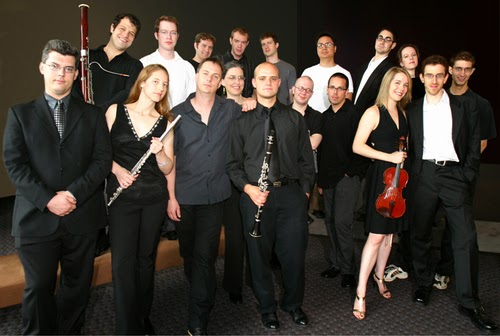
The Pageant presents the contemporary music ensemble Alarm Will Sound on Tuesday, April 1, at 7:30 PM. " Alarm Will Sound returns to St. Louis to perform music of Aphex Twin, Steve Reich, Tyondai Braxton and John Orfe at The Pageant. Alarm Will Sound has been described as "the SEAL Team Six of new music" by the New York Magazine and as "one of the most vital ensembles on the American music scene" by the New York Times. In this show, Alarm Will Sound transforms the electronica of Aphex Twin into live performance on acoustic instruments, putting machine-made music into the hands of human players. Also on the program is Steve Reich's newest work "Radio Rewrite," based on the music of Radiohead, and Ty Braxton's "Fly By Wire", both written specifically for Alarm Will Sound's adventurous virtuosos, and both exploring the relationship between popular and classical music." The Pageant is at 6161 Delmar. For more information: alarmwillsound.com.

The Pulitzer Foundation for the Arts presents ICE (International Contemporary Ensemble) with Claire Chase on Friday, April 4, at 7:30 PM. "Claire Chase, a 2012 MacArthur Fellow, is a soloist, collaborative artist and arts entrepreneur. Over the past decade Chase has presented the world premieres of over 100 new works for flute, many of them tailor-made for her. ICE will present a performance inspired by "Things of Their Own Making" exhibit at Pulitzer, which 'explores the autonomous object as something simultaneously enduring and ephemeral, synchronic, and diachronic.'" The performance takes place at the Pultzer Center for the Arts, 3716 Washington. For more information: pulitzerarts.org

Christian Tetzlaff
David Robertson conducts The St. Louis Symphony Orchestra and violinist Christian Tetzlaff in Shostakovich's Violin Concerto No. 1 and Sibelius's Symphony No. 2 on Saturday at 8 PM and Sunday at 3 PM, April 5 and 6, at Powell Symphony Hall, 718 North Grand. “After garnering rave reviews as part of the STL Symphony's 2012 European Festivals Tour for his “angelic playing” (Times of London), Christian Tetzlaff returns to perform Shostakovich's Violin Concerto No. 1. Considered a song of praise for summer and the joy of life, Sibelius' Second Symphony creates a romantic feeling with its memorable melodies. Full of heroic character in the first and final movements, this work touches the hearts of many in its views of man's struggle and a nation's independence.” For more information: stlsymphony.org.

The St. Louis Symphony Orchestra presents a free concert on Tuesday, April 1, beginning at 7 PM at the Piper Palm House in Tower Grove Park. “The STL Symphony celebrates more than 15 years performing for audiences in the beautiful Piper Palm House inside Tower Grove Park. Each of these popular concerts is followed by a complimentary wine tasting reception. Doors open at 6:30pm and all concerts begin at 7pm. Seating is limited and available on a first-come, first-served basis.” For more information: www.stlsymphony.org/symphony_neighborhood/.

Third Baptist Church presents an organ concert on Friday, April 4, at 12:30 PM as part of its free Friday Pipes series. "Join us on Fridays at Third Baptist Church for Friday Pipes, the free organ recital series celebrating the restoration of the church's 72-rank Kilgen/Möller pipe organ. Each week a different performer will be presenting a program of classical, church, and theatre organ music in the beautiful sanctuary of Third Baptist. This season's performers come from across the USA, and even from around the world. Free parking is available in the church lots on Washington Avenue." Third Baptist Church is at 620 N Grand. For more information: www.third-baptist.org.

Tuesday, January 24, 2012

Love and death


Who: Violinist Christian Tetzlaff and The St. Louis Symphony Orchestra and Chorus conducted by David Robertson
What: Music of Wagner, Sibelius, and John Adams
Where: Powell Symphony Hall, St. Louis
When: January 21 and 22, 2012

Share on Google+

“Love and Death”. It’s not only a classic Woody Allen movie, it’s also the theme of John Adams’s massive choral cantata Harmonium, the closing work in a varied program that opened with the reverent Prelude to Act I of Wagner’s Parsifal and an electrifying performance of Sibelius’s one and only violin concerto.

The violin was Jean Sibelius’s first musical love. He began playing as a child and showed great promise as a performer, despite an elbow fracture that impeded his bowing technique. Even after it became clear that his real talent was for composition, he continued to play in chamber ensembles and even teach the instrument. It’s no surprise, then, that his Violin Concerto — originally presented in 1903 and then again in a substantially revised form in 1905 — is both thoroughly idiomatic and incredibly demanding. The long solo passages in the first movement and virtuoso fireworks in the finale will test the mettle of the best performers.

Soloist Christian Tetzlaff seemed thoroughly at east with this difficult material. He performed with a score, but appeared to refer to it only rarely, having clearly internalized the music. Even the ambulance obbligato during the first movement failed to shake his concentration. I did get the sense that he was less than completely comfortable with David Robertson’s breakneck pace in the finale, but overall he and the maestro were completely in synch. This was a reading that married technical facility with musical sensibility, with impressive results. The audience responded with a (mostly) standing ovation, and was rewarded with a beautiful encore: the third movement (Largo) from Bach’s Violin Sonata in C Major, BWV 1005.

The contrast between the intimacy of Bach’s solo violin music and cinematic expansion of John Adams’s Harmonium looks pretty stark on the surface. Scored for a large, post-Romantic orchestra that includes piano, celesta, synthesizer, and an expanded percussion section along with a full chorus, Harmonium would appear to be separated from the Bach sonata by more than just chronology. Take a step back, though, and it becomes apparent that there are similarities. Adams has, for example, very different notions of melody and harmony, but the way in which he organizes his music follows a logical pattern that Bach might have recognized.

In a note on the genesis of Harmonium on the web site of his publisher, G. Schirmer, Adams writes that the piece “began with a simple, totally formed mental image: that of a single tone emerging out of a vast, empty space and, by means of a gentle unfolding, evolving into a rich, pulsating fabric of sound.” He goes on to note that “[s]ome time passed before I was able to get beyond this initial image. I had an intuition of what the work would feel like, but I could not locate the poetic voice to give it shape. When I finally did settle on a text for the piece I was frankly rather surprised by the oddity of my choice.”

That’s putting it mildly. The first of the three texts set in Harmonium is a John Donne poem with the surprisingly modern title “Negative Love”. Its meaning is elusive. “Every time I read it,” Adams writes, “it seemed to mean something different.” His response was to embrace that ambiguity and build a setting that starts with a wordless tone cluster for the women’s voices and eventually builds to an ecstatic outpouring for full orchestra and chorus before falling back to serenity on the final couplet. A more explicit interpretation is up to the listener, which only seems appropriate.

The second half of Harmonium is a setting of two poems by Emily Dickinson: “Because I Could Not Stop for Death” and the uncharacteristically unbuttoned “Wild Nights”. The former moves at an unhurried (but not funereal) pace that reflects the calm resignation of the poem. The music fades to a delicate passage for what sounded like Tibetan bells and then slowly and inexorably builds to the delirious ecstasy of the “Wild Nights” text before subsiding to a gentle rocking that suggests (as it says in the text) that the poet’s heart is “in port” and is now “rowing in Eden”.

It’s lovely stuff, really. Bracketing musings on death with two different visions of love works nicely from a dramatic standpoint, and there’s enough musical variety to make me reconsider some of my reservations about John Adams’s expressive range.

The composer notes that a successful performance of this work “should give the feeling of travelling — sometimes soaring, sometimes barely crawling, but nonetheless always moving forward over vast stretches of imaginary terrain.” Without a doubt, Saturday’s performance did all of that. Mr. Robertson and chorus director Amy Kaiser have done a splendid job realizing this fascinating and complex piece. I have always thought Adams’s music sounds challenging to sing, so I think the chorus deserves a particular pat on the back for this one

The performance of the Parsifal prelude that opened the concert was a fine piece of work as well. Wagner liked to refer to Parsifal as "A Festival Play for the Consecration of the Stage" rather than an opera, and the mood of the Act I prelude is appropriately peaceful. This is spiritual love — specifically for the Holy Grail. The orchestra’s performance captured the ethereal beauty of the music nicely.

Next at Powell Hall: Christopher Warren-Green conducts Tchaikovsky’s Symphony No. 4, Sibelius’s En Saga, and Liszt’s Piano Concerto No. 1 with soloist Arnaldo Cohen. Performances are Friday at 10:30 AM (a Coffee Concert with free Krispy Kreme doughnuts), Saturday at 8 PM, and Sunday at 3 PM, January 27–29. For more information you may call 314-534-1700, visit stlsymphony.org, like the Saint Louis Symphony Facebook page, or follow @slso on Twitter.