Showing posts with label comic opera. Show all posts

Friday, July 11, 2025

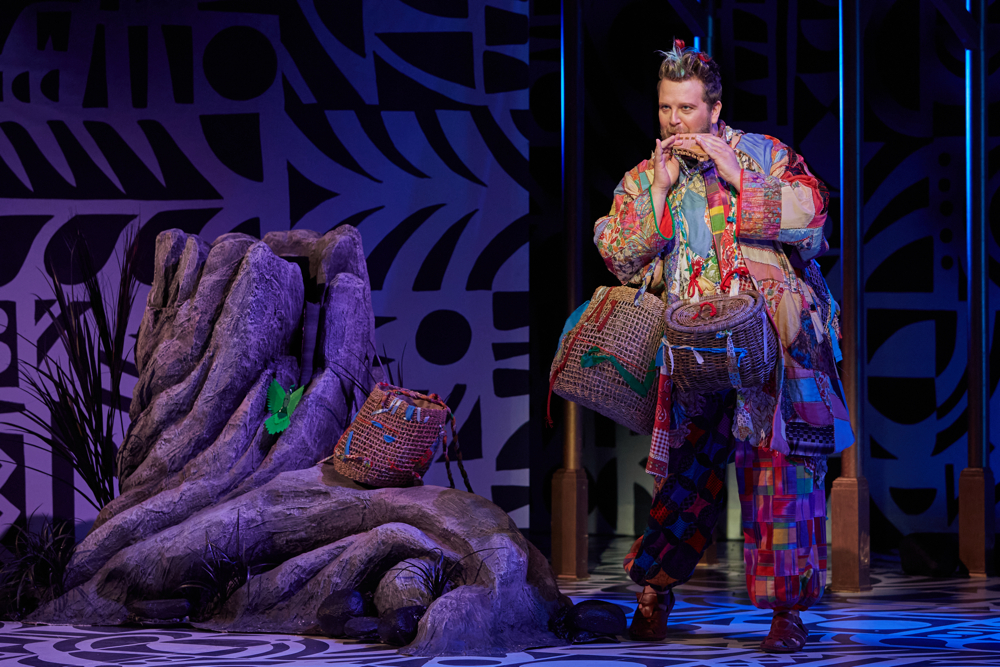
Opera Review: An Avalanche of Sight Gags Buries "Don Pasquale" at Opera Theatre

The actual opera recedes into the background.

Susanne Burgess and the company.
Photo by Eric Woolsey

As part of its 50th Festival Season, Opera Theatre of St. Louis (OTSL) has elected to return to a classic opera buffa that was part of its very first season in 1976: Donizetti’s 1843 hit Don Pasquale. Returning as well is the director of the first production, Christopher Alden. That first Don Pasquale is hard to remember after all these years. The new one will be difficult to forget—which is not necessarily a good thing.

In his program notes, Alden says that the current production “replaces the period-specific picture postcard realism” of his original “with a more open-ended fluidity, in an attempt to conjure up a psychic space in which the eternal conflict between young and old can be seen from different shifting perspectives.”

OK, then.

In practice, that means using sight gags and other visual gimmicks to underline, reflect, and comment on the thoughts and emotional states of the characters. That’s not a bad concept as those things go . But when the music, lyrics, and singers are constantly upstaged by swarms of people in nearly constant motion, it all starts to feel less like Opera Theatre and more like Circus Flora.

The story and characters are pure commedia dell’arte with the serial numbers filed off. Don Pasquale, a rich old bachelor, decides to get married and to disinherit his rebellious nephew, Ernesto. But Ernesto’s crafty friend Dr. Malatesta cooks up a scheme to make Pasquale rethink marriage. Ernesto’s feisty fiancée Norina will disguise herself as Malatesta’s demure sister Sofronia and “marry” Pasquale in a bogus ceremony solemnized by a fake Notary. “Sofronia” then transforms into a domineering spendthrift, making Pasquale’s life unbearable. As chaos unfolds, Pasquale realizes he has been played, concedes defeat, and blesses the union of Ernesto and Norina.

Set in a “psychic space” that looks a lot like early 1960s Rome, this Don Pasquale boasts exuberantly colorful sets and costumes by Marsha Ginsberg, complimented by inventive wigs and makeup by Krystal Balleza and Will Vicarl. And my earlier comments aside, some of the sight gags did strike me as ingenious and funny.

A case in point is the absurdly large gold-colored chair, footstool, and lamp in Pasquale’s apartment that mock the character’s self-importance. As my wife noted at the time, the image of a little man with a big ego looking like a child on a golden throne is not only a good comment on Pasquale, but it also seems politically relevant. So does the Act I finale, in which Malatesta, Norina, and the omnipresent Notary rejoice at the prospect of Pasquale’s downfall while holding a “Viva la Resistenza” banner.
 
Mostly, though, it just felt like so much noise. Still, nothing succeeds like excess, as the old joke goes, and most of the opening night audience found it all quite hilarious. To steal a line from S.J. Perelman, “de gustibus ain’t what dey used to be.”

The saving grace of this production is its cast. Bass-baritone Patrick Carfizzi, who was such an outstanding Don Basilio in The Barber of Seville last season, once again demonstrates his impeccable comic timing and big, accurate voice in the role of Don Pasquale. He punches out those low notes with ease and handles the rapid-fire patter songs with ease, despite all the on-stage distractions,

Baritone Kyle Miller is not just wily as Dr. Malatesta—a pun on mal di testa (headache), which is what he proves to be for Pasquale—but also moves with the kind of grace I’d associate with a dancer. It’s an unusual look for the character but works quite well.

Soprano Susanne Burgess has the coloratura chops for the role of Norina, along with the sass and spark needed to make this character fun. She lights up the stage whenever she appears—a good thing since Norina dominates the second and third acts.

The role of Ernesto can be a bit one-dimensional, but tenor Charles Sy brings out the tragic heartbreak of his Act II “renunciation” aria. He also makes the most of some comic business Alden has given him in the Act III garden scene. Decked out in a cheesy blue brocade tux and shades for his serenade to Norina (“Com ‘ è gentil la notte a mezzo / How soft and light is the spell of the night”), he’s the very model of a 1960s lounge singer. When Norina joins him for their duet (“Tornami a dir che m’ami / Tell me again you love me”) it becomes a “Steve and Eydie” moment that’s both romantic and risible.

Last but certainly not least for the Opera Theatre audience, the celebrated soprano and educator Sheri Greenawald, who sang Norina back in OTSL’s 1976 production, played the Notary. As written, the Notary is a comic cameo but in recognition of Greenawald’s many starring roles at OTSL over the years (to say nothing of a long and distinguished operatic career in general), Alden has elevated the role to a kind of Greek Chorus. Silently observing the action and putting in a bit of pantomime now and then, Greenawald clearly had a lot of fans on hand opening night and got a massive ovation at the end.

In his OTSL debut, guest conductor Kensho Watanabe led members of the St. Louis Symphony Orchestra (SLSO) in an outstanding reading of Donizetti’s tuneful score. There were some fine solo moments from (among others) Principal Cello Daniel Lee and Associate Principal Horn Thomas Jöstlein. A special shout-out is due to SLSO Principal Trumpet Steven Franklin for his lyrical solo in the Act II Prelude.

I really wanted to like this Don Pasquale. Having greatly enjoyed the 2023 Union Avenue Opera production as well as the Norina/Malatesta scene that was part of that same year’s Center Stage concert at OTSL, I know this is a very funny piece taken on its own terms and was looking forward to what OTSL would do with it for its 50th anniversary.

Ah, well. As the old song goes, “you can’t always get what you want.”

Don Pasquale runs through June 27th on the Browning Mainstage Theatre at the Loretto-Hilton Center on the Webster University campus. More information on times and tickets for the Opera Theatre season can be found at their web site.

This article originally appeared at St. Louis Arts Scene, where Chuck Lavazzi is the founder and principal critic.

Saturday, June 15, 2024

Opera Review: In the pink with Opera Theatre's "Barber of Seville"

The last time I saw Rossini’s comic masterpiece “The Barber of Seville” at Opera Theatre of St. Louis in 2015 under the capable direction of Michael Shell, I described it as “always funny and sometimes inspired”.

L-R: Justin Austin, Hongni Wu
Photo: Eric Woolsey

This year’s “Barber,” with Eric Sean Fogel at the helm, doesn’t quite rise to that level, mostly because Fogel can’t seem to resist the temptation to gild the comedy lily now and then. But it’s certainly fast, funny, and whimsically silly in a sort of cartoon way. So, as the Bard wrote, “’tis enough, ‘twill serve.”

From a purely musical point of view, this “Barber” had me on its side from the first notes of the famous overture. Conductor Jonathan Brandini found levels of nuance in it that I’d never heard before and which made it seem fresh and new—no small trick with music that is so familiar that Warner Brothers could use it for a Bugs Bunny soundtrack (“The Rabbit of Seville,”1950; it you haven’t seen it, you must) knowing that the audience would get the jokes. Brandini’s perfectly paced conducting of the finale was a delightful demonstration of why Rossini was sometimes called “Signor Crescendo.”

L-R: Nathan Stark, Patrick Carfizzi
Photo: Eric Woolsey

Better yet Fogel, unlike most directors at OTSL, resisted the temptation to fill the stage with distracting pantomime and elected instead just let us sit and enjoy the music.  For that alone I could have given him a laurel wreath.

His cast is splendid. Baritone Justin Austin, a powerfully dramatic Scott Joplin/Remus in last season’s “Treemonisha,” displays a radically different musical and theatrical side to his talent as the wily, cheerfully self-assured Figaro. His Rosina is mezzo Hongni Wu, expertly mixing comedy and coloratura in her OTSL debut.

Tenor Andrew Morstein is a perfect foil for them as the moonstruck Count Almaviva, desperate to woo Rosina before she can be forced into a marriage of inconvenience by her pompous guardian Dr. Bartolo.

L-R: Andrew Morstein, Hongni Wu
Photo: Eric Woolsey

Speaking of whom, bass-baritone Nathan Stark does a wonderful “slow burn” as Bartolo—you can almost see him turning purple and shooting steam out of his ears, like a Chuck Jones animation. He sang Mozart’s Bartolo in OTSL’s  “The Marriage of Figaro” in 2019 with equal authority. He rattles off the those sixteenth- and thirty-second notes in Bartolo's Act I (Rossini's Act II) scene with Rosina with aplomb.

Bass-baritone Patrick Carfizzi, last seen on the OTSL stage as the con artist Dr. Dulcimara in “The Elixir of Love” (2014), is equally at home as the shifty Don Basilio, happy to change sides for the right price. He, too, sounds impressively comfortable with the machine-gun patter, notably in the famous “gossip” song ("l vecchiotto cerca moglie") in which he unfurls a plot to use fake news to undermine Almaviva.

Rounding out this fine ensemble are baritone David Wolfe as Almaviva’s servant Fiorello, soprano Chase Sanders as Bartolo’s ancient governess Berta, and bass Jared Werlein as the Officer whose sunflower-wielding cops try to deal with the chaos at Chez Bartolo at the end of Act I.

L-R: Nathan Stark, Patrick Carfizzi, Hongni Wu
Justin Austin, Andrew Morstein, Chase Sanders
Photo: Eric Woolsey 

The continuing popularity of “The Barber of Seville” is remarkable when you consider that the composer dashed it off in three weeks. He didn’t even have time to write an original overture, choosing instead to recycle one he had used for two previous operas, "Aureliano in Palmira" and "Elisabetta, regina d'Inghilterra." Which is why none of the engaging tunes in that impeccably played overture appear in the actual opera.

But then, everyone needs a good laugh now and then. Especially now.

Performances of this unapologetically silly “Barber of Seville” are sung in English with English supertitles and run through June 29th at the Loretto-Hilton Center on the Webster University campus. Run time is around two hours and thirty minutes including intermission. More information is available at the Opera Theatre web site.

Sunday, May 19, 2024

St. Louis theatre calendar for the week of May 20, 2024

What's on St. Louis theater and cabaret stages this coming week. Please leave a comment if anything was wrong or got left out

The Alpha Players present Charlotte’s Web, adapted by Joseph Robinette from the book by E.B. White, through May 26. “A classic for the entire family! A perfect show for the young and the young-at-heart. All the enchanting characters are here: Wilbur, the irresistible young pig who wants to avoid the butcher; Fern, a young girl who understands animals; Templeton, the gluttonous rat; and most of all, Charlotte, the spider, who proves to be a true friend and a good writer. This beautiful, charming play about friendship will surely warm your heart.” Performances take place in the James J. Eagen Center in Florissant. For more information: www.alphaplayers.org.

The Black Rep presents the musical Timbuktu!, based on the Broadway classic Kismet, through June 9.  “Opulent beyond man’s dreams, travelers died crossing the Sahara in search of Timbuktu! Set against this exotic locale is the story of the Poet; his beautiful daughter, Marsinah; an evil Wazir of Police; his restless Wife of Wives, Lundanda; and The Mania of Mali, Bobo. While wandering incognito, Bobo meets Marsinah and instantly falls in love. Still, the twisted twine of fate must unravel in many thrilling and exciting ways before the two lovers can finally tie the knot.” Performances take place at the Edison Theatre on the Washington University campus. For more information: www.theblackrep.org.

Alice Ripley
The Blue Strawberry presents Alice Ripley with John McDaniel on Friday and Saturday May 24 and 25, at 7:30 pm. “Tony-Award winner Alice Ripley and Grammy and Emmy Award Winner John McDaniel take us through their own musical journey. Alice sings the songs she made famous on Broadway, and John joins her as they share their stories from a lifetime spent on Broadway, and always in music.”  The Blue Strawberry is at 364 N. Boyle.   The Blue Strawberry is at 364 N. Boyle. For more information: bluestrawberrystl.com.  And check out my video interview with Alice Ripley on Chuck's Culture Channel!

Encore Theatre Group presents Shakespeare’s The Tragedy of Othello, Moor of Venice through June 9. “Othello tells the story of a valiant Moorish general, Othello, who falls victim to the manipulations of a cunning villain. Themes of race, prejudice, and the devastating power of jealousy unfold in a way that feels shockingly contemporary. The play serves as a mirror to our society, reflecting the struggles for acceptance and equal footing that many people of color still face.” Performances take place at 2607 Patomac in the Marine Villa neighborhood. For more information: www.encorestl.org.

Opera Theatre of St. Louis presents Rossini’s The Barber of Seville opening on Saturday, May 25, at 7:30 pm and running through June 29. “Take a romp through a world of high notes, hijinks, and hair-raising escapades with Rossini’s comedic masterpiece. The razor-sharp barber Figaro may be a master mischief-maker, but his favorite role is that of matchmaker. When he meets Count Almaviva, a dashing but naïve young nobleman, he promises to help Almaviva win the heart of the beautiful Rosina. A comedy of mistaken identities, cunning disguises, and laugh-out-loud antics ensues as the love-struck Almaviva attempts to outwit Rosina’s guardian.” Performances are sung in English with projected English supertitles and take place at the Loretto-Hilton Center on the Webster University Campus. For more information: opera-stl.org.

The STL Fringe Festival presents ShimmySTL: The Surprising History of Bellydance in St. Louis on Saturday, May 25, at 7:30 pm. “This spellbinding show blends documentary with dance performances to unveil the deep connections between our Midwestern city and a beautiful dance form from Middle East.” The performance takes place at the Kranzberg Arts Center at Grand and Olive in Grand Center. For more information: www.stlfringe.org.

Looking for auditions and other artistic opportunities? Check out the St. Louis Auditions site.
To get your event listed here, send an email to chuck at kdhx.org Your event information should be in text format (i.e. not part of a graphic), but feel free to include publicity stills.
Would you like to be on the radio? KDHX, 88.1 FM needs theatre reviewers. If you're 18 years or older, knowledgeable in this area, have practical theatre experience (acting, directing, writing, technical design, etc.), have good oral and written communications skills and would like to become one of our volunteer reviewers, send an email describing your experience and interests to chuck at kdhx.org. Please include a sample review of something you've seen recently.

Wednesday, June 07, 2023

Opera Review: Babes in khaki

Opera Theatre of St. Louis’s new production of Mozart’s last and arguably most controversial opera “Così fan tutte, ossia La scuola degli amanti” (roughly “All women are like that, or the school for lovers”) is the fifth in the company’s history and the third that I have seen. The last two (in 1997 and 2012) were a bit disappointing but I had high hopes for this latest version, based on the insightful program note by director Tara Branham. They were not, sadly, fulfilled.

The cast of Così fan tutte
Photo: Eric Woolsey

A quick look at the story of “Così” shows why this can be a difficult piece to present to a contemporary audience. Two army officers, Ferrando and Guglielmo, are so convinced of the faithfulness of their fiancées—Dorabella and her sister Fiordiligi, respectively—that they accept a bet from their cynical philosopher friend Don Alfonso that the women can't be seduced. Don Alfonso convinces the boys to go away on a mock military expedition and then return in disguise and attempt to seduce each others' fiancées. The usual complications result, helped along by the wily maid Despina. All ends happily, more or less, but only after the disillusioned officers are forced to admit, in the words of Sherlock Holmes, that "women are never to be entirely trusted—not the best of them."

Even in Mozart’s day the story was seen, as Julian Rushton writes at Grove Online, as a “heartless farce clothed in miraculous music” and the opera was not widely performed until the second half of the last century. Ferrando and Guglielmo seem to take an almost sadistic delight at undermining the sisters’ fidelity and display an ugly braggadocio when they do. The “happy ending” in which the couples are reconciled is unusually abrupt and clumsy for Mozart (who usually could be counted up for elegant finales like the one he delivers at the end of the opera’s first act). Attempts to stage it in a way that undercuts the reconciliation have proved no more convincing than the original.

In the program, Branham acknowledges the libretto’s “problematic gender stereotypes,” but appears to grasp one of the opera’s major themes. “Life and love continue,” she writes, “as the experienced Despina and Don Alfonso know all too well. Love will continue to complicate matters for the rest of their lives… Lead with compassion for those experiencing life for the first time, and remember that love is beautiful even when it challenges everything we’ve ever known.”

Inexplicably, none of that keen understanding ever makes it to the stage.

L-R: Angel Romero, John Chest
Photo: Eric Woolsey

A major issue is the decision to set the piece in World War II Britain. Given that “Così” was composed during the Austro-Turkish War of 1788–1791, the idea isn’t a bad one, but Branham makes it the commanding visual image of the work rather than a background element and plot device as it was for Mozart and DaPonte. In the process, key social and power relationships are undone.

Ferrando and Guglielmo become new volunteers instead of professional officers. Don Alfonso is transformed from an old friend and mentor to a recruiting officer. Dorabella and Fiordiligi are changed from somewhat spoiled aristocrats to Red Cross volunteers, their wily maid Despina becomes an Army nurse, and the sisters’ household somehow becomes a hospital ward. When Ferrando and Guglielmo enter in disguise they are wounded American sailors instead of the comically exotic foreigners (think Saturday Night Live’s “wild and crazy guys”) of the original.

Mozart’s opera takes place in a seaside villa far removed from the war. In this version, everybody is in the Army now. It’s W.S. Gilbert’s topsy-turvy world, and it’s a mess.

The saving grace of this production is the high quality of the performances by the cast. As Ferrando and Guglielmo, tenor Angel Romero and baritone John Chest are as effective in their comic posturing as they are in their anger and despair as they realize their conquest campaigns have been just a bit too successful. Chest makes Guglielmo’s Act II aria simultaneously criticizing and praising women (“Donne mie la fate a tanti”/”Ladies, you treat so many this way”) a comic gem and Romero infuses “Fra gli amplessi” (“Very soon now”), the lyrical duet that finally melts  Fiordiligi’s heart, with such anguish that it’s not hard to see why he finally wins her over.

L-R: Megan Moore, Murella Parton
Photo: Eric Woolsey

Soprano Murrella Parton is an utterly convincing Fiordiligi with a spectacular voice to match. “Come scoglio” (“Like a rock”), the famous Act I aria in which she heroically rebukes the advances of the disguised Ferrando and Guglielmo, is a triumph of vocal art. Mozart’s music is challenging, with massive octave-plus leaps and florid decoration, but Parton’s opening night performance was so impressive that it literally stopped the show. Fiordiligi is the one character who genuinely grows in stature during the opera, and Parton made sure that we saw and heard that.

Dorabella emerges sadder but wiser as well, fully coming to terms with her unbridled sensuality. Mezzo Megan Moore communicates that quite effectively in her second act aria “È amore un ladroncello” (“Love is a little thief”). Her rich voice matches Mozart’s sophisticated instrumentation perfectly.

The role of Despina comes to us straight from the commedia dell’arte tradition: the clever and cheerfully sensual maid who runs rings around her employers. Soprano Vanessa Becerra’s comic timing and vocal flexibility serve the part well, making it easy to ignore the absurdity of that uniform. Her impersonation of the fake doctor in Act I, whose fake magnetic therapy miraculously saves the disguised Ferrando and Guglielmo from their fake suicide attempt, is brilliant stuff. And that’s despite the fact that the “magnet” gag (originally a parody of the notorious quack Franz Mesmer) makes no sense in a 20th century setting.

Vanessa Bacerra and magic magnet
Photo: Eric Woolsey

Baritone Hugh Russell, last seen on the OTSL stage in 2017 as the tragically simple-minded Noah Joad in “The Grapes of Wrath,” demonstrates his musical and dramatic range here as the cynical Don Alfonso. He’s funny and ingratiating and handles the character’s patter numbers with aplomb.

Conductor Jeri Lynne Johnson shows a deep understanding of Mozart’s complex musical structure and delivers a perfectly balanced reading of the score. Her performance of the overture was so good that I was able to largely ignore the onstage pantomime in which Don Alfonso bizarrely turns the sisters’ home into a recruiting center. Under her direction the ensemble of St. Louis Symphony Orchestra members plays with all the finesse I have grown accustomed to hearing during the SLSO's regular season.

So: are the musical values of this “Così” exemplary enough to compensate for a wrong-headed directorial concept? In my view, I’m sorry to say, the answer is no. Mind you, there is plenty of slapstick stage action—some of it in scenes where it doesn’t belong—so if that is your thing you might find this entertaining. Many of the audience clearly did on opening night. Otherwise I’d say you can give this one a miss.

Opera Theatre of St. Louis’s “Così fan tutte” runs through June 23rd at the Loretto-Hilton Center on the Webster University campus. Performances are sung in Andrew Porter’s superb English translation with projected English text. For more information, consult the OTSL web site.

[Footnote: the title of this article is a Firesign Theatre reference.]

This article originally appeared at 88.1 KDHX, where Chuck Lavazzi is the senior performing arts critic.

Tuesday, August 02, 2022

Opera Review: Union Avenue Opera's "Falstaff" achieves musical perfection in an imperfect space

Now in its 28th season, Union Avenue Opera has, over the decades, presented a wide range of operas—ancient to modern, intimate to grand—with a remarkable degree of success. Despite working with a small stage and a less than ideal acoustic environment in the venerable Union Avenue Christian Church, UAO’s hits far outnumber its misses.

Running through August 6th, the company’s production of Verdi’s “Falstaff” is in some ways the quintessential UAO show. Under the skilled baton of Stephen Hargreaves, the orchestra sounds great, with Verdi's many expressive instrumental details coming through loud and clear. Individual performances range from good to stunning, both musically and theatrically, and the overall experience is immensely satisfying.

L-R Mark Freiman as Pistola. Marc Schapman
as Bardolfo. Robert Mellon as Falstaff
Photo: Dan Donovan

Flawless it isn’t, but what flaws there are can largely be attributed to the physical limitations of the performance space. Transferred to an actual theatre like the Browning Mainstage at the Loretto-Hilton Center or the auditorium of the Kirkwood Performing Arts Center, this “Falstaff” would be darn near perfect. As it is, opera lovers won’t want to miss it, especially since it hasn’t graced a local stage in nearly three decades.

First performed in Milan in February 1893 (just a few months short of Verdi’s 80th birthday), “Falstaff” was the composer’s third Shakespearean opera and second attempt at comedy since his flop “Un giorno di regno” way back in 1840. It’s considered by many, including yours truly, to be his greatest work for the stage, if not the greatest opera of the 19th century.

There are many reasons for that. To begin with, Verdi had the best of all possible librettists in the person of Arrigo Boito, who had worked with Verdi on “Otello” only a few years earlier. A gifted writer and composer (his “Mefistofele” is still the best of the “Faust”-inspired operas, in my view), Boito was, like Verdi, a great admirer of The Bard of Avon. His “Falstaff” libretto ingeniously combines “The Merry Wives of Windsor” with bits of the “Henry IV” plays and even hints at “A Midsummer Night’s Dream” with the faux fairies of the "Herne's" Oak" scene that ends the opera.

L-R Janara Kellerman as Quickly. Brooklyn Snow
as Nannetta. Karen Kanakas as Alice.
Melody Wilson as Meg
Photo: Dan Donovan

Verdi, for his part, produced a score that departed radically from everything he had written previously. Instead of a typical 19th century Italian opera in which the action pauses for arias, duets, and other set pieces, he wrote a fast-paced through composed musical play that moves at the speed of speech. Jokes and puns fly back and forth so quickly that even the original Milanese audience probably didn’t catch them all. The result is a seamless integration of words and music that is often exhilarating.

All of this makes “Falstaff” a challenge to produce. Verdi demanded over sixty rehearsals for his original La Scala cast because of the sheer complexity of the work. The sets are detailed, making scene changes potentially cumbersome. And the principal roles require performers with not only vocal and theatrical skills but comic timing as well.

Union Avenue has, I’m happy to say, a cast that meets and often exceeds those expectations, headed by baritone Robert Mellon in the title role.  His Falstaff roars, boasts, preens, and schemes—all in a big, resonant voice that reaches every corner of the theatre. His Act I “honor” monologue (one of the choice bits Boito lifted from “Henry IV”) is delivered with an authority and comic force that makes it a genuine showstopper. He even manages, in the less boisterous third act, to let us see a bit of the nobility buried under the character’s folly—no easy task, given that he’s lumbered with an absurd fat suit that’s more appropriate to a circus than the stage.

L-R Anthony Heinemann as Caius.
Jacob Lassetter as Ford.
Marc Schapman as Bardolfo.
Mark Freiman as Pistola
Photo: Dan Donovan

Falstaff’s nemesis is Alice Ford, whose sharp wit punctures the absurd schemes of both her husband and Falstaff. Falstaff wants to seduce both her and her friend Meg Page, while Ford arrogantly attempts to keep their daughter Nannetta from her true love Fenton and force her into an unsuitable marriage with the ancient Dr. Caius. Lighting up the role here is soprano Karen Kanakis, whose effulgent voice and impeccable acting have enlivened many roles at both UAO and Winter Opera. Her Alice is all quicksilver wit and irresistible charm.

Mezzo Janara Kellerman is delightful as Dame Mistress Quickly, Alice’s chief co-conspirator. Verdi saw the role as “the most individual and original” of the four women’s parts. The three scenes he wrote for her in Acts II and III are comic gems and Kellerman makes them shine. The part calls for a contralto, but Kellerman sounded perfectly at home in it.

The massive talents of soprano Brooklyn Snow and mezzo Melody Wilson are rather underused in the roles of Nannetta and Meg, respectively, but their finely wrought performances demonstrate the value in putting star performers in supporting roles. Snow also has some charming moments with tenor Jesse Darden’s Fenton as his limpid voice joins with hers in love duets that are invariably interrupted by the plot’s comic complications.

Tenor Marc Schapman and bass Mark Freiman make a first-rate pair of clowns as Falstaff’s wily minions Bardolfo and Pistola. The role of the clueless Dr. Caius offers little opportunity for tenor Anthony Heinemann to display his wide vocal range, but he does get to show off his fine comic timing.

Brooklyn Snow as Nanetta
and Jesse Darden as Fenton
Photo: Dan Donovan

Baritone Jacob Lassetter’s voice packs a serious punch in Ford’s big “revenge” monolog “È sogno o realtà?” ("Is it a dream or reality?") but his acting is a bit monochromatic. Verdi saw Ford as a character “who, in a towering outburst of jealousy, roars, screams, jumps all over”—a larger than life counterpoint to Falstaff. A bigger stage presence was called for, I thought.

The UAO chorus does fine work with some difficult music here thanks to the meticulous direction of company Artistic Director Scott Schoonover. They are not always easily understood, but the blame must rest with the imperfect acoustics of the Union Avenue Christian Church. Indeed, the tendency of the space’s overly resonant acoustics to sometimes turn Verdi’s multi-layered vocal lines to mush, especially in the brilliant fugue that concludes the opera, is probably the production’s biggest flaw. And one that is, alas, entirely out of UAO’s control.

The UAO stage was also an issue, simply because of its small size. The libretto calls for multiple sets, with the most elaborate being the room in Ford’s house where the madcap farce of Act II takes place. Lex Van Blommenstein’s scenic design evokes the feel of Shakespeare’s Globe theatre, with a massive wooden framework supporting painted scrolls that were apparently designed to roll up and down quickly. In practice, doing so required multiple stagehands to laboriously raise and lower each one, resulting in scene changes that seemed to go on forever and killed the forward momentum in the middle of each act.

Even so, stage director Jon Truitt shows the same skill in maneuvering large forces around a small stage that served his Winter Opera production of Puccini's "La Fanciulla del Weat" so well two years ago.

Still, these are relatively minor blemishes in an otherwise outstanding production of Verdi’s final masterpiece. Add in Teresa Doggett’s bright period costumes (that fat suit not withstanding) and you have a “Falstaff” that must be seen.

Performances of Verdi’s “Falstaff” continue through Saturday, August 6th, at the Union Avenue Christian Church on Union in the Central West End. Information on this and the company’s final show of the season, Sondheim’s “A Little Night Music,” are available at the UAO web site.

Tuesday, June 07, 2022

Opera Review: Could it be magic? Opera Theatre's 'Magic Flute' pushes the envelope but keeps the enchantment

Opera Theatre of St. Louis (OTSL) has had a long and mostly happy history with Mozart’s final opera “The Magic Flute.”  The current production, which runs through June 26th, is the fifth in the company’s 47-season history and one of the most entertaining, even if it does flirt with revisionism a bit.

Written towards the end of the composer's sadly brief life (Mozart had only a few months to live when it premiered in September of 1791), “The Magic Flute” is a singspiel—the 18th century equivalent of a present-day musical—set in a mythical land of monsters and magic. The protagonists are Prince Tamino and Princess Pamina, who find themselves and the less-than-heroic bird catcher Papageno caught up in a war between The Queen of the Night, Pamina’s mother, and Sarastro, High Priest of the Sun.

L-R: Erica Peterocelli and Joshua Blue
Photo: Eric Woolsey

The Queen and her three Ladies con the young prince into believing Sarastro is an evil wizard from whom Pamina must be rescued. Arming Tamino with the titular flute and Papageno with a set of magic bells, they summon a trio of Spirits to lead the lads to Sarastro’s temple.

Shortly after arriving at the temple, Tamino realizes that he has been played and that Sarastro actually wants  to end the Queen’s reign of eternal night and usher in a new age of light, wisdom, and brotherhood. Furthermore, he wants the lovers to undergo the purification of trials by fire and water so that they can marry and replace him as equal rulers of the Temple of the Sun. Which, with the aid of the flute’s magical melodies, is exactly what happens.

Essentially, it’s the age-old story that Joseph Campbell would later codify as “The Hero’s Journey,” with a  heavy dollop of Masonic symbolism. Both Mozart and his librettist Emanual Schikaneder (who also produced the work’s premiere and played the role of Papageno) were Masons and wanted the work to reflect Masonic values—which is to say, the values of the Enlightenment. Indeed, as Peter Branscombe and Stanley Sadie have written, “The Magic Flute” is "above all an opera of the Enlightenment. In it, the forces of darkness and light are counterposed: the former in the person of the Queen of the Night and her entourage, the latter in that of Sarastro and his priestly community, which erects temples to Wisdom, Nature, and Reason."

Jeni Houser
Photo: Eric Woolsey

Director Omer Ben Seadia puts her thumb on the ethical scale a bit by suggesting, as related in her program notes, that the Queen and Sarastro represent “two equal and competing forces.” Both are “determined to secure their legacies but, in the process, they managed to leave the ground beneath them scorched and barren.” In this context the struggle is seen less as one of reason and freedom vs. superstition and autocracy (i.e. Enlightenment vs. Medievalism) and more as a generational conflict in which the lovers must “decide for themselves how to reshape the nature and the character of the world.”

That sounds revisionist, but practically speaking this “Magic Flute” is still a story of the journey from darkness and deception into light and truth. The moment when, after the Queen and her minions are routed, Ryan Howell’s desolate and monochromatic set suddenly blossoms with color and golden light is still a powerful affirmation of the transformative power of love.

If that all sounds a bit weighty, fear not. Mozart and Schikaneder set out to entertain as well as educate, and this new English version, with dialog by Ben Seadia in combination with earlier translations by Andrew Porter and Colin Graham, retains all the comedy, fantasy, and romance of the original. Howell’s sets, Jessica Jahn’s inventive and colorful costumes, and Christopher Akerlind’s lighting all combine to create a fanciful atmosphere.
 
That said, a few of Ben Seadia’s additions sometimes sound a bit too contemporary. Adding same-sex relationships to the lyrics of Papageno and Pamina’s Act I duet extolling the joys of love, for example, might be seen by some as a bit too 21st century. Still, I suspect politically liberal Mozart would probably approve.

Adam Lau and the temple monks
Photo: Eric Woolsey

The cast is generally a strong one, as is often the cast at OTSL. As Papageno, baritone Jonathan McCullough’s clear diction, impeccable timing, and just the right amount of shtick make him immediately appealing. He is the perfect fumbling foil for Joshua Blue, whose big, clear tenor and stalwart sincerity make him an ideal Tamino. Soprano Erica Petrocelli is an appealing and vulnerable Pamina.

Bass Adam Lau radiates calm authority as Sarastro and projects even the lowest notes effectively. Tenor Christian Sanders brings just the right mix of despicable lust and comic incompetence to the role of the Monostatos, whose attempts to have his way with Pamina end badly for him. The staging of his punishment as a violent stomping by some of the monks, however, feels gratuitous and weirdly out of synch with the rest of the production.

Soprano Jeni Houser handles the Queen of the Night’s two big numbers with ease, hitting all the unnervingly high notes with accuracy and clarity. But either her voice lacks power or she has been directed to dial it back. The result, in any case, is that her character feels as pallid as the plain white gown she wears in Act I. Is this, like the oddly brutal punishment of Monostatos, a directorial attempt blur the difference between the Queen and Sarastro by softening her image and hardening his? If so, making the character less powerful also makes her less interesting and somewhat blunts the effect of her famous Act II “revenge” aria.

Jonathan McCullough
Photo: Eric Woolsey

Speaking of the Queen, here’s a bit of applause for the way soprano Meghan Kasanders and mezzos Meridian Prall, and Stephanie Sanchez turn each of the Queen’s Three Ladies into distinct, fully realized characters. They harmonize beautifully  as well.

Seán Curran’s choreography is inventive, but the ritualistic movement he has given the temple monks in all their appearances sometimes feels unnecessary and even distracting. Less would have been more here.

Rory Macdonald conducts members of the St. Louis Symphony Orchestra in a clean, clear, and smartly paced reading of the score. The overture was particularly impressive, with the fugal sections impeccably precise. A tip of the hat is also due to Damien Krzyek, whose glockenspiel serves as the voice of Papageno’s magic bells, and to SLSO flutist Jennifer Nitchman. Kevin J. Miller’s chorus sings with the same power and clarity that it displayed in “Carmen” on opening night.

New York Times critic Charles Isherwood once wrote that “the first responsibility of the director should be serving the musical drama,” and while Ben Seadia’s concept of “The Magic Flute” pushes the envelope a bit, I think it ultimately remains true to the spirit of the 18th century Enlightenment. Her web site bio notes that she is “known for her inventive, thoughtful, and socially conscious productions” and in her program notes she states that she is “concerned about our world, threatened by natural disaster, climate change, and polarizing social and political camps.”

Rear: Megan Kasanders, Meridian Prall, 
Stephanie Sanchez
Front: Joshua Blue, Jonathan McCullough
Photo: Eric Woolsey

It’s not hard to see those concerns as a logical outcome of Enlightenment values such as reason, science, and the Big Three: liberty, equality and fraternity. Those values sparked revolutions in both Europe and the colonies which would eventually become the USA. At a time when one of those “polarizing social and political camps” is dedicated to the destruction of those values, their celebration in “The Magic Flute” could hardly be more relevant.    

Opera Theatre of St. Louis's "The Magic Flute" runs through June 26th in rotating repertory with three other operas. To get the full festival experience, come early and have a picnic supper on the lawn or under the refreshment tent. You can bring your own food or purchase a gourmet supper in advance from the OTSL web site. Drinks are available on site as well, or you can bring your own.  For more information, visit the web site.

This article originally appeared at 88.1 KDHX, where Chuck Lavazzi is the senior performing arts critic.

Thursday, July 29, 2021

Opera Review: There's "un'abbondanza di gioia" in Union Avenue Opera's "Il barbiere di Siviglia"

Back in 2015 I asked Michael Shell, who was directing Opera Theatre’s production of Rossini’s "The Barber of Seville," why he thought this comic opera had remained so popular over the centuries. His answer: “I think I can sum that up with one word : JOY. There is so much joy in the spirit of the piece that I think that is why it has stood the test of time.”

L-R: Pedro Barbosa and Andy Papas
Photo by Ron Lindsey

If you were looking for a good word to describe what made Union Avenue Opera’s production of “Il bariere di Siviglia” such a success, you could do far worse than “joy.” Or, since this was sung in the original Italian with English supertitles, “gioia.” There was certainly plenty of that to go around, thanks in large measure to the outstanding performances of the principal cast members.

Baritone Robert Mellon schemed cheerfully as Figaro, taking uproarious pleasure in every trick he played on baritone Andy Papas’s brilliantly befuddled Dr. Bartolo. Tenor Pedro Barbosa’s Almaviva loved wooing mezzo Janera Kellerman’s Rosina as much as he did putting one over of Bartolo. And bass-baritone Isaiah Musik-Ayala’s Don Basilio was happy to work both sides as long as someone crossed his palm with oro.

The singing was on the same high level as the acting. Mellon’s “Largo al factotum” (perhaps one of the most famous baritone arias of all time) was polished and funny, even though he and the orchestra came perilously close to getting out of synch towards the end. Kellerman’s “Una voce poco fa" was a masterful mix of comedy and coloratura, and Barbosa displayed a heavenly bel canto-style voice in “Ecco, ridente in cielo,” the elaborate cavatina in which Almaviva extols the virtues of Rosina.

Robert Mellon, Janara Kellerman, Pedro Barbosa
Photo by Ron Lindsey

Basically, everyone was having a good time. And that included the audience, who laughed and applauded frequently and with enthusiasm

Union Avenue’s “Bariere” was less hampered by the shallow staging area at the Big Top than its “Les contes Hoffmann” since "Barbiere" doesn't really require much in the way of scenery or stage effects, so the emphasis was on the impeccable singing and comic abilities of the cast. Stage Director John Truitt even made a virtue of necessity by using the orchestra and conductor Stephen Hargreaves (who also played the recitativo secco passages on an electronic keyboard) as "props" for some of the comedy. The staging got a bit overly busy at times—most notably during the “Fredda ed immobile, come una statua” ensemble at the end of Act I, when time stopped for everyone except Figaro—but it generally worked quite well.

The cast of Il barbiere
Photo by Ron Lindsey

The continuing popularity of “Il barbiere” (Operabase consistently shows it in the “top 10” list worldwide) is remarkable when you consider that the composer dashed it off in three weeks. He didn’t even have time to write an original overture, choosing instead to recycle one he had used for two previous operas, "Aureliano in Palmira" and "Elisabetta, regina d'Inghilterra." Which is why none of the engaging tunes in the impeccably-played overture appear in the actual opera. I guess it comes back to that infectious sense of joy. Congratulations to Union Avenue for capturing it so effectively.

Union Avenue Opera’s “Il barbiere di Siviglia” ran in alternating repertory with Offenbach’s “Les contes d’Hoffmann” July 21 through 25. For information on upcoming Union Avenue Opera productions, visit the company’s web site.

Wednesday, May 26, 2021

Opera Review :Downsized and outdoors, Opera Theatre opens its season with a lively "Gianni Schicchi"

Few economic sectors have been as damaged by COVID-19 as the performing arts. Entire seasons were wiped out, including that of Opera Theatre of St. Louis (OTSL). OTSL is back in business this year, though, with four operas performed in rotating repertory, the traditional Gerdine Young Artists showcase, and even a special Juneteenth event at the Missouri History Museum. Picnic dinners on the lawn are back, along with full bar service.

House size is smaller—300 seats vs. close to 1000—seating is physically distanced, and everything including bar service involves minimal physical contact.

Buoso's family in bogus mourning

Performances are also outdoors, on a newly constructed stage taking up what is usually the Loretto-Hilton Center’s main parking lot. Think of it as a less massive version of an evening at the Muny.

The operas are shorter as well. Following the lead of the St. Louis Symphony Orchestra, OTSL’s productions all run around an hour with no intermission. That limits them to one-act operas but that’s not necessarily a bad thing. The season opener, Puccini’s 1918 comedy “Gianni Schicchi,” is getting such a spirited and entertaining production that it seems astonishing that OTSL hasn’t presented it in over forty years.

As the opera opens, the wealthy Florentine Buoso Donati has shuffled off his mortal coil and his relations are making a great show of mourning, accompanied by descending minor seconds in the orchestra. Their grief becomes real, though, when a search for Donati’s will turns up a document giving everything to the local monastery. It’s a financial disaster for everyone and a personal one for Donati’s nephew Rinuccio, who had hoped that a bequest would smooth the way for him to wed his beloved Lauretta, daughter of the wily Gianni Schicchi.

Rinuccio’s snooty family disapproves of the match and looks down on Schicchi because he’s a peasant and, worse yet, an immigrant. But Rinuccio reminds them, in a mock-heroic aria, that fellows like Schicchi are what made Florence great. Besides, it will take a schemer of his ability to find a way around that will.

Needless to say, he succeeds, employing comic devices that are direct descendants of commedia dell'arte gags. The relatives get what they deserve (if not exactly what they wanted) and the opera ends with Rinuccio and Lauretta looking forward to their wedding and Schicchi looking forward to a life on Easy Street (or, as they might say in Firenze, una vita alla grande).

Evan Lazowski reads the new will

Opera Theatre has assembled a fine cast, headed by baritone Levi Hernandez as Schicchi, who was so impressive in OTSL’s “Don Giovanni” in 2011. His wide vocal range and sharp comic sense serve the character well. As Rinuccio, British tenor Joshua Blue puts his big, ringing voice to good use in his hymn to the wit of Schicchi and the glory of Florence. Soprano Elena Villalón is a charming Lauretta who earned loud shouts of “brava” for her superb rendition of the opera’s hit tune, “O mio babbino caro.” Both Mr. Blue and Ms. Villalón are former Gerdine Young Artists, which says a lot for that program.

Contralto La’Shelle Q. Allen makes a strong OTSL debut as Rinuccio’s elitist aunt Zita, while Nathan Stark, as the late Buoso’s pompous cousin Simone, uses his big voice and imposing presence as effectively here as he did in "The Marriage of Figaro" in 2019. Tenor Steven Cole, also a newcomer to OTSL, has a delicious cameo as the befuddled doctor Spinelloccio (another classic commedia dell'arte character).

There are many other fine performances in this consistently talented ensemble, including tenor Jermaine Smith as Buoso’s greedy nephew Gherardo, soprano Meghan Kasanders as his equally avaricious wife Nella, baritone Schyler Vargas as Buoso’s son Marco, and soprano Helen Zhibing Huang as his wife, La Ciesca, who declares she will mourn “povero Buoso” for the rest of her life. Soprano Bianca Orsi proves to be convincingly boyish as Gherardino , the seven-year-old son of Gherardo and Nella.

Rounding out the cast are baritone Rob McGinness as Buoso’s poor brother-in-law Betto, whose information on the will gets the plot rolling, baritone Kyle Miller as the dyer Guccio, and bass-baritone Evan Lazowski as both the cobbler Pinellino and as the Notary Ser Amantio di Nicolao, to whom Schicchi dictates the false will.

Tenor Chance Jonas-O’Toole has no lines as the deceased Buoso, but he does have to appear credibly lifeless as the other actors toss him around looking for a place to stash the body. That calls for both physical acting skills and trust in your fellow cast members.

St. Louis Symphony Orchestra Conductor Laureate Leonard Slatkin leads members of the SLSO in a brisk and precise reading of the score. Stage Director Seán Curran’s dance background in apparent in the fluid staging—no mean feat, given the relatively small size of the playing area. His decision to move the action from the 13th century to the 1930s doesn’t seem to serve any real point, but it also doesn’t detract in any way.

Allen Moyer’s sumptuous red and gold set is enhanced by the digital picture window designed by Greg Emetaz, which gives the audience a lovely picture-postcard view of the Duomo and, in the end, a romantic sunset.

My only real complaint about Opera Theatre’s “Gianni Schicchi” comes down to something that is largely beyond the company’s control: the outdoor venue effectively mandates the use of wireless body mics and amplified sound. That makes individual vocal lines a bit clearer (and the projected English text mostly unnecessary), but it tends to turn the big ensemble numbers into sonic mush and doesn’t do the orchestra’s fine playing any favors.

Joshua Blue and Elena Villalón

Still, everything else about this “Gianni Schicchi” is of the finest quality. And given that it’s a comedy that is ultimately about death, it seems an appropriate way to open a season that’s taking place against the background of a pandemic that has killed millions worldwide. Also contributing to the comedy’s dark subtext is the fact that both Schicchi and Donati were based on real residents of 13th-century Florence. The former did actually impersonate the latter, and both are sent to hell by Dante in cantos XXV and XXX of his “Divine Comedy.”

“But I digress”—Tom Lehrer

The important point is that Opera Theatre’s “Gianni Schicchi” is a well-crafted and diverting evening’s entertainment, especially when supplemented (as ours was) with a picnic and prosecco.  It runs through June 10th, in rotation with the season’s three other operas. Performances are sung in English with projected English text. Note that you’ll need to arrive early if you want to get a table in the picnic area. For more information, visit the Opera Theatre web site.

This article originally appeared at 88.1 KDHX, where Chuck Lavazzi is the senior performing arts critic.

Tuesday, January 28, 2020

Review: Oh, what a lovely war!: La fille du régiment at Winter Opera

Donizetti wrote so many popular operatic tragedies that it's easy to forget that his long list of operas includes a fair number of comedies. His 1840 opéra comique (i.e. an opera with spoken dialog) La fille du régiment is one of the most popular, and the Winter Opera production last weekend (January 24 and 26), despite some obvious flaws, demonstrated why that's the case.

Andrew Potter, Isaac Frischman, Gina Galati
Originally written as a quick replacement for a delayed opera by another composer, La fille was initially greeted with indifference by the Parisian public and hostility by Berlioz (then music critic for the Journal des débats)--mostly because he was annoyed by what he saw as Donizetti's domination of the Parisian opera scene. Audiences quickly came around, however, and over the years the title role has become a favorite of high-flying sopranos from Jenny Lind to Joan Sutherland.

Marie, the titular daughter, is a war orphan adopted as a baby by the rather tender hearted French soldiers of the 21st Regiment. Now a beauty with the voice of an angel and a colorful military vocabulary, she loves and is loved by Tonio, who saved her from toppling off an Alp. Their love is opposed initially by her guardian, Sergeant Sulpice, and the other soldiers (who mistake Tonio for a spy), and then by the snobbish Marquise de Birkenfeld who, in a classic comic opera revelation, turns out to be Marie's long-lost mother. All ends happily, of course, with plenty of rousing ensembles and solo vocal fireworks along the way.

Andew Potter and Gina Galati
Make no mistake, a production of this work depends heavily on the singing and acting skills of the singers in the three principal roles of Marie, Tonio, and Sulpice. Fortunately for Winter Opera, they had a strong trio in those parts.

Tenor Isaac Frishman was a fine Tonio. He handled the demanding air "Pour mon âme,” with its (in)famous nine high Cs, with real polish, and proved equally effective in the more dramatic "Pour me rapprocher de Marie" in the second act. Winter Opera General Director Gina Galati was a convincingly tomboyish Marie. When I saw the show on Sunday afternoon, though, her voice seemed less strong than it has in the past and she seemed to strain for some of the high notes-of which there are quite a few in this demanding coloratura part.

Still, she and Mr. Frishman blended well vocally and had convincing chemistry on stage. And given Ms. Galati's exemplary work in the past (most recently in Union Avenue's Glory Denied last August), I'm inclined to treat this as an outlier.

Gina Galati, Andrew Potter, Joy Hermalyn
Bass Andrew Potter, who has done plenty of first-rate comedy work for Winter Opera in the past-most recently as the wily Dulcamara in their 2018 L'elisir d'amore--once again demonstrated that infallible combination of vocal authority and comic timing that has apparently made him the company's "go to" guy for basso buffo roles. His imposing stature (he's well over 6 feet tall) also had the advantage of making Mr. Frishman and Ms. Galati look, in comparison, like the youngsters they are supposed to be.

Mezzo Joy Hermalyn's broadly played Marquise of Berkenfield might not have been to everyone's liking, but I found her willingness to sacrifice vocal purity for the sake of theatrical effect refreshing and very effective. Baritone Gary Moss, another Winter Opera regular, turned in yet another fine bit of slapstick comedy as the Marquise's fussy butler Hortensius.

Members of the chorus
The chorus was small but mighty as it so often is at Winter Opera. Since no choral director is listed, I assume the credit must go to conductor Edward Benyas and, of course, to the company's stalwart ensemble singers.

Winter Opera's equally small but cohesive orchestra played very well, with especially fine work by Tricia Jostlein and Nancy Schick on horns. Their solo at the beginning of the overture was perfect. Trumpets Jason Harris and Dawn Weber deserve praise as well. Mr. Benyas's tempi felt a bit on the slow side at times, but overall his account of the score felt right.

Scott Loebl's brightly colored set and Felia Davenport's equally vivid costumes helped contribute to the comic atmosphere, giving everything the look of a 1950s Warner Brothers cartoon.

Joy Hermalyn
My biggest issue was with Audrey Chait's direction. For reasons which escape me, she had the cast singing in the original French but speaking in English, which made little sense and tended to induce a kind of linguistic whiplash. The pacing of the spoken interludes also felt sluggish and some of the comic business felt more intrusive than funny. All of which is a bit surprising, considering what a great job she did with the aforementioned L'elisir d'amore.

Winter Opera's season continues March 6 and 8 with Puccini's rarely-seen La fanciulla del west (usually referred to as "The Girl of the Golden West"), which will be getting its St. Louis premiere. Set in the American west circa 1850, it's a work I've always wanted to see staged, so it looks like I'm finally getting my wish. For more information, visit the Winter Opera web site.

Tuesday, March 13, 2018

Review: The fool on The Hill

Gina Galati and cast
Photo by Wylde Brothers Productions
Share on Google+:

When I saw my first Winter Opera production back in 2012, I wrote that the company "stands poised to be an important player in the growing opera scene locally" and that "we can expect great things from them." If their production this past weekend (March 9 and 11, 2018) of Donizetti's comedy "L'Elisir d'Amore" ("The Elixir of Love") is any indication, that prediction has come true.

Based on Eugène Scribe's libretto for Daniel Auber's popular comedy "Le philtre" from 1831, Felice Romani's book for "The Elixir of Love" is the story of Nemorino, a humble peasant smitten with the wealthy and beautiful landowner Adina. She, though, is more taken with the macho Sergeant Belcore. In desperation, Nemorino buys a love potion (actually just some cheap wine) from the traveling quack Dr. Dulcamara. Complications, as they say, ensue. But all ends happily for everyone-including Dr. Dulcamara who, as the curtain descends, is still fleecing the suckers.

Winter Opera's cast was one of the strongest they have come up with to date, with solid voices and acting skills to match. Tenor Peter Scott Drackley was an outstanding Nemorino, with a powerful tenor voice (including some remarkably strong low notes) and a winsome character that reminded me of Lou Costello (of Abbot and..). Winter Opera General Director Gina Galati was a lively and charming Adina, with a bright and flexible voice.

Bass Andrew Potter, who was so hilarious as Don Magnifico in Winter Opera's "La Cenerentola" last year, once again stole the show as the wily Dulcamara, complete with top hat, cape, magic wand and blonde assistant. His voice was solid right down to the bottom and his comic timing was impeccable.

L-R: Christopher Holloway, Gina Galati, Peter Scott Drackley
Photo by Wylde Brothers Productions
Equally adept at comedy was baritone Christopher Holloway as the self-admiring Belcore. Soprano Karen Kanakis turned in a strong performance as the Giannetta, lighting up the stage with her gossipy "Saria possibile" number at the top of Act II.

Donizetti and Romani intended "The Elixir of Love" to be somewhat remote from its original Milan audience from the start, setting it in Basque country late in the previous century. Winter Opera director Audrey Chait moved the action to St. Louis's Italian "The Hill" neighborhood in the early 1940s, which put it at about the same remove chronologically and culturally, in addition to injecting some local color.

Conductor Darwin Aquino led the small but robust orchestra in a fine account of Donizetti's appealing score. As is so often the case, they sounded bigger than ther modest size would lead one to expect.

"L'Elisr d'Amore" concluded Winter Opera's 11th season. Season 12 pick up in November with Strauss's "Die Fledermaus." At this point, my biggest criticism of the company is that they only present two performances of each show. Work this good deserves more exposure. I hope they get it some day.

Friday, January 27, 2017

Review: Flaws and all, Winter Opera's "La Cenerentola" is good fun

Share on Google+:

Rossini's romantic comedy La Cenerentola, based in part on the classic fairy tale Cinderella, was your prototypical rush job. He threw it together in three weeks at the end of 1816 when the libretto for the opera he was originally supposed to write (on a completely different subject) was rejected by the Papal Censor. Bits of the opera (notably the overture) were recycled from earlier works and some of the music was composed not by Rossini but by his collaborator Luca Agolini.

L-R: Sharon Sullivan, Robin Bradley, Andrew Potter,
Joseph Ryan, Isaac Frishman
Photo: Wade Brothers Productions
Still, as the production Winter Opera is presenting this Friday and Sunday (January 27 and 29) demonstrates, it holds up pretty well. The score is a charming cornucopia of elaborate coloratura arias, rapid-fire patter songs, and the kind of layered ensembles that earned Rossini the nickname “Signor Crescendo.” Stage director Matthew Haney may be overly fond of cluttering up those ensembles with silly stylized movement that is almost (but not quite) choreography, but even so the good humor of Rossini's music and Jacopo Ferretti's libretto remain intact.

The role of Angelina (a.k.a. Cenerentola) is something of a rarity-a leading coloratura part written for a contralto. Kate Tombaugh, who sings the role here, is a mezzo but sounded quite at ease with the part's tessitura when I saw her at the final dress rehearsal Wednesday night. Combined with her capable acting, that higher voice gave the character an engagingly naïve charm that contrasted nicely with the acidic brattiness of her stepsisters. I thought she sounded a bit less comfortable with the role's coloratura side, however. Her big rondo finale ("Nacqui all'affanno ... Non più mesta") lacked the vocal fireworks I would have expected.

Rossini was generous to the lower male voices as well, with choice roles for two basses and a baritone - the social-climbing stepfather Don Magnifico (the prototypical "buffo" clown of Italian comic opera), the Prince's wise tutor Alidoro (substituting for the fairy godmother because Rossini hated supernatural elements in opera), and the wily valet Dandini, who spends most of the opera masquerading as Prince Ramiro so the latter can get an unvarnished look at the Magnifico family.

Kate Tombaugh
Photo: Wade Brothers Productions
Winter Opera is blessed with three very strong performers in these key parts. Bass Andrew Potter's alcoholic pomposity is spot on, and he handles the role's more florid passages expertly, although at dress rehearsal he sometimes got out of synch with the orchestra. Baritone Joseph Ryan is equally strong vocally and makes the most of Dandini's droll observations.

Bass Nathan Resika turns in perhaps the most surprising performance, finding interesting shadings in what could be the fairly ordinary role of Alidoro. The character is essentially a saintly fellow who delivers the libretto's explicitly Christian message about the last being first, but Mr. Resika acting (and, more importantly, reacting) makes him more three-dimensional than one might expect.

Soprano Sharon Sullivan and mezzo Robin Bradley are Angelina's stepsisters Clorinda and Tisbe. In this version of the story they're not so much wicked as foolish, superficial, and terminally self-involved. Their vocal and physical battles are appropriately funny stuff, and nicely sung.

Tenor Isaac Frishman is Prince Ramiro, hiding behind a pair of glasses, Clark Kent style, to separate the gold diggers from the real princess candidates. Angelina passes the test, of course, by falling for him even though she believes him to be only a servant, while he spends much of the opera being moonstruck by her. Mr. Frishman acts the part a bit blandly but sings beautifully, which is ultimately more important. His voice blends perfectly with Ms. Tomaugh's, which is also a bonus.

The male chorus, under the direction of Nancy Mayo, sings with power and precision even when they're marching around the stage and then falling down into a heap (which happens more often than necessary). This is not the first time I have been impressed with Ms. Mayo's work at Winter Opera, and I expect it won't be the last.

Conductor Kostis Protopapas conducts with a sure hand-although I would have liked somewhat more fleet tempi in the overture-and the small orchestra (fewer than 20 players) sounded quite polished, especially for a final dress. There was especially nice work by (among others) Chamber Project St. Louis members Jennifer Gartley and Dana Hotle on flute and clarinet, respectively, as well as Peg Bumb on bassoon and Tricia Jöstlein on horn.

Joseph Ryan (center) and the company
Photo: Wade Brothers Productions
Scenic Designer Scott Loebl and Costume Designer JC Krajicek have created a bright, colorful, fairy-tale world for Cenerentola, lit dramatically (if sometimes a bit obtrusively) by Maureen Berry. And while Mr. Haney's direction sometimes gilds the theatrical lily, as I noted earlier, for the most part it creates effective stage pictures and directs our focus where it needs to be.

Rossini's La Cenerentola isn't heard that often-it was last done in a somewhat stripped-down version by Union Avenue Opera in 2011—so this production is most welcome and a great deal of fun overall. Besides, Winter Opera remains one of the better practitioners of musical theatre in St. Louis. They also have the distinction of being the only one of our three opera companies to be working in a space that was actually built with an orchestra pit and music-friendly acoustics-a virtue not to be taken lightly.

Winter Opera's La Cenerentola will be performed Friday at 8 p.m. and Sunday at 3 p.m., January 27 and 29, at the Skip Viragh Center on the Chaminade campus on Lindbergh just north of Plaza Frontenac. The opera is sung in Italian with English supertitles. It's not especially long as operas go-around two and one-half hours, including intermission-and the bright comic action might make it a good choice for younger audience members as well as for adults. For more information: winteroperastl.org.