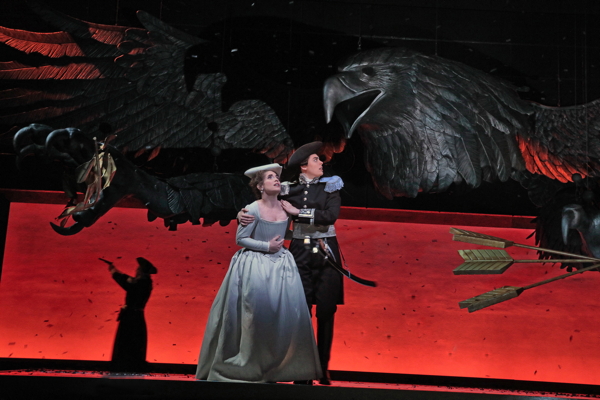
When George Frederic Handel’s “Julius Caesar” (“Giulio Cesare”) had its 1724 premiere at the King’s Theatre in London, it was a huge success. That’s because it gave audiences what they wanted: dramatic thrills, lavish sets, and first and foremost spectacular singing. They expected (and got) a classic opera seria—a drama intended to be “serious in tone and clear in structure”—with a heroic Caesar and a seductive (and ultimately commanding) Cleopatra.
[Watch my interview with Conductor Daniela
Candillari.]
 |
| L-R: Sarah Mesko, Emoily Pogorelc Photo: Eric Woolsey |
I don’t know whether or not the current Opera Theatre of St. Louis (OTSL) production is giving the audience what it wants but judging from the opening night applause it’s certainly giving them a solid evening’s entertainment. Musically, this “Julius Caesar” is impeccable and, yes, the singing is spectacular. The staging, however, is at odds with the text, the music, and that spectacular singing.
I’ll circle back to that right after I talk about the best thing about this “Julius Caesar”: the exceptional performances by members of the St. Louis Symphony under the baton of OTSL Principal Conductor Daniela Candillari and by the amazing cast.
In Handel’s day, the leading male roles were usually sung by castrati—or, as they were euphemistically called at the time, “musici”. These were male singers who had been castrated before puberty to keep their high voices. These days those roles are sung by women or, when you can find one, a male countertenor who understands Baroque singing style. That can sound odd to a modern audience, but Opera Theatre’s cast is so uniformly strong that this wasn’t an issue.
 |
| L-R: Key'mon Murrah, Meridian Prall Photo: Eric Woolsey |
Mezzo Sarah Mesko as Caesar and soprano Emily Pogorelc as Cleopatra looked and sounded equally at home in their dramatic solos. Mesko’s “Va tacito e nascosto,” in which Caesar compares his pursuit of Ptolemy to a hunter pursing his prey, was a highlight, as was Pogorelc’s seductive “V’adoro, pupille.” Mesko cuts a heroic figure as the self-proclaimed “master of the world,” and Pogorelc’s portrayal of Cleopatra’s progression from superficial tease to triumphant empress is masterfully done.
Countertenor Key’mon Murrah, who made such a strong impression on me in the St. Louis Symphony Orchestra’s “Messiah” in 2022, displayed a stunning vocal and dramatic range as the scheming Ptolemy. His high notes could have shattered glass, and like the rest of the cast, he has a good feel for Baroque vocal ornamentation.
Mezzo Meridian Prall plumbs tragic depths as Cornelia, the window of the murdered Pompey. At the same time, she’s obliged to repel the unwelcome attempts at sexual assault by the Egyptian general Achillas, sung with menacing authority by bass-baritone Cory McGee. Mezzo Megan Moore sounds utterly at ease in the soprano role of Pompey’s son Sextus and vividly evokes the character’s seething rage in the revenge aria “Svegliatevi nel core.”
 |
| Megan Moore Photo: Eric Woolsey |
Mezzo Madeline Lyon and bass John Godhard Mburu make strong impressions as, respectively, Cleopatra’s aide Nirena (originally Nireno, another castrato part) and Caesar’s tribune Curio, despite the drastic cuts in their roles.
Conducting from the harpsichord just as Handel did Back in the Day, OTSL Principal Conductor Daniela Candillari leads members of the St. Louis Symphony Orchestra in a wonderfully idiomatic reading of the score. Her knowledge of and affection for the music are obvious. There are also memorable solo moments by, among others, Principal Horn Roger Kaza accompanying Mesko “Va tacito” (virtually a duet for voice and natural horn), and the elaborate imitations of birdsong by Second Associate Concertmaster Celeste Golden Andrews as an entranced Caesar enters Cleopatra’s garden.
Musically, in short, OTSL’s “Julius Caesar” in a winner. The staging, however, is another matter.
In her program note, Stage Director Elkhannah Pulitzer talks about her intention to “to preserve the beauty and arc of the characters and remain faithful to their journeys of discovery…. The transformative force of love, the brutality of power wielded with malice, the courage to overthrow tyranny, as well as the deep valleys of loss and healing we all experience as humans, make it universal.” It’s not clear to me how those admirable goals are served by putting everyone in modern dress and moving the action from first century B.C. Egypt to a sterile grayscale business center, complete with a focus-stealing cleaning staff.
 |
| The cast of "Julius Caesar" Photo: Eric Woolsey |
Her declared intentions notwithstanding, Pulitzer seems to have directed the work with a wink and a nod, filling it with lots of fussy stage business, show biz choreography, and even visual gags that seem to be suggesting that we really shouldn’t take all this stuff about heroism, love, and tragedy all that seriously. Not surprisingly, the opening night house responded by laughing at scenes that were never intended to be seen as amusing.
The conventions of Baroque opera create a distance from modern audiences as it is. Mocking them only increases that distance. In attempting to make “Julius Caesar” contemporary, Pulitzer has merely made it silly.
That said, the sheer musical excellence of this production probably makes it worth seeing despite its theatrical sins. Performances of “Julius Caesar” are sung in English with English supertitles and take place through June 28th at the Loretto-Hilton Center on the Webster University campus. Run time is around two hours and fifty minutes including intermission. More information is available at the Opera Theatre web site.