Showing posts with label digital concert. Show all posts

Friday, June 03, 2022

Digital Symphony Review: The SLSO summer digital series concludes with two very varied quintets

Available for on-demand streaming through August 31st, the fifth of five videos in the St. Louis Symphony Orchestra’s digital series presents two quintets by Prokofiev and Mozart. The pair are a study in contrasts, and not just because they were written nearly 250 years apart. They’re also scored for two very different groups of instruments and represent very different moods.

Prokofiev's Quintet

The video opens with Prokofiev’s Quintet in G minor, op. 39. Scored for oboe, clarinet, violin, viola, and double bass, the quintet was written in Paris in 1924. The work was originally intended as the score for “Trapeze,” a circus-themed ballet that was to be performed by a five-member dance troupe of fellow Russian émigrés. The oddball instrumentation was dictated by the instruments the troupe had on hand.

The ballet never happened, but you can hear more than a hint of the Big Top in what Second Associate Concertmaster Celeste Golden, in her spoken introduction to the original live video performance on March 14th 2021, called the “technical acrobatics” of the score.

There are times, especially in the second and fourth movements of this six-movement work, when the music turns wistful, grim, and even a bit creepy, but on the whole the Quintet is all bright lights, greasepaint, and reckless abandon. It’s fun to hear, and fascinating to watch as the performers do, indeed, execute some musical high-wire acts. At one point the camera zooms in on Celeste Golden Boyer’s fingers rapidly dashing up and down the strings; at another you can see Principal Bass Erik Harris working at the extremes of his instrument’s range. Principal Clarinet Scott Andrews, Cally Banham (on oboe rather than her usual English horn), and violist Shannon Farrell Williams provide copious amounts of dazzling moments as well.

The instrumentation of Mozart’s String Quintet No. 4 in g minor, K. 516, was also unusual for its time: two violins, two violas, and one cello. The dominance of the lower and darker voices is a perfect match for the predominantly tragic and even angry mood of the work. It’s fraught with drama and overhung with musical storm clouds that don’t clear until the lengthy adagio introduction of the fourth movement gives way to a sunny, danceable allegro in rondo form.

L-R: Alvin McCall, Jonathan Chu,
Beth Guterman Chu

In her spoken introduction, Assistant Principal Second Violin Eva Kozma describes this as one of her favorite chamber works, and you can both see and hear that in the passion she and Principal Second Violin Alison Harney bring to their performances. Mozart gives the violas prominent roles as well, and the wife and husband team of Principal Viola Beth Guterman Chu and Associate Principal Viola Jonathan Chu fill them admirably. To my eyes and ears, at least, their playing seems to have that extra level of intimacy that can come with living together as well as playing together. Cellist Alvin McCall provides a deep, resonant backbone for the ensemble.

The Prokofiev was broadcast live only once and although it was recorded last February the Mozart Quintet is, as far as I know, being presented here for the first time. So for many of you this will be your only chance to enjoy these excellent performances. Both were recorded in an audience-free Powell Hall, and the long-distance shots of five performers alone in that big auditorium add an extra layer of melancholy to the Mozart.

The St. Louis Symphony’s concert of quintets by Prokofiev and Mozart is available via on-demand video through August 31st. For more information visit the SLSO digital concerts page.

This article originally appeared at 88.1 KDHX, where Chuck Lavazzi is the senior performing arts critic.

Wednesday, May 11, 2022

Digital Symphony Review: The SLSO does recycling in a program of chamber music by Strauss and Schubert

Available for on-demand streaming through August 31st, the fourth of five videos in the St. Louis Symphony Orchestra’s digital series comes from a pair of concerts recorded in an audience-free Powell Hall last spring. Both of the two works on this one-hour program engage in musical recycling but they do so in very different ways.

Till Eulenspiegel, einmal anders!

The video opens with Richard Strauss’s popular orchestral tone poem “Till Eulenspiegels lustige streiche” (“Till Eulenspiegel’s Merry Pranks”) retooled by violinist/composer Franz Hasenöhrl  and retitled “Till Eulenspigel, einmal anders!) (“Till Eulenspiegel Another Way!)”.  Hasenöhrl cut Strauss’s piece to half its original length and reorchestrated it for five players, so hearing it is rather like viewing Strauss’s big, splashy original through the wrong end of a telescope. Still, all of the composer’s snarky, rambunctious fun survives intact, even if it does create a real workout for the five musicians.

The players are up for it, though. Associate Principal Second Violin Kristin Ahlstrom and bassist Sarah Hogan Kaiser impressively represent the entire string section while clarinetist Ryan Toher, horn player Victoria Knudtson, and Principal Bassoon Andrew Cuneo carry the flag for the winds. Knudtson knocks the infamously difficult opening solo right out of the park while Toher and Cuneo turn in equally praiseworthy performances of their many solo passages.  The performance was originally released as part of a live video broadcast, so it’s good to have it available on demand. It deserves a wider audience.

The rest of the program is taken up with an example of musical expansion instead of contraction.  Schubert’s Piano Quintet in A major, D. 667, was written in 1819 as a commission for Sylvester Paumgartner, a wealthy amateur cellist. The composer used the theme from his earlier song “Die Forelle” (“The Trout”) as the basis for a series of variations in the fourth of the quintet’s five movements and it has been known as the “Trout Quintet” ever since. Given that Schubert’s original song runs only a little over two minutes vs. around 45 for the full quintet, it might seem odd to name the entire work after it, but the tune is a genuine “ear worm”—so jaunty and appealing that it's unforgettable.

The "Trout" Quintet

The performance by members of the SLSO is pretty jaunty and appealing as well. Kristen Ahlstrom, Principal Viola Beth Guterman Chu, Principal Cello Daniel Lee, Associate Principal double bass Aleck Belcher, and pianist Peter Henderson (who should, in my view, be Principal Keyboard but isn’t) all work seamlessly as a team. The videography makes it easy to admire the way the string players stay in visual contact with each other as well as with Henderson, even though he’s not facing the quartet directly. Closeups provide intimate glimpses of the emotional engagement of each player with Schubert’s appealing score.

The frequent shifts between light and darkness that are so much a part of Schubert’s style are expertly handled, although there are, perhaps, fewer of those in this mostly sunny and leisurely work than in the composer’s other chamber music. Certainly the performance radiates good cheer, even in the more lyrical Andante second movement.

Unlike the Strauss/Hasenöhrl remix, this performance has not been publicly released, so this is your first chance to experience it. I think you'll find that it was worth the wait.

The St. Louis Symphony Orchestra’s concert of chamber music by Schubert and Richard Strauss is available via on-demand video through August 31st. Visit the SLSO web site for more information.

Saturday, April 23, 2022

Digital Symphony Review: Denève and the SLSO explore the heart of darkness in video of November 2021 concert

On November 5th and 6th 2021, Stéphane Denève and the St. Louis Symphony Orchestra (SLSO) presented a concert that opened with a powerful work of personal lamentation and ended with a gripping and ultimately horrifying depiction of life under an autocratic regime run by a personality cult centered on a morally bankrupt and violent ideologue. In between we had a violin concerto that evoked images of pines, snow, and brisk northern winds.

[Find out more about the music with my symphony preview.]
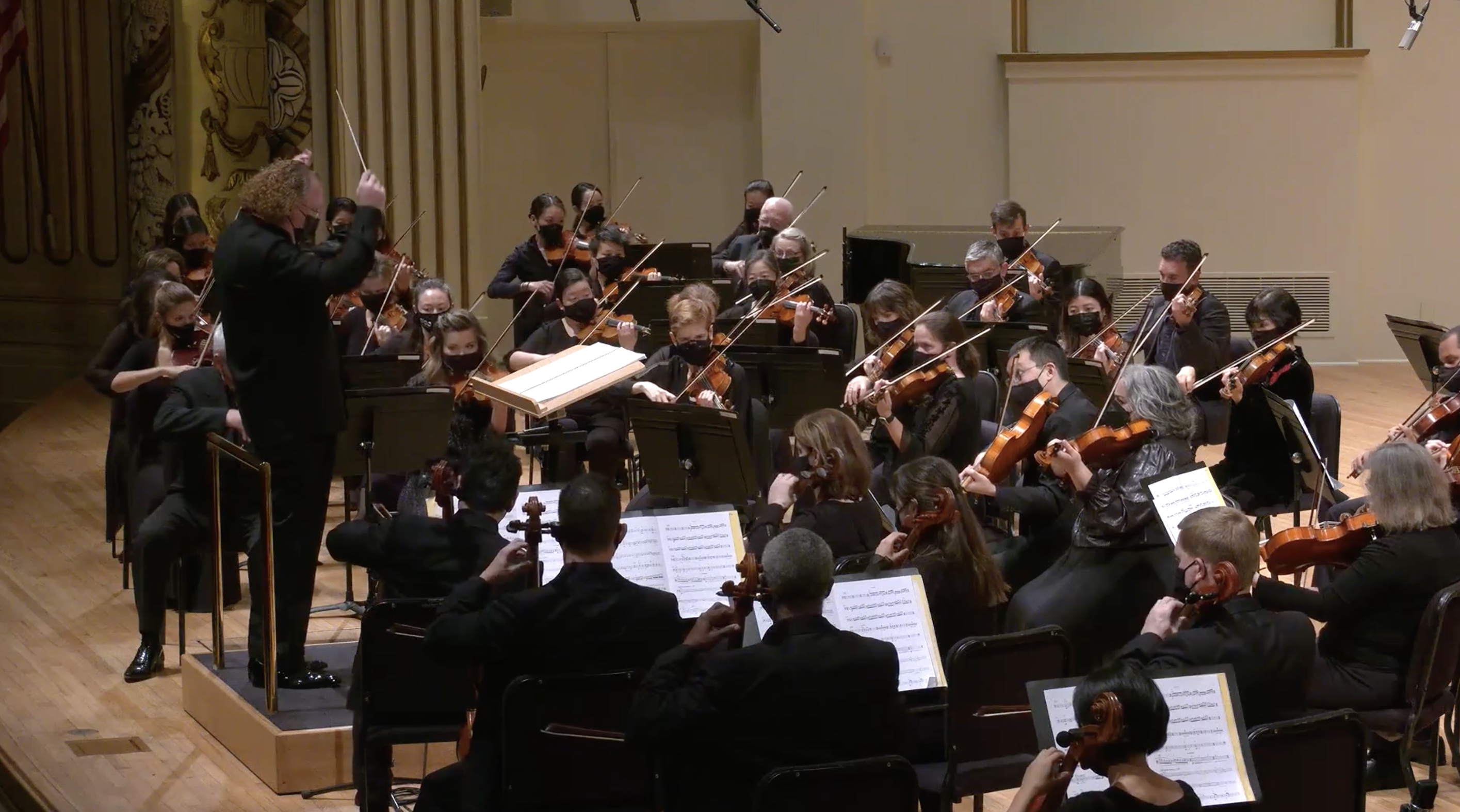
Denève conduct Emotive Transformations

It was dark, disturbing, and engrossing. And I loved it. A live HD video recording of that concert, with some illuminating commentary from Maestro Denève, is now available from the orchestra’s web site through August 31st 2022.

The lamentation comes from the opening work, “Emotive Transformations,” written in 2018 by Michigan-born James Lee III. Inspired by the death of the composer’s father the work, as Stéphane Denève said in his pre-concert talk back then, can he heard as referring to the five stages of grief described by Swiss-American psychiatrist Elisabeth Kübler-Ross in her 1969 book “On Death and Dying”: denial, anger, bargaining, depression, and acceptance.

“Emotive Transformations” opens with an agitated theme that suggests the first two stages of denial and anger. A second, more soothing motif in the strings and winds hints at “comforting words” according to Denève, but to my ears it also could include the “bargaining” stage. Denève described a third ascending theme in the strings as a reference to resurrection, and I’m inclined to agree, although you could just as easily say it’s about acceptance.

Either way, that last theme is almost overwhelmed by the opening sense of anger and agitation. Indeed, it eventually takes over the “comfort” theme entirely, turning it into a kind of wail of anguish (depression, possibly?) which slowly descends through the string section and is extinguished. The initial theme returns again, but now it has taken on the character of the acceptance music, rising triumphantly to a final major chord.

Nikolaj Szeps-Znaider

It all sounds a bit like Strauss’s “Death and Transfiguration,” but the resemblance is at best superficial. Lee’s musical world is more compact and less sentimental than that of Strauss. His musical vocabulary is unquestionably contemporary, but still listener-friendly—a hallmark of the new music that Denève has introduced to local audiences. And it is beautifully played by Denève and the band, with a shout-out due to Principal Clarinet Scott Andrews for the tranquil start of the resurrection/acceptance theme.

Up next is the Violin Concerto in D minor, op. 47 by Jean Sibelius. Originally presented in 1904 and then, after a thorough drubbing by critics, premiered in a substantially revised form in 1905, the work is deeply informed by the composer’s love of his native Finland’s forests and striking but somewhat forbidding landscape. I have always found it to be a dramatic and often emotionally intense piece—qualities that are communicated very effectively in Saturday’s deeply committed and finely shaded performance by Denève and soloist Nikolaj Szeps-Znaider.

Close friends outside of the concert hall, Szeps-Znaider and Denève have often performed the Sibelius concerto together, a fact which lends an air of intimacy to the performance and often produces the illusion that you are hearing the music of, in the words of novelist Jasper Fforde, “two minds with but a single thought.”
Denève conducts the Shostakovich Fifth

Szeps-Znaider’s virtuosity is clearly on display in the challenging first movement cadenza and the galloping final movement, but his technique is always deployed in the service of Sibelius’s dark, passionate soundscape. It is, as well, always completely in synch with Denève’s nuanced approach to the work.  The many video closeups make it possible to see Szeps-Znaider at work in a way that wouldn’t be possible in a live concert.

The dark soundscapes of Sibelius are almost tropical compared to the harsh, cold winds that blow through the final work of the evening, Shostakovich’s Symphony No. 5 in D minor. Written over the course of three months in 1937 it was, at the time, seen as an attempt by the composer to get himself off of Stalin’s blacklist, since being on it was likely to end not just his career but his life. He even went so far as to accompany the first performance with an article in the Moscow newspaper Vechernyaya Moskva titled "A Soviet Artist’s Reply to Just Criticism"—lest there be any doubt that he had Learned His Lesson.

It worked. Official response was enthusiastic, and Shostakovich was officially rehabilitated. Even in the West the work was, well through the 1960s, seen as an example of unabashed pandering to mandatory patriotism. As more details began to emerge about what composer’s private thoughts might have been about the fifth symphony, critics and conductors began to realize that something much darker lurked beneath the brilliant orchestration, memorable tunes, and apparent bombast of the Allegro non troppo finale.

That something was a portrait of the grim reality of life in a one-party state run by a mass murderer and his ethically challenged enablers. "Many in the premiere audience were seen to weep openly," wrote Richard Freed in his liner notes for the SLSO’s 1986 recording of the work. "They wept, Shostakovich himself felt, because 'they understood; they understood what was happening around them and they understood what the Fifth was about.'"

These days, performances of the symphony are more likely to emphasize that dark side. Denève’s certainly does. Conducting without a score, he delivers a Fifth that beings with a cry of pain in the strings, followed by snarling march from the brass and percussion sowing death and destruction. The first movement ends with nobody left to tell the tale except the harp and celesta (Allegra Lilly and Peter Henderson, respectively, in a beautifully tragic duet) quietly commenting on the smoking ruin of the battlefield.

Finale of the Shostakovich Fifth

And so it goes for the next three movements. The Allegretto is a lumbering waltz of storm troopers, briefly interrupted by graceful ballerina (Concertmaster David Halen, in a touching solo assisted by Lilly and flutist Jennifer Nitchman). She tries to return in a pleading English horn solo by Jelena Dirks but is ultimately banished from the scene. The Largo that made Russians weep is pure desolation, ending in tranquil string chords that fade to a silence which is violently broken, after only a brief pause, by the aggressive final movement.

Here, in a fusillade of blazing brass and pounding percussion, the Soviet bureaucrats heard triumph, affirmation, and apotheosis. And perhaps, in that first performance, conductor Evgeny Mravisnky made sure it came across that way. But, as Mr. Denève demonstrates, it only takes a few adjustments to reveal the coercion behind that triumph. The slow, relentless hammer blows of the percussion in the coda sound less like affirmation and more like a “tragic, forced smile,” as Denève says in his video introduction. The effect is both thrilling and horrifying.

Depending on the quality of your home theatre system, the sound on the video might or might not deliver quite the same emotional impact of the original performance, which left me in a state of stunned silence. It is, in any case, a brilliant reading which still leaves me with the uneasy feeling that I  have heard America’s future and its name is Dmitri Shostakovich.

This video is part of a series of recordings of recent live concerts. Ticket information and a complete list of videos in the series is available at the SLSO web site.

This article originally appeared at 88.1 KDHX, where Chuck Lavazzi is the senior performing arts critic.

Saturday, February 26, 2022

Digital Symphony Review: The SLSOs Bryan Miller tribute concert comes to HD video

Last November 27 and 28, Gemma New, the former Resident Conductor of the St. Louis Symphony Orchestra (SLSO), returned to Powell Hall to conduct the first of a special pair of concerts honoring the life and work of the late St. Louis Post-Dispatch music critic Sarah Bryan Miller. A live HD video recording of that concert is now available from the orchestra’s web site.

[Find out more about the music with my symphony preview.]

A former professional mezzo-soprano and life-long singer, Bryan (as she preferred to be called) died on November 28, 2020 after a long and valiant battle with cancer. She left the SLSO a substantial bequest, which was used to establish the Sarah Bryan Miller Fund to support vocal soloists and performances of choral repertoire with the SLSO. That weekend’s concerts, which featured two works for solo mezzo-soprano, represented the first use of that fund. If you missed this exceptional program in 2021, this is a golden opportunity to experience it in the comfort of your own home.

Mezzo Sasha Cooke in Sea Pictures

The concert opens with the 1898 version of Elgar’s song cycle “Sea Pictures.” Although it uses poems by five different writers (including the composer’s wife, Alice), both the sea and mortality are consistent presences. The latter is often in the subtext or just in the dark orchestral colors of the lower strings and percussion, but it’s always there.

Still, there is a wide variety of moods and imagery in “Sea Pictures,” and mezzo Sasha Cooke (who was so very good in Bernstin's Symhony No. 2 here in 2019) masterfully does them all justice. Her voice is rich and fluid and her acting skills (as you would expect from someone with her opera credentials) vividly bring out the joy of “In Haven (Capri)” (text by Alice Elgar), the religious ecstasy of “Sabbath Morning at Sea” (text by Elizabeth Barrett Browning), and in Richard Garnett’s “Where Corals Lie,” that unfocused, distant stare of someone who is halfway between life and death. Principal Harp Allegra Lilly’s playing here strongly reinforces that feeling.

When I saw this live, Cooke was sometimes overwhelmed by Elgar’s large orchestra, but that’s not an issue with the clear, well-balanced sound in this video, which also makes the lyrics more understandable than they were live. As a bonus, you get a close-up view of Cooke’s impassioned performance that was impossible in the original concert.

Balance issues are also absent in the next work, Jake Heggie’s “The Work at Hand” from 2015. Based on a poem of the same name by late Laura Morefield (1961-2011), who had just been diagnosed with cancer, “The Work at Hand” is, in the words of the composer, “about the difficult and deeply human experience of knowing it is time to say goodbye and let go.” He calls the poet’s language and imagery “particularly striking: origami, the yoga Warrior 1 position, and a shimmering reconnection to nature.”

Elizabeth Chung

Here, again, Cooke is always fully in the moment, making the complex and beautiful text truly live. And the combination of Heggie’s more transparent orchestration and the high quality of the audio engineering make it easy for her to be easily heard and understood. Closed captioning is available, but I doubt that most of you will need it.

Heggie’s arrangement of his own original for voice, cello and orchestra (the latter replacing the piano) is quite imaginative, treating each of the poem’s three stanzas as separate entities; a sensible decision, given their contrasting moods. His use of woodblocks and other “Japanese” touches sets the tone for “Part One: Original Origami”; the militaristic feel of “Part Two: Warrior One” reflects the poet’s vision of defiance; and the ethereal sounds of the harp, woodwinds, and vibraphone provide an otherworldly ambiance for the quiet acceptance of “Part Three: The Slow Seconds.” A transcendent violin solo by Concertmaster David Halen) adds to that sensibility.

SLSO cellist Elizabeth Chung is also a powerful presence here, especially in the highly dramatic solo part that opens and closes the first section.

Despite the fact that the Heggie work was a local premiere and that the Elgar might as well have been (it was last performed by the SLSO 35 years ago), New and the band do a grand job of bringing them to life. If you have seen New in action before, you know she is a theatrical conductor who engages on a very physical level with the score. Her big, sweeping gestures are a kind of 3-D metaphor for the music. The camera also allows you to see the way her deep involvement with the music is reflected in her face—a view normally available only to the musicians.

That striking visual presentation only works, though, because of the rigorous effort that has clearly gone into preparing the piece in advance. Much like a theatrical director, a conductor does the vast majority of their work out of sight of the audience.

Gemma New conducting Scheherazade

That same combination of discipline and visual drama also make Rimski-Korsakov’s popular "Scheherazade," the concluding work on the program, an experience to be savored and one which is likely to live long in my memory.

New is truly in her element here, with a majestic, high-energy rendition of the composer’s colorful fairy-tale world of the "One Thousand and One Nights.” The opening duet for harp and violin is magical, thanks to Lilly and Halen, and the main body of the movement, depicting “The Sea and Sinbad’s Ship,” carries with it an almost visceral sense of the vast ocean and the rocking vessel. “The Story of the Kalandar Prince” is filled with a sense of adventure,with outstanding opening and closing solos by Principal Bassoon Andrew Cuneo and Principal Oboe Jelena Dirks. “The Young Prince and Princess” has just the right amount of romance without a trace of treacle and with some graceful dancing from the muted trumpets, flute, and tambourine. The final movement is a high-definition, big-screen evocation of Rimsky-Korsakov’s rich collage of images: a fair in Baghdad (including some brilliant double- and triple-tonguing from the trumpet section); a shipwreck; and the final, gentle triumph of Scheherazade. Some of New’s tempos here are breathtakingly fast and pack a potent punch.

You will be less than astonished to know that it brings the entire house quickly to its feet. That included everyone in our party when we saw it live.

This video is part of a series of recordings of recent live concerts. Ticket information and a complete list of videos in the series is available at the SLSO web site.

This article originally appeared at 88.1 KDHX, where Chuck Lavazzi is the senior performing arts critic.

Wednesday, August 11, 2021

Symphony Digital Review: Youthful music for winds highlights the St. Louis Symphony's final summer digital concert

The live concert season of the St. Louis Symphony Orchestra (SLSO) is on hiatus until the fall, but the orchestra’s on-demand video series is still going strong. Available through September 4th, the latest release stars members of the SLSO winds in a thoroughly engaging pair of serenades by Mozart and Richard Strauss under the baton of Music Director Stéphane Denève.

[Find out more about the music with my original symphony preview.]

Stéphane Denève conducts the Strauss Serenade

Recorded at Powell Hall April 30th through May 2nd and originally reviewed by me back then, the concert features a pair of works by young composers just starting to make a name for themselves, albeit around a century apart.

In a reversal of the usual musical cliché, the Strauss Serenade for Winds in E-flat major, op. 7 that opens the program is the short and pithy one, while Mozart's Serenade No. 10 in B-flat major, K. 361 (370a) is the symphony-length work with seven entrancing movements. Both get exceptionally well-crafted performances by Maestro Denève and his musicians, beginning with a pleasant trip through Strauss’s musical terrain.

Written when the composer was a lad of 17 who had yet to graduate from high school, the Op. 7 serenade has often been called a surprisingly mature-sounding work. Presumably that’s a reflection of the mood of quiet contemplation that can be heard in some of the composer’s much later work. Scored for a 13-member ensemble (three pairs of flutes, oboes, clarinets, and bassoons, four horns, and either contrabassoon or double bass) the work gets a warm and welcoming treatment from Mr. Denève that neatly balances the calm outer sections with the more stormy B-minor interlude in the middle.

It’s as if a serene sunset were briefly interrupted by a sudden squall that subsides into a euphonious horn chorale before returning to the more contemplative mood of the opening. Principal Horn Roger Kaza and his fellow players Julie Thayer, Tod Bowermaster, and Victoria Knudtson truly distinguish themselves here and in the Mozart that follows.

Stéphane Denève conducts the Mozart "Gran Partita"

Speaking of which: Mozart was only a few years older than Strauss when he wrote the Serenade No. 10. The composition date is a bit obscured by the fog of history, but it probably dates from around 1781—almost exactly a century before the Strauss serenade. Equally obscure is the nickname the work has picked up over the centuries, “Gran Partita” (literally “Large Suite”). Someone other than Mozart scribbled it on the manuscript, and it has clung, like a stubborn barnacle, over the years.

It not hard to understand why, though. At around 45-50 minutes and boasting a 13-piece orchestra (like Strauss’s serenade, but with two basset horns instead of flutes) the piece is over twice the size of the conventional aristocratic garden party wind band of the late 18th century. Everything about it is, for its time, larger than life, from the opening Largo—Allegro molto that feels more like an opera overture, to the theme and virtuoso variations of the sixth movement and the high-stepping Finale seventh movement.

In his introductory comments on the video, Denève describes the Serenade as “an incredible masterwork of epic proportions [that] exudes joy and vital energy.” No surprise, then, that his interpretation is appropriately grand and expansive without ever getting within even hailing distance of stodgy.

The first Menuetto is dignified and graceful—aristos gliding in the garden—with a bubbly, bucolic trio featuring Scott Andrews and Tzuying Huang on clarinets and Ryan Toher and Jane Carl on the larger and lower-pitched basset horns. The second Menuetto gets a good-humored treatment that suggests the servants dancing in the cellar—more openly jolly with a Ländler trio that brings in a bit of brisk Tyrolean air.

L-R: Xiomara Mass and Cally Banham

Anyone who has seen Peter Shaffer’s play "Amadeus" in any of its multiple stage revisions or its 1984 film adaptation will recognize the exquisite Adagio third movement as the music whose beauty drives poor Salieri to distraction. Here in the real world, Erik Smith has called the Adagio “the loveliest of all movements written for wind instruments”. It’s easy to believe both, given the lovely treatment of this music by oboists Xiomara Mass and Cally Banham (usually heard on English horn), along with Andrews, Huang, Toher, and Carl. The videography brings you face-to-face with Mass during her solo, allowing you to see the intense concentration of her performance.

The Thema mit Variationen gives everyone a chance to show off a bit, including bassoonists Andy Gott and Felicia Foland, along with the redoubtable Erik Harris providing a solid foundation on double bass, just as he does in the Strauss. Mr. Denève follows that attacca (without pause) with a frolicsome Finale (to steal a phrase from Benjamin Britten) that brings everything to a happy conclusion. To quote Caitlin Custer’s original program notes on that last movement: “Serve the coffee, gather the coats, get the guests on their way!”

Available through September 4th, this is the last in a summer series of digital recordings of concerts by the SLSO from this past spring. If you missed them live, this is a golden opportunity to see them in the comfort of your own home. For more information, visit the SLSO web site.

This article originally appeared at 88.1 KDHX, where Chuck Lavazzi is the senior performing arts critic.

Saturday, July 31, 2021

Symphony Digital Review: "Equal Play" features three very different works for string quartet by contemporary women composers

The St. Louis Symphony Orchestra's season may have ended back in June, but the orchestra's digital concert series continues at their web site. The latest addition to the series is "Equal Play," a program honoring women composers that has been an annual SLSO tradition since 2017. It went live on July 29th and will be available through August 28th.

Assembled from a previously released SLSO digital concert and one live concert that has yet to appear on video, "Equal Play" features works by Jessie Montgomery, Caroline Shaw, and Gabriela Lena Frank. I reviewed the original concerts when they were first performed live at Powell Hall last fall as well as when they first came out on video. This article is assembled from what I wrote back then, with some nips and tucks here and there.

L-R: Xiaoxiao Qiang, Andrea Jarrett,
Jennifer Humphreys, Jonathan Chu in "Strum"

The concert begins with "Strum" by Jessie Montgomery, a violinist and composer whose colorful "Starburst" was the first piece to be played on the stage at Powell when it re-opened briefly on October 15th, 2020. Like that earlier work, "Strum" bubbles over with exuberance. It's quick to engage your interest with what the composer calls "a kind of narrative that begins with fleeting nostalgia and transforms into ecstatic celebration."

It achieves that by employing a wide variety of techniques, as the string players pluck, strum, and bow in ways that call to mind everything from Appalachian folk tunes to guitar rock. As performed by violinists Xiaoxiao Qiang and Andrea Jarrett, violist Jonathan Chu, and cellist Jennifer Humphreys, it dances its way merrily and expertly off the stage and into the hearts of the physically distanced audience.

Next is Caroline Shaw's "Ent'racte" (from 2011), which is essentially a virtuoso study in just how much sonic variety a person can get out of a string quartet. There are some eerie harmonics, creative use of pizzicato, an almost-inaudible brushing of the strings with bows and, at one point, something that sounded rather like an amiable conversation among a quartet of cats. It asks a lot from the players, but the quartet of violinists Alison Harney and Angie Smart, violist Christian Tantillo, and cellist Jennifer Humphreys are more than an equal for the challenges of this fascinating twists and turns of this music. It's gets a lot of mileage out of a short theme that, to my ears, calls to mind the work of 16th-century British composer Thomas Tallis. That gives it a kind of timeless quality—both ancient and modern at the same time.

This is, as far as I know, the first time the SLSO performance of the work has appeared on video.

L-R: Jessica Cheng, Asako Kuboki,
Andrew Francois, Alvin McCall in "Leyendas"

The program concludes with three of the six movements of "Leyendas: An Andean Walkabout" by Gabriela Lena Frank, Composer-in-Residence with the Philadelphia Orchestra and a graduate of my alma mater, Rice University. Each movement is a kind of mini tone poem reflecting some aspect of Peruvian history or culture. "Chasqui" represents the titular Incan messenger runners with rapid runs and pizzicati suggesting fleet-footed speed. "Toyos" uses gliding melodic lines interspersed with plucked strings to evoke the Andean panpipe. And "Coqueteos" pays homage to Peruvian troubadours known as "romanceros" with grand, sweeping gestures that suggested the open sensuality of the Argentinian tango. It made me think of the songs of Carlos Gardel or the bandoneón music of Astor Piazzolla, even though neither of them are Peruvian.

This time the quartet consists of violinists Jessica Cheng and Asako Kuboki, violist Andrew Francois, and cellist Alvin McCall. Fine players all, they bring out all of the many moods of this music. I was sorry I couldn't hear them perform the entire piece.

As I have noted in reviews of previous SLSO digital video programs, the format actually improves the concert experience in some ways by providing a sense of intimacy that isn't available in the vastness of Powell Hall. A brief introduction by flutist Jennifer Nitchman adds a personal note to it all.

The video runs around a half hour and is available through August 28th. More information is available at the SLSO web site.

This article originally appeared at 88.1 KDHX, where Chuck Lavazzi is the senior performing arts critic.

Wednesday, July 21, 2021

Symphony Digital Review: Hope, joy, and the change of the seasons in a Franco-American festival

Through August 14th, the St. Louis Symphony Orchestra is offering on-demand video of a program originally performed live on April 1st through 3rd, 2021. Consisting of music by Aaron Copland, Arthur Honegger, and Camille Saint-Saëns, it offers what SLSO Music Director Stéphane Denève describes in his introductory comments as “music of rebirth, of sunrise, nature, expressing the hope of spring.”

[Find out more about the music with my symphony preview.]

Appalachian Spring

As COVID-19 infections soar along with the temperature and humidity, that hope seems a bit more distant than it once did, but even so it’s impossible not to come away from this inspiring and enchanting concert without a bit of hope and even joy.

The program opens with 1970 suite from Aaron Copland’s 1944 ballet “Appalachian Spring,” which sounds like it ought to be seasonal but actually isn’t. When Copland began the score, his working title was simply “Ballet for Martha” because all he knew was that he was writing a ballet for legendary dancer/choreographer Martha Graham. "I was really putting Martha Graham to music,” he would later recall. “I wasn't thinking about the Appalachians or even spring.”

This is, in any case, music that is direct and uncomplicated in its appeal, telling the simple story of a young couple in rural Pennsylvania starting their life together and building their home with the help of their neighbors and the local preacher. Originally scored for a 13-member chamber ensemble, the ballet was arranged for full orchestra by the composer in 1954. Copland returned to his original scoring for his 1970 suite, and that’s the version presented here.

The smaller ensemble loses none of the poetic appeal of the original, but it does put a lot more pressure on the individual players to be at their best. This is especially true of the wind section, consisting of only one bassoon (Principal Andrew Cuneo), one clarinet (Principal Scott Andrews), and one flute (Jennifer Nitchman). The three of them are frequently featured, both individually and as a trio, and Nitchman has an especially moving solo at the end. The last thing you hear is the sound of her flute, hanging in the air like a small bird before it glides off into silence; it’s a transcendent moment, and Denève allows that silence to linger just long enough to keep it that way.

Pastorale d'été

Add in the flawless playing of the small string section and pianist Peter Henderson, and you have a pristine rendition of what Maestro Denève describes as “a poetic vision of an America of additions, open to all with humility and grace.” We’re a long way from ever achieving that, but at least a performance of the “Appalachian Spring” suite of this quality reminds us that we once had that dream, and not really all that long ago.

Up next is Arthur Honegger’s “Pastorale d’été” (“Summer pastoral”). Composed in and inspired by a 1920 summer vacation in the Swiss Alps, it powerfully evokes the misty languor of a mountain sunrise, complete with shimmering strings, avian twittering from the flute, and a long, sensuous melodic line from the horn and oboe. Maestro Denève’s description of it as “an undeservingly rarely performed piece” is right on the money; it is, to quote the old Robert Palmer song, “simply irresistible.”

Principal Horn Roger Kaza brings a balmy warmth to his opening solo, segueing neatly to Xiomara Mass’s limpid oboe line. The strings are radiant, and the entire performance radiates the kind of grace and subtlety that characterizes so much of Maestro Denève’s work.

The concert concludes with a bit of pure fun in the form of Saint-Saëns's witty 1886 suite “La Carnaval des animaux” (“The Carnival of the Animals”). Maestro Denève calls it a “party piece,” and it was, in fact, written primarily for the private amusement of the composer’s musical friends. He explicitly banned its public performance during his lifetime, afraid that it might eclipse his more serious work in popularity—which, to some extent, it has.

Saint-Saëns has no one but himself to blame for that. What else could he have expected from a work that packs so much pure entertainment into 14 brief movements? The serene beauty of “The Swan” has made that movement a Greatest Hit of its own, but there are so many flashes of wit, elegance, and even outright music hall slapstick in “Carnaval” that no audience could be expected to defy its charms.

Alessio Max and Lucille Chung in
La Carnaval des animaux

Scored for two pianos with orchestra, “Carnaval” has proven popular with many keyboard duos over the years. The soloists here are Alessio Bax and Lucille Chung, and I’d put the sophistication and sense of fun of their performance up there with the best of them. Bax even joins Denève for some physical comedy in “Pianists,” who Saint-Saëns portrays as a form of wildlife that practices the C major scale endlessly and with no great skill. At one point Denève, in a fit of mock exasperation, switches places with Bax, who then takes over for him at the podium. Much hilarity ensues.

The work is also brimming with nifty solos, all delivered with serious and/or playful virtuosity (as the music warrants) by members of the band. Principal Cello Daniel Lee’s “Swan” glides with sweet serenity, Jennifer Nichtman’s flute flutters acrobatically around the “Aviary,” percussionists Tom Stubbs and Alan Stewart enhance the watery ambience of the “Aquarium” and the satirical creepiness of “Fossils.” Alec Belcher’s double bass lumbers along cheerfully as the waltzing “Elephant,” and Scott Andrews gets an astonishing amount of variety out of the simple two-note motif in the “Cuckoo in the Depths of the Woods.”

There are many other delightful moments as well, but that should give you some idea of how much fun this performance is. Maestro Denève’s direction brings out both the comedy and poetry in this musical candy box that’s both a suite and a sweet at the same time.

Available through August 14th, this Franco-American fun fest runs around an hour and is available on demand through August 14th. If you missed it live, this is a golden opportunity to see it in the comfort of your own home. For information on this and other live and digital SLSO concerts, visit the orchestra's web site.

This article originally appeared at 88.1 KDHX, where Chuck Lavazzi is the senior performing arts critic.

Wednesday, July 14, 2021

Symphony Digital Preview: Re-sprung

July 15 though August 14, the St. Louis Symphony Orchestra (SLSO) continues their digital video concert series with a program originally recorded April 1-3 with a live audience at Powell Hall. The emphasis was on the coming of spring with music by Copland, Honegger, and Saint-Saëns—although only one of the three works on the program explicitly refers to anything meteorological.

L-R: Aaron Copland, Samuel Barber,
Gian-Carol Menotti, 1945
Photo by Victor Kraft

The title notwithstanding, that work is not the one that opens the program: the 1970 suite from Aaron Copland's 1944 ballet “Appalachian Spring.” Copland composed the score in response to a commission from legendary dancer/choreographer Martha Graham and the talented amateur pianist-turned-arts patron Elizabeth Sprague Coolidge for an as as-yet unnamed ballet. Indeed, his original working title was simply “Ballet for Martha” because, at the time, all he knew was that he was writing a ballet for Ms. Graham.

"I was really putting Martha Graham to music,” he would later recall. “I had seen her dancing so many times, and I had a sense of her personality as a creative office. I had—really in front of my mind I wasn't thinking about the Appalachians or even spring. So that I had no title for it. It was a ballet for Martha, was actually the subtitle that I had. "

The ballet didn't get its official title until shortly before the premiere, when Ms. Graham suggested “Appalachian Spring” based on lines from the Hart Crane poem "The Dance":

O Appalachian Spring! I gained the ledge; Steep, inaccessible smile that eastward bends And northward reaches in that violet wedge Of Adirondacks!

So the "spring" is more a reference to the aquatic feature than to the season, although since the poem overall is about the coming of spring it would not be too much of a stretch to see it as a reference to both.

Dating from a time in Copland's career when he was trying to write in a more popular and accessible style, the score for “Appalachian Spring” is direct and uncomplicated in its appeal. That is only fitting, since the ballet scenario is equally straightforward, telling the simple story of a young couple in rural Pennsylvania starting their life together and building their home with the help of their neighbors and the local preacher.

Although the ballet was originally scored for a small ensemble of 13 players, Copland created a suite scored for full orchestra in 1945, followed by a full orchestra version of the complete score in 1954. The suite you’ll hear this weekend, prepared and premiered by Copland in 1970, brings us full circle by returning to the 13 instruments of the original

Arthur Honegger in 1928
By Agence de presse Meurisse -
Bibliothèque nationale de France,
Public Domain, Link

The next work on the program is the one that’s explicitly seasonal: Arthur Honegger’s “Pastorale d’été” (“Summer pastoral”). Composed in and inspired by a 1920 summer vacation in the Swiss Alps, it powerfully evokes the misty languor of a mountain sunrise, complete with shimmering strings, avian twittering from the flute, and a long, sensuous melodic line from the horn and oboe. Things become more lively about halfway through in a section marked "vif et gai" (lively and cheerful), with a woodwind tune that could be a kind of Swiss version of the traditional Morris Dance, and finally the sun breaks through in full orchestral glory. Apparently you can only dance for so long at that altitude, though, as the iridescent atmosphere of the opening soon returns and the work ends with a contented sigh in the strings.

The first page of the score for “Pastorale d’été” bears a quote from “Aube” by the surrealist poet Arthur Rimbaud: “J'ai embrassé l'aube d’été” (“I kissed the summer’s dawn”). As capsule descriptions go, it’s not half bad. In his comments in the program notes, SLSO Music Director Stéphane Denève describes the work as “tender, charming, and impressionistic… If you close your eyes, Honegger’s sun delicately warms you.” Listen to this performance by the Lusanne Chamber Orchestra and see if you don't agree.

The concerts conclude with a work that needs little introduction: Saint-Saëns's witty 1886 suite “La Carnaval des animaux” (“The Carnival of the Animals”). The composer wrote the piece primarily for the private amusement of his musical friends and explicitly banned its public performance during his lifetime, afraid that it might eclipse his more serious work in popularity.  

Glass armonica at The Franklin Institute

Subsequent history has apparently proved him correct. Ogden Nash wrote comic verses to accompany each of its fourteen movements for a 1949 recording by Andre Kostelanetz, a tradition that has become popular during the intervening decades, especially at “family friendly” concerts. His rhymes also show up in an abridged (ten movements) and rearranged 1976 cartoon version of the work, “Bugs and Daffy’s Carnival of the Animals,” with an orchestra conducted by Michael Tilson Thomas.

Originally scored for an eleven-player ensemble that included two pianos, xylophone, and glass harmonica  (a once-trendy instrument invented by Benjamin Franklin), “Carnival of the Animals” is usually heard in a full orchestra arrangement, so it should be fun to see it done live with the original instrumentation.

Players of the glass harmonica are rare these days, so I expect a glockenspiel or other more mainstream instrument will stand in for it (I have a recording where a regular harmonica was used, which is almost as odd). That said, you can hear a bit of “Aquarium,” the movement for which the glass harmonica was intended, performed on what looks like a historical reproduction of an original instrument on (where else?) YouTube.

The Essentials: Stéphane Denève conducts the St. Louis Symphony Orchestra, with pianists Alessio Bax and Lucille Chung, in music by Copland, Honegger, and Saint-Saëns, in an on-demand digital video recording of a concert performed liveat Powell Symphony Hall April 1-3. The concert is available from July 15 through August 14 at the SLSO web site.

This article originally appeared at 88.1 KDHX, where Chuck Lavazzi is the senior performing arts critic.

Saturday, June 05, 2021

Symphony Digital Review: Scenes from childhood

“Spring work,” wrote famed naturalist John Muir, “is going on with joyful enthusiasm.” By that standard, there is over an hour of spring work on display in the St. Louis Symphony Orchestra (SLSO) digital concert that’s available for on-demand streaming through July 24th, 2021.

[Find out more about the music with my symphony preview of the original concert.]

Recorded at Powell Hall April 9-11 and originally reviewed by me back then, the concert features the SLSO’s newly appointed Assistant Conductor Stephanie Childress leading the SLSO strings in a cheerfully blooming program of music by Britten, Dvořák, and contemporary British composer Sally Beamish.

Stephanie Childress conducts Britten

As Ms. Childress notes in her introductory comments, the common thread among the three works is childhood. Britten used tunes recycled from his youthful compositions (he began writing at the age of 5) in his “Simple Symphony”; Dvořák’s “Serenade for Strings” was inspired, in part, by the birth of his first child; and Beamish dedicated “The Day Dawn” to her friend Christine McKemmie, whose daughter Zoe had just died. “[T]he piece symbolizes new beginnings,” she wrote, “recalling the sense of calm Chris felt on the day of the funeral, dawning bright after a week of rain.”

Originally written with student ensembles in mind (and when the composer himself was only 20), Britten’s symphony is, in indeed, simple enough for both young audiences and performers, but it’s also sophisticated enough to appeal to adults. And in the hands of a polished professional ensemble like the SLSO strings, it yields delightful details of wit and nuance that might escape less experienced players.

This is very apparent in Ms. Childress’s interpretation, which brings out the rambunctious fun of the “Boisterous Bourrée” first movement, delivers delicate and cheerful precision in the “Playful Pizzicato” second, and is sweetly nostalgic in the “Sentimental Sarabande.” A lively romp through he “Frolicsome Finale” brings the entire business to a most successful conclusion. Indeed, the echoes of that last movement continued to frolic in my memory for days afterwards.

Celeste Golden Boyer and Eric Schreiber

Beamish’s “The Day Dawn” is a more serious affair for a larger ensemble (around 40 players, twice the size of the Britten symphony) and with a degree of musical detail that can be both heard and seen clearly in the HD video. Opening with an early spring sunrise in the low strings followed by a pop-up thunderstorm and a return to sylvan tranquility, it’s a richly evocative piece that conjures up images of the Scottish highlands and the Shetland islands that provided the work’s titular folk tune.

That tune is heard most clearly in the dramatic central section and again at the very end, played simply and sweetly by violinists Celeste Golden Boyer and Erin Schreiber in a close-up shot that makes it easy to admire their concentration. But it seems to me that the tune lies at the heart of the sonically layered and richly contrapuntal body of the work as well. The orchestra plays it with heart and polish under Ms. Childress’s sympathetic direction.

Dvořák’s Op. 22 “Serenade,” which dates from May 1875, concludes the program. It’s a work that has always been a favorite of mine and, based on her video comments, a favorite of Ms. Childress’s as well. Certainly her reading of it was loving and finely shaded—clearly the product of someone attuned to the sunny springtime mood that permeates the serenade’s five melody-saturated movements.

That said, there are times when I find her approach perhaps a bit too loving and lyrical. I would have preferred a brisker tempo in the Moderato opening movement, for example, and a bit less lingering over the poetic trio section of the Tempo di valse second movement. There is, on the other hand, a bracing energy to both the Scherzo and the final Allegro vivace as well as real beauty in the sentimental Larghetto, so on the whole I can’t complain. It’s a fine performance, and perfectly played by all concerned.

Stephanie Childress

This was Stephanie Childress’s debut as a conductor (she appeared as a violin soloist with the orchestra March 26-28), and it was intriguing to watch her at work when I saw the original concert of April 9. Her podium style was elegant and precise, neither flamboyant nor overly reserved. I had the sense that she felt great confidence in the expertise of her orchestra and was content to simply keep them moving in the direction they had already carefully rehearsed. The video close-ups of her strongly reinforce those initial impressions.

London Symphony violinist Hugh Bean once opined that conducting “is the strongest evidence I’ve yet seen that telepathy, in one form or another, exists.” Seeing Ms. Childress in action, I’m inclined to agree.

Available through July 24, this is the first in a summer series of digital recordings of concerts by the SLSO from this past spring. If you missed them live, this is a golden opportunity to see them in the comfort of your own home. For more information, visit the SLSO web site.

This article originally appeared at 88.1 KDHX, where Chuck Lavazzi is the senior performing arts critic.

Tuesday, April 13, 2021

Review: The SLSO strings get to the heart of the matter in a rich romantic digital concert

The title of the fifth concert in the on-demand video series by the St. Louis Symphony Orchestra (SLSO), “The Heart of the Matter,” reflects not only the powerful emotional content of the four short works for strings that make up the program, but also the fact that the string section is often regarded as the heart of the orchestra. Under the baton of Music Director Stéphane Denève, that heart beats with real passion in this concert, which is available through May 8th.

[Find out more about the music with my symphony preview.]

The concert opens with Elgar’s “Serenade in E minor,” Op. 20.  With two dance-like movements bracketing a sweetly amorous Larghetto, the “Serenade” was inspired by the composer’s love for his wife Alice. The string sound is rich and warm, and Maestro Denève’s interpretation brings out all the sweeping romance in Elgar’s music. The Larghetto is an especially attractive mix of sentiment and nobility while the opening and closing movements gambol trippingly on the bows of the SLSO strings.

Stéphane Denève conducts the SLSO strings

Next is Tchaikovsky’s “Andante Cantabile.” Originally the second movement of his 1871 String Quartet No. 1, it was so touching that it soon had a life of its own as a work for string orchestra. Mr. Denève’s take on it allows the composer’s irresistibly melodic score to speak for itself, without either downplaying or overstating its lush Romanticism. Perhaps best known in an arrangement for solo cello with either piano or orchestral accompaniment, it works every bit as as well as an ensemble piece that, like the Elgar, shows off the rich sound of the SLSO string section.

The second half of the concert features what Mr. Denève, in his spoken comments, describes as a pair of “beautiful meditations on loss, love, and life.” It begins with Puccini’s 1890 “I Crisantemi” (“The Chrysanthemums”). Written in a single night in response to the news of the death of a close friend, this brief, beautiful work gets a typically nuanced reading from Mr. Denève and the band.

The concert concludes with Anna Clyne’s “Within Her Arms.” Like Puccini’s “Crisantemi,” it was composed in just 24 hours in response to news of a death—in this case, the passing of Ms. Clyne’s mother in 2009. It begins with a soft, despairing sigh that slowly builds to a mix of anguish and even anger. About two-thirds of the way through, there’s an abrupt break, like a pause for breath, followed by something that sounds like acceptance.

The scoring for 15 strings means that each individual player can be clearly heard, so there’s no room for error. And there aren’t any in this performance, which reaches out and grabs you by the heart, not letting go until the tranquil final notes. Assistant Concertmaster Erin Schreiber and her characteristic red violin lead the way here with some fine solo lines, but everyone in this ensemble is top notch.

In his comments, Maestro Denève asks why we enjoy listening to sad music these days. The reason, he suggests, is that works like “I Crisantemi” and “In Her Arms” “speak to that astounding capability that makes us all human, the power of compassion.” If so, perhaps we need to hear a lot more sad songs these days, since our nation and, indeed, or world seem desperately in need of a compassion upgrade.

Performed and recorded at Powell Hall last November 20th, The St. Louis Symphony Orchestra’s “Heart of the Matter” concert was originally intended to be performed for a live audience, but a rise in COVID-19 cases obliged them to perform without one. It runs around 45 minutes and is available on demand through May 8th. Information on upcoming SLSO concerts, both live and on-demand, is available at the orchestra’s web site.

This article originally appeared at 88.1 KDHX, where Chuck Lavazzi is the senior performing arts critic.

Wednesday, April 07, 2021

Symphony Digital Preview: Mourning becomes electric

The St. Louis Symphony Orchestra (SLSO) continues its digital season April 8th through May 8th with an on-demand program of four short works that showcase the SLSO string section under the direction of SLSO Music Director Stéphane Denève. The title of the concert, “The Heart of the Matter,” reflects not only the fact that the strings are often regarded as the heart of the orchestra, but also the powerful emotional content of all four of these works.

Anna Clyne
Photo: Christina Kernohan

In my preview of an earlier SLSO digital offering, I noted that the emotional state of a composer sometimes has little to do with the content of their work. In this program, though, the connection between art and life is quite close.

The opening piece is an excellent example. As SLSO Communications Manager Caitlin Custer writes in her program notes, London-born composer Anna Clyne was working on an “energetic, chaotic” piece in the spring of 2009 when she learned that her mother had died:

“I sat at the piano with a candle and a beautiful photo of her from that week,” she says. “And I just wrote this music over the course of the next 24 hours. It was my instinct to process this by writing music. I felt very close to her through that process of writing.”

The closeness is clearly audible in the music, which begins with a soft, despairing sigh that slowly unfolds and builds to a mix of anguish and even anger—sometimes for the full ensemble, sometimes for individual players. Suddenly, about two-thirds of the way through, there’s an abrupt break, like a pause for breath, followed by something that sounds like acceptance. It’s almost like the five stages of grief described by Swiss-American psychiatrist Elisabeth Kübler-Ross in her 1969 book “On Death and Dying” condensed into fifteen intense musical minutes. Listen to the St. Paul Chamber Orchestra recording at YouTube and see if you don’t agree.

Edward Elgar, circa 1900
en.wikipedia.org

The mood lightens with Elgar’s “Serenade in E minor,” Op. 20.  With two dance-like movements bracketing a sweetly romantic Larghetto, the “Serenade” is officially dedicated to the organ builder and amateur musician, Edward W. Whinfield. The real spirit behind it, though, belongs to Elgar’s wife Alice, for whom he wrote it as a kind of third wedding anniversary present and who, as the composer noted in his original manuscript, “helped a great deal to make these little tunes.” Like the rest of the works on the program, the “Serenade” is so popular that you have almost certainly heard it many times, but if not, Timothy Judd’s Listeners’ Club blog has links to a complete performance by the Hallé Orchestra under Sir Mark Elder, along with a details analysis of each movement.

Speaking of familiar music, the odds that anyone reading this has not heard the next item on the menu often enough to hum it are likely quite roughly the equivalent of the proverbial snowball in Hades. Tchaikovsky’s “Andante Cantabile” started out life as the second movement of his first major work, the 1871 String Quartet No. 1. The quartet was a hit and the second movement so moving (it supposedly brought Leo Tolstoy to tears) that it soon had a life of its own as a work for solo cello and string orchestra.

The program for this concert makes no mention of a cello soloist, though, so I have to assume this is an arrangement for string orchestra only. In any case it is, to borrow some words from Keats, “a thing of beauty and a joy for ever.”

GiacomoPuccini
Giacomo Puccini
See page for author,
Public domain,
via Wikimedia
Commons

The last work on the concert brings us full circle with a work written as a memorial. Puccini’s 1890 “I Crisantemi” (“The Chrysanthemums”) was written, as the composer wrote in a letter to his brother, in a single night in response to the news of the death of Puccini’s friend Amadeo di Savoia, Duke of Aosta. Originally scored for string quartet, it’s often heard in a string orchestra version as well, which is presumably what’s on the program here. Regardless of the arrangement, the piece has proven to be popular with both audiences and the composer himself, who re-used both of its themes in his 1893 opera “Manon Lescaut.”

And in case you’re wondering “why chrysanthemums?”, the answer is that in Italy the flower is commonly associated with death, somewhat the way lilies are in the English-speaking world. “During the period leading up to November 2,  Il Giorno dei Morti, or Day of the Dead,” notes the “Italian Connections” blog, “Italians flock to the cemeteries to commemorate their dead, very often leaving chrysanthemums at a gravesite.”

The Essentials: From April 8th through May 8th, the St. Louis Symphony Orchestra, under the baton of Stéphane Denève, presents an on-demand digital livestream of music by Anna Clyne, Edward Elgar, P.I. Tchaikovsky, and Giacomo Puccini.  Details are available at the SLSO web site.

This article originally appeared at 88.1 KDHX, where Chuck Lavazzi is the senior performing arts critic.

Wednesday, March 17, 2021

Review: The St. Louis Symphony digital series continues with musical light in the darkness

The pandemic forced the St. Louis Symphony Orchestra (SLSO) to halt its 2020 season last spring. Last fall they were able to resume concerts in Powell Hall by enforcing small houses and strict health measures. A local rise in COVID-19 cases forced them to cancel public performances of the last two concerts, but the SLSO performed them as scheduled to a house empty of everyone except the audio and video techs.

Stéphane Denève conducts Stravinsky

The resulting digital concerts are being offered on demand at the SLSO web site. The program from last November 13th and 14th went live on March 11th, and it’s a winner on all counts, with SLSO Music Director Stéphane Denève leading the band in superb renditions of music by Russian composers Igor Stravinsky and Pyotr Tchaikovsky and Pulitzer Prize-winning African-American composer George Walker, who died at the age of 96 in 2018.

The concert opens with the "Dumbarton Oaks" concerto by Stravinsky. Written on commission for Robert Woods Bliss and Mildred Barnes Bliss and first performed at a private concert at their Dumbarton Oaks estate, this chamber concerto is a sprightly and cheerful homage to the Brandenburg Concertos of Bach in general and the third concerto in particular.

The lighthearted tone of the piece hides a sad truth, though. The year before its 1938 premiere, Stravinsky’s wife and eldest daughter died of tuberculosis—the same disease that would put the composer in the hospital for five months and prevent him from conducting that first performance. It’s a reminder of how little correlation there can be between a composer’s life and their work.

Because the piece is scored for only 16 musicians, it demands prodigious playing from all concerned, and the that’s exactly what Stravinsky’s music gets in this exemplary performance. Even the most rhythmically tricky passages are crystal clear and Maestro Denève’s interpretation bubbles with piquant energy.

The concerto asks a lot of the solo wind players—flute, clarinet, and bassoon—if only because they are solo parts and therefore more visible. They’re done with real elan here by Jennifer Nichtman, Scott Andrews, and Andrew Cuneo, respectively. The multi-camera videography lets the viewer get close enough see their expertise as well as hear it.

Stéphane Denève conducts the SLSO strings

Up next is Walker’s "Lyric for Strings". Inspired by the death of the composer’s grandmother, the piece is both elegiac and uplifting. The ethereal beauty of the strings combines with Maestro Denève’s conducting to produce an intensely moving experience.

The orchestra also has an impressive version of Walker’s “Lyric” for a chamber ensemble of nine players on their YouTube channel as part of the “Songs of America” series. Former SLSO resident conductor Gemma New conducts that one, which was recorded at the Soldier’s Memorial downtown.

The concert concludes with Tchaikovsky’s popular Serenade for Strings in C major, Op. 48. Inspired by the composer’s love of Mozart, the Serenade mixes elegance, melodic beauty, and more than a touch of melancholy, especially in third movement Élégie.

Stéphane Denève’s nuanced interpretation, with the wide dynamic and expressive range I have come to expect from him, does full justice to Tchaikovsky’s many moods. The famous Valse second movement was delightfully graceful and romantic, and the crackling energy of the final movement would surely have guaranteed a standing ovation, had there been an audience present.

The St. Louis Symphony Orchestra’s irresistible mix of Stravinsky, George Walker, and Tchaikovsky runs just over one hour and is available on demand through April 10th. For information on the rest of the SLSO’s digital series as well as the new spring series of live concerts: slso.org.