Showing posts with label richard strauss. Show all posts

Tuesday, April 25, 2023

Symphony Review: Fantasy with a Spanish flair as Slatkin conducts Joshua Roman and the SLSO

When he took the stage last Sunday afternoon (April 23rd), St. Louis Symphony Orchestra (SLSO) Conductor Laureate Leonard Slatkin noted that this would be his last appearance on “this particular version” of the Powell Hall stage. That’s because when the current season ends on May 14th, Powell will be closed for renovation and expansion until 2025, the building’s centennial year. When it reopens, the stage will look pretty much the same, but every aspect of it and the rest of the building will have been upgraded.

[Find out more about the music with my symphony preview.]

For his last appearance in the current version of Powell Hall, Slatkin picked a program that he described, with tongue firmly in cheek, as “very Slatkin-esque; or, as some of you might be saying, ‘oh, no, it’s one of those.’” It got a laugh, but it was also accurate in that the evening consisted of a couple of well-established mainstream works bracketing the local premiere of a contemporary piece. And, as I noted in my preview, all three share some points in common—another quintessential Slatkin touch.

The concert started with a sparkling performance of the lively “España,” composed in 1883 by Emmanuel Chabrier (1841–1894). It’s his most popular piece and even inspired at least two "borrowings": Emil Waldteufel's "España Waltz" in 1886 and the pop song "Hot Diggity (Dog Ziggity Boom)," which was a big hit for Perry Como in 1956.
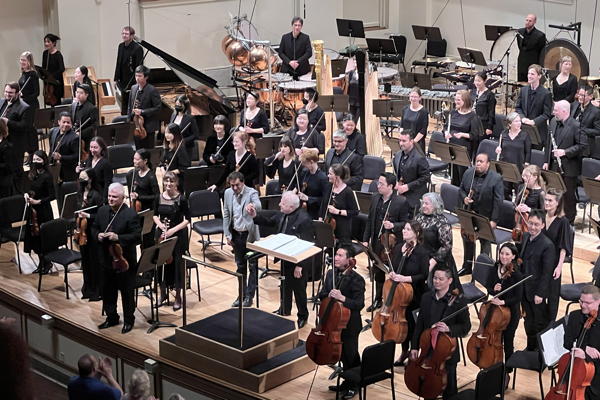
Mason Bates and Leonard Slatkin

Aside from the “ear worm” status of its tunes, the most striking thing about “España” is the sheer ingenuity of the orchestration. Chabrier tosses the work’s two main themes back and forth among the various sections of the orchestra with breathtaking speed. He also alternates moments of sharply contrasting moods, as when a delicate harp duet (Allegra Lilly and Megan Stout) is repeatedly interrupted by the brass section. The result is something of a musical soccer game with the ball in constant motion.

Needless to say, this calls for both an orchestra and conductor who are, so to speak, fleet of foot. Sunday afternoon we had both, with a crisp, precise, and viscerally exciting performance by Slatkin and the band. Enthusiastic applause followed.

Thematic material got bounced around quite a lot in the next work, the “Anthology of Fantastic Zoology” by Mason Bates (b. 1977). Based on the “Book of Imaginary Beings” by one of the previous century’s premier Spanish-language writers, Jorge Luis Borges, it’s described by the composer as “a kind of psychedelic Carnival of the Animals.”

That’s not a bad analogy. Sure, the animals here are entirely mythical if not downright outré (e.g. the Zaratan, a ginormous sea turtle the size of an island) but that just gives Bates all the more opportunity to show off his genius as an orchestrator as well as his flair for the theatrical. That’s most apparent in the “Sprite” movement, where the short, quicksilver theme leaps from player to player and even to a pair of violins placed far stage right and stage left (they’re supposed to be offstage, but that would have rendered them inaudible at Powell). It’s a bit like Chabrier’s soccer game, but on amphetamines.

The first ten of the work’s eleven movements are an auditory funhouse. Each fantastic animal has its own unique and enticing musical profile, building steadily to “Sirens,” which Bates calls “the lyrical core of the piece.” In it, the not-quite-offstage violins trade a pair of themes which are gradually taken up by the entire orchestra, leading to a massive outpouring of ecstasy. The ecstasy mutates into agony as dissonant intervals are added to the mix until it all becomes a mass of tone clusters à la György Ligeti that represent the all-consuming Zaratan.

Wonderful stuff so far, but for me the work goes off the rails in the finale, “Madrugada” (the legendary “witching hour” between midnight and dawn). Bates describes this movement, in which “the entire work collapses upon itself,” as “sprawling.” I’d describe it as overwritten and discursive. Running over ten minutes (nearly a third of the work’s 30-minute running time), it vitiates much of the energy accumulated up to that point.

Still, it was great fun for the first 20 minutes or so and allowed the musicians of the SLSO to show off their virtuosity. Even without seeing the score, it’s clear to me that “Anthology of Fantastic Zoology” is (ahem) a beast to play and conduct. A special shout-out is due Principal Tympani Shannon Wood, playing ten instruments in what looks like a section of the “drum cage” he built for William Kraft’s Tympani Concerto back in 2016, but everybody in the band had a workout on this one. That included Slatkin, who held this massive structure together masterfully.

Joshua Roman and Leonard Slatkin

This was only my second exposure to a live performance of music by Mason Bates (the first was the world premiere of his opera “The (R)evolution of Steve Jobs” in Santa Fe back in 2017) and I was once again impressed by his originality and his ability to engage the audience without “writing down” to us. His is an eclectic and inventive voice that is very much welcome these days. I hope to see and hear more of his work here in the future. Meanwhile, he's well represented on both YouTube and Spotify for those of you interested in hearing more of that voice.

The concert concluded with another virtuoso orchestral showpiece with Spanish connections, “Don Quixote (Fantastic Variation in a Theme of Knightly Character)” by Richard Strauss (1864–1949). Written at around the same time as Strauss’s “Ein Heldenleben” (“A Hero’s Life”), “Don Quixote” balances the former’s triumph with a mix of comedy and tragedy—so much so that Strauss saw them (according to Grove Online) “as paired works, and suggested that they be performed together.” Given that Strauss notoriously saw himself as the protagonist of “Heldenleben,” I have to wonder if he saw the Don as another side of his personality.

Certainly it’s a sympathetic portrayal of Cervantes’s “knight of the woeful countenance”, with Quixote represented musically by the mellow, resonant tones of the cello. This past weekend’s soloist, Joshua Roman, proved more than equal to the task, clearly connecting with his character’s emotional arc. In an interview for St. Louis Public Radio earlier in the week, Roman talked about the importance of “becoming the Don,” something that could be seen in his face and heard in his playing.

That said, it wasn’t always easy to hear his instrument from our seats upstairs. His tone sounded a bit thin, and he was often swamped by the orchestra. Given that I did not notice these issues when I listened to the broadcast of Saturday’s concert, I’m inclined to chalk it all up to Powell Hall’s acoustics rather than to Roman’s performance.

Backing Roman up were Principal Viola Beth Guterman Chu as the loyal Sancho Panza, assisted by Concertmaster David Halen, Tim Myers on euphonium, and Tzuying Huang on bass clarinet. The give and take between Chu and Roman in “Variation III: Dialogue of the Knight and the Squire” was a pleasure to watch, as the progress of the conversation could be seen and heard in their performances. Chu’s Sancho argues, cajoles, and finally gives in as Roman’s Don remains cheerfully oblivious, head firmly in the clouds.

Next at Powell Hall: Stéphane Denève returns to conduct Gabriela Lena Frank’s “Apu,” Bartók’s Piano Concerto No. 3 (with soloist Piotr Anderszewski), and Stravinsky’s “Le Sacre du Printemps.” Performances are Saturday at 8 pm and Sunday at 3 pm, April 29 and 30.

This article originally appeared at 88.1 KDHX, where Chuck Lavazzi is the senior performing arts critic.

Wednesday, August 11, 2021

Symphony Digital Review: Youthful music for winds highlights the St. Louis Symphony's final summer digital concert

The live concert season of the St. Louis Symphony Orchestra (SLSO) is on hiatus until the fall, but the orchestra’s on-demand video series is still going strong. Available through September 4th, the latest release stars members of the SLSO winds in a thoroughly engaging pair of serenades by Mozart and Richard Strauss under the baton of Music Director Stéphane Denève.

[Find out more about the music with my original symphony preview.]

Stéphane Denève conducts the Strauss Serenade

Recorded at Powell Hall April 30th through May 2nd and originally reviewed by me back then, the concert features a pair of works by young composers just starting to make a name for themselves, albeit around a century apart.

In a reversal of the usual musical cliché, the Strauss Serenade for Winds in E-flat major, op. 7 that opens the program is the short and pithy one, while Mozart's Serenade No. 10 in B-flat major, K. 361 (370a) is the symphony-length work with seven entrancing movements. Both get exceptionally well-crafted performances by Maestro Denève and his musicians, beginning with a pleasant trip through Strauss’s musical terrain.

Written when the composer was a lad of 17 who had yet to graduate from high school, the Op. 7 serenade has often been called a surprisingly mature-sounding work. Presumably that’s a reflection of the mood of quiet contemplation that can be heard in some of the composer’s much later work. Scored for a 13-member ensemble (three pairs of flutes, oboes, clarinets, and bassoons, four horns, and either contrabassoon or double bass) the work gets a warm and welcoming treatment from Mr. Denève that neatly balances the calm outer sections with the more stormy B-minor interlude in the middle.

It’s as if a serene sunset were briefly interrupted by a sudden squall that subsides into a euphonious horn chorale before returning to the more contemplative mood of the opening. Principal Horn Roger Kaza and his fellow players Julie Thayer, Tod Bowermaster, and Victoria Knudtson truly distinguish themselves here and in the Mozart that follows.

Stéphane Denève conducts the Mozart "Gran Partita"

Speaking of which: Mozart was only a few years older than Strauss when he wrote the Serenade No. 10. The composition date is a bit obscured by the fog of history, but it probably dates from around 1781—almost exactly a century before the Strauss serenade. Equally obscure is the nickname the work has picked up over the centuries, “Gran Partita” (literally “Large Suite”). Someone other than Mozart scribbled it on the manuscript, and it has clung, like a stubborn barnacle, over the years.

It not hard to understand why, though. At around 45-50 minutes and boasting a 13-piece orchestra (like Strauss’s serenade, but with two basset horns instead of flutes) the piece is over twice the size of the conventional aristocratic garden party wind band of the late 18th century. Everything about it is, for its time, larger than life, from the opening Largo—Allegro molto that feels more like an opera overture, to the theme and virtuoso variations of the sixth movement and the high-stepping Finale seventh movement.

In his introductory comments on the video, Denève describes the Serenade as “an incredible masterwork of epic proportions [that] exudes joy and vital energy.” No surprise, then, that his interpretation is appropriately grand and expansive without ever getting within even hailing distance of stodgy.

The first Menuetto is dignified and graceful—aristos gliding in the garden—with a bubbly, bucolic trio featuring Scott Andrews and Tzuying Huang on clarinets and Ryan Toher and Jane Carl on the larger and lower-pitched basset horns. The second Menuetto gets a good-humored treatment that suggests the servants dancing in the cellar—more openly jolly with a Ländler trio that brings in a bit of brisk Tyrolean air.

L-R: Xiomara Mass and Cally Banham

Anyone who has seen Peter Shaffer’s play "Amadeus" in any of its multiple stage revisions or its 1984 film adaptation will recognize the exquisite Adagio third movement as the music whose beauty drives poor Salieri to distraction. Here in the real world, Erik Smith has called the Adagio “the loveliest of all movements written for wind instruments”. It’s easy to believe both, given the lovely treatment of this music by oboists Xiomara Mass and Cally Banham (usually heard on English horn), along with Andrews, Huang, Toher, and Carl. The videography brings you face-to-face with Mass during her solo, allowing you to see the intense concentration of her performance.

The Thema mit Variationen gives everyone a chance to show off a bit, including bassoonists Andy Gott and Felicia Foland, along with the redoubtable Erik Harris providing a solid foundation on double bass, just as he does in the Strauss. Mr. Denève follows that attacca (without pause) with a frolicsome Finale (to steal a phrase from Benjamin Britten) that brings everything to a happy conclusion. To quote Caitlin Custer’s original program notes on that last movement: “Serve the coffee, gather the coats, get the guests on their way!”

Available through September 4th, this is the last in a summer series of digital recordings of concerts by the SLSO from this past spring. If you missed them live, this is a golden opportunity to see them in the comfort of your own home. For more information, visit the SLSO web site.

This article originally appeared at 88.1 KDHX, where Chuck Lavazzi is the senior performing arts critic.

Thursday, April 04, 2019

Symphony Preview: Old French wine, new bottles

This article originally appeared at 88.1 KDHX, where Chuck Lavazzi is the senior performing arts critic.

A couple of weeks ago we had an all-French evening at the St. Louis Symphony. This weekend Resident Conductor Gemma New will lead the orchestra in a program of three works for which the inspiration was French, even if the composers aren't.

Composer Thomas Adès
Photo by Brian Voce
The concerts open with a local premiere, the "Three Studies after Couperin" by contemporary British composer Thomas Adès (b. 1971). Commissioned by the Basel Chamber Orchestra and first performed by them in 2006, the "Three Studies" are orchestrations/transformations of keyboard works by the great French composer François Couperin (1668-1733).

Known as Couperin le Grand ("the Great") to distinguish himself from other not-quite-as-prominent members of his very musical family, François Couperin wrote, among other things, four volumes of harpsichord music between 1713 and 1730 for a total of over 230 individual pieces, many with highly descriptive and often fanciful titles. The three Adès selected for his "Studies" are "Les Amusemens" ("Amusements"), "Les Tours de Passe-Passe" ("Sleight of Hand"), and "L'âme-en-peine" ("The Soul in Pain"). As Guardian music critic Tom Service points out in his notes on the Faber Music web site, Adès calls these "studies" because they expand on the originals:
Each piece...has the same number of bars as the original, and contains the same harmonies and rhythms. So why, then, are these pieces 'studies' and not simply 'arrangements'? Adès may take nothing away from Couperin's original pieces, but he adds to them. Using an orchestra--really two, since the heart of the ensemble is a double string orchestra-- Adès makes each piece an investigation of a different musical idea: the textural amusement of the first, the way the melody melts from the bass flute solo to bassoon, to the strings and the brass, or the amplification of Couperin's pain-wracked soul in the third piece into a multi-faceted musical space. The second, Couperin's 'magic tricks' is the most spectacular of all, as Adès's own compositional sleight of hand creates a rhythmic tempest in the music's final moments.
If you'd like to get a preview of the music, the links in the previous paragraph will take you to performances by the Chamber Orchestra of Europe, conducted by the composer, so it's a safe bet they're authoritative. "Les Tours de Passe-Passe" is especially interesting in the way Adès has traditionally low instruments play at the top of their ranges. As Yvonne Frindle writes in her SLSO program notes, "[t]he frenetic sharing of melody notes between parts threatens disaster--hocus pocus!"

Parenthetical note: the literal translation of "Les Tours de Passe-Passe" would be "the passe-passe towers." Given that magicians still perform a trick today called the "passe-passe bottles," I strongly suspect that the present-day trick had its origins in an illusion Couperin depicted in his music.

Mozart, as drawn by Doris Stock, 1789
Up next will be Mozart's Concerto in C major for Flute and Harp, written in 1778 during a trip to Paris. Mozart was only 22 and already a seasoned traveler at the time, but this particular trip was not, like his earlier journeys to Europe's capitals, part of a concert tour. This time Mozart was looking for regular employment, and he thought he'd found it when the Duke of Guînes commissioned him to write a concerto that the Duke--an accomplished flutist--could perform with his harpist daughter.

Unfortunately, the Duke turned out to be the kind of rich guy who contracts for services and then refuses to pay for them (sound familiar?). Mozart never got paid for the work and it never got a public performance in his lifetime. Still, it's a lively and charming piece that will shine the spotlight on two of our local musical stars, Principal Flute Mark Sparks and Principal Harp Allegra Lilly.

It's interesting to note that at the time Mozart wrote this concerto the harp wasn't taken seriously as an instrument. Here's Chris Myers writing for the Redland Symphony:
Though popular in amateur settings, the instrument had a number of technical limitations that kept it from establishing a foothold in the concert hall (the modern concert harp as we know it wasn't even invented until 1810). Mozart seems to have decided to approach the instrument as a kind of plucked piano. Not only does the concerto lack the glissandi and broadly dramatic arpeggios we think of as so typically "harpish" today, but those listeners familiar with Mozart's piano works will recognize many of the gestures typical of his keyboard writing in the harp part. Though he left few clues as to his feelings about the experience, it is perhaps telling that he never used the instrument in another piece--an unusual omission for an eager adopter of new technology and an early champion of instruments such as the clarinet and the glass harmonica.
Reproduction of a late 18th-century flute
by flute-maker Boaz Berney
Photo by I, Aviad2001, CC BY 2.5
commons.wikimedia.org
Not only was Mozart uncomfortable with the harp, he didn't much care for the flute either. That might have been because the instrument was, in 1778, a fairly primitive wooden contraption with a small number of keys that was hard to keep in tune. The Duke's instrument apparently was a cutting edge English model with extra keys (for which Mozart wrote some extra low notes) but it still almost certainly bore little resemblance to the complex modern instrument Mr. Sparks will be playing. It's a safe bet that it was (to steal a joke of uncertain origin) an ill wind that nobody blows good.

English 6-key flute circa 1800
From oldflutes.com
The concerts will conclude with another instance of old French wine in new bottles: the suite from Richard Strauss's music for a revised and greatly expanded version of Molière's 1670 comedy about social climbers, "Le Bourgeois gentilhomme" (roughly "The Middle Class Gentleman"). The revision, by Strauss's frequent collaborator Hugo von Hofmannsthal, took a fake Turkish "marriage ceremony" in the original play and turned it into a full-length opera, "Ariadne auf Naxos."

The resulting very long evening (around four hours) was a flop. "Theater people," according to Aspen Music Festival program notes, "thought the opera took too much attention away from the play; opera buffs hated to have to sit through a play before the singing started. Moreover it was impractical and expensive, since a producer had to hire both a theater company and an opera company to put it on!"

These days "Ariadne" is often performed all by itself (the most recent local production was in 2016). Strauss prepared a suite of his incidental music for Hofmannsthal's version of the play, publishing it in 1919 as his Op. 60. It's not performed as often as it ought to be, in my view (the SLSO last did it in 1991), given what a continual delight it is.

Richard Strauss in London, 1914
Most of the music is original to Strauss, although he did base three of the nine movements in the suite on music originally composed for the play by Jean-Baptiste Lully (1632-1687), the celebrated French composer who frequently collaborated with Molière. The piece is a mock-Baroque amusement park, chock filled with solo small ensemble passages that give members of the band a chance to strut their stuff.

The "Menuett," for example, prominently features the flutes, while the movement that follows ("The Fencing Master") has some comically loopy bits for trombone, trumpet, and piano that portray the elaborate parry and thrust of the class. "The Entrance and Dance of the Tailors" offers a violin part so substantial it could almost be a mini-concerto.

As if all that weren't already enough fun, the final movement ("The Dinner") is filled with musical in-jokes, as detailed in the Aspen Festival Notes cited above:
It begins with an entrance march for the guests, and a series of courses identified musically and followed by the opportunity for some (musical) conversation: The fish is salmon (a quotation from Wagner's Ring tells us that it must have been caught in the Rhine). The meat is mutton (the sheep from Strauss's own Don Quixote). A lovely meditation for cello follows, perhaps for no better reason than that thinking of Don Quixote brought made Strauss think of the instrument featured in that score. Roasted songbirds are identified partly by the larks heard at the beginning of Rosenkavalier (and, for some strange reason, Verdi's "La donna è mobile"). Finally an omelette surprise is marked by the sudden arrival of a kitchen lad who performs a lively, suggestive waltz, though Strauss's music is filled with simple joie de vivre.
In short, if this music doesn't send you out of Powell Hall with a smile on your face, you might need to heed the advice of lyricist Lew Brown: "Life is just a bowl of cherries / Don't take it serious; it's too mysterious."

But don't take my word for it. There's a fine performance by Vladimir Jurowski and the Chamber Orchestra of Europe on YouTube that's marred only by commercials between some of the movements. There's also one conducted by JoAnn Falletta who was recently named Classical Woman of the Year by Performance Today listeners. It doesn't have the fancy camera work of the Jurowski performance, but on the other hand it doesn't have commercials.

The Essentials: Gemma New conducts the St. Louis Symphony Orchestra along with soloists Mark Sparks, flute, and Allegra Lilly, harp, on Friday at 10:30 am, Saturday at 8 pm, and Sunday at 3 pm, April 5-7. The concert takes place at Powell Symphony Hall, 718 North Grand in Grand Center.

Monday, January 21, 2019

Review: New kids on the block

This article originally appeared at 88.1 KDHX, where Chuck Lavazzi is the senior performing arts critic.

Karina Canellakis
Photo: Chris Christodoulou
Share on Google+:

This weekend's St. Louis Symphony Orchestra concerts gave us some notable local debuts, both on the stage and on the page.

[Find out more about the music with my symphony preview.]

On stage, Saturday night's concert (January 19, 2019) was a triumph for guest conductor Karina Canellakis, the newly appointed Chief Conductor of the Netherlands Radio Philharmonic Orchestra. In her first appearance with the orchestra, she showed an impressive grasp of a wide range of music, from Mozart's 1775 Violin Concerto No. 5 ("Turkish") to Paul Hindemith's 1944 "Symphonic Metamorphosis on Themes of Carl Maria von Weber." In his own local debut, Ray Chen (a last-minute substitute for an ailing Renaud Capuçon) made an equally strong impression as the soloist in the Mozart.

On the page, the new kid in town was Richard Strauss's "Symphonic Fantasy from Die Frau ohne Schatten." First performed in 1919 but making its first appearance with the SLSO, this 22-minute orchestral synthesis of scenes from the composer's massive fairy tale opera neatly captures the drama and fantastic atmosphere of the original. It's a typically Straussian exercise in orchestral excess, with over 100 musicians (including an expanded percussion section and an organ) delivering a captivating kaleidoscope of orchestral color.

It was all beautifully played and conducted with great authority by Ms. Canellakis, whose interpretation provided a cohesive view of this potentially very episodic work. In an interview for the SLSO program, she describes the music of "Die Frau ohne Schatten" ("The Woman Without a Shadow") as "unbelievable, impressive, and beguiling." You could hear that happy enthusiasm for the music in every minute of this stunning performance.

Ray Chen
Photo: John Mac
I heard and saw that same joy and sense of fun in the way both she and Mr. Chen delivered the Mozart concerto. The last of the composer's violin concertos, the Fifth is filled with unexpected turns of phrase, including the so-called "Turkish" interlude of the finale in which the cellos and basses strike their strings, col legno, to produce an exotic percussive effect. This was an interpretation that bubbled over with sheer delight in music making, and it was impossible not to smile in response. A violinist herself, Ms. Canellakis clearly had a strong connection with both this work and with Mr. Chen.

Enthusiastic applause moved Mr. Chen to return to the stage and play an encore: Paganini's Caprice No. 21--a nice contrast to the Mozart and expertly played.

The concert opened with a performance of Beethoven's "Lenore Overture No. 3" that covered a wide emotional range, from the hushed introduction to a coda that crackled with energy. Ms. Canellakis's conducting was incisive, with neatly shaped phrases and a fine sense of the drama of this very theatrical work. Associate Principal Tom Drake provided the authoritative offstage trumpet.

The evening ended with a virtuoso romp through the Hindemith "Metamorphosis." Originally intended (but never used) as a ballet score, the four-movement work is, like the Strauss piece that preceded it on the program, a riot of vivid orchestral color. Hindemith's transformations on Weber's original themes is striking in its originality and filled with great solo moments, performed with great polish here by (among others) Principal Flute Mark Sparks, Principal Oboe Jelena Dirks, and Principal Clarinet Scott Andrews. The brass section was in fine form, as was the percussion section, most notably in the "Chinoiserie" of the second movement, based on themes from incidental music for Schiller's play "Turandot."

It's always a pleasure to see new, young performers at Powell Hall. Based on their strong showing Saturday night, I would think both Ms. Canellakis and Mr. Chen would be strong contenders for more appearances with the SLSO in the future.

Next at Powell Hall: Gemma New conducts the St. Louis Symphony Orchestra in "Star Wars: A New Hope in Concert" Thursday through Saturday at 7 pm, and Sunday at 2 pm, January 24-27. Performances take place at Powell Hall in Grand Center. At this time, only "limited view" tickets are available.

Wednesday, January 16, 2019

Symphony Preview: Known unknowns

Beethoven by Joseph Karl Stieler, 1820
Share on Google+:

It's an all-German program this weekend (January 18 and 19, 2019) as guest conductor Karina Canellakis leads the St. Louis Symphony Orchestra and violinist Renaud Capuçon in an evening of music by Beethoven, Mozart, Richard Strauss, and Paul Hindemith. The names are familiar to most music lovers, but some of the program might not be.

The concerts open, appropriately, with an overture. Specifically, it's the second of four overtures Beethoven wrote for his opera "Fidelio" (originally titled "Lenore") so, naturally, it's known as the "Lenore" Overture No. 3.
Allow me to explain.

With a libretto adapted from Pierre Gaveaux's 1798 opera "Léonore, ou L'amour conjugal," Beethoven's opera is the story of Lenore's efforts to free her husband Florestan from a political prison by disguising herself as a guard named Fidelio. In fact, management at the Theater an der Wein, where the opera was first performed, insisted on changing the name from "Lenore" to "Fidelio" to avoid confusion with the earlier opera.

With each production, "Fidelio" got a new overture. The overture now labeled "Lenore" No. 2 was actually the one performed at the first production in 1805. An 1806 revision got the overture we'll hear this weekend, "Lenore" No. 3. A planned performance in Prague in 1808 never happened, but the revised overture was discovered after the composer's death and labeled "Lenore" No. 1 on the mistaken belief that it was his first attempt. These days when the opera is performed, it's in the 1814 revision.

Of the four overtures, "Lenore" No. 3 gets the most attention, primarily because it's the one that best encapsulates the story of the opera. As Michael Steinberg writes in notes for the San Francisco Symphony, it's "too strong a piece and too big, even too dramatic, to be an effective introduction for a stage action, something that Beethoven realized almost at once. It does, however, stand as one of the great emblems of the heroic Beethoven, a potent and controlled musical embodiment of a noble humanistic passion." In short, what works as a concert opener doesn't necessarily work as an opera opener.

Mozart, ahead of his time
Up next is Mozart's Violin Concerto No. 5 ("Turkish"), performed by Ray Chen. It's a late substitute for the originally scheduled Schumann Violin Concerto due to the illness of the original soloist, Renaud Capuçon. The last and most sophisticated of Mozart's violin concertos, the fifth is, as Blair Johnson points out at Allmusic.com , a forward-looking piece "very nearly in line with the instrumental concerto of the next century":
Though the piece itself is clearly within the Classical chamber concerto tradition, its scale (better than 25 minutes, usually) and the degree of its technical demands mark the work as something new for the violin. Many pieces with equal or greater raw physical demands had already been composed by the time of the Concerto No. 5, but none of them has survived the test of time, and certainly none is as formidable a piece of music -- it is not without reason that this is the only one of the five to regularly receive as much attention from musicologists and historians as do the crown jewels of Mozart's piano concerto catalog. A warhorse of the student repertory and a staple of the professional's diet, this may well be the most frequently played violin concerto ever written.
Regarding this weekend's soloist, Ray Chen began to attract attention when he won First Prize in the 2008 Yehudi Menuhin and 2009 Queen Elisabeth Competitions for young violinists. Since then he has appeared with orchestras in Europe, Asia, and North America. This season his schedule includes the Los Angeles Philharmonic, the Singapore Symphony Orchestra, and the Barcelona Symphony Orchestra.

Richard Strauss in 1938
Up next is Richard Strauss's "Symphonic Fantasy from Die Frau Ohne Schatten" composed in 1946 and based on themes from his 1919 opera "Die Frau Ohne Schatten" ("The Woman Without a Shadow"). Like "Fidelio," the opera has a troubled history. The complex fairy tale libretto by Strauss's frequent collaborator Hugo von Hofmannsthal tended to leave audiences cold, and the serious technical demands of the work placed it outside the capabilities of all but the most well heeled companies.

"If ever an opera was weighed down by its creators' joint ambition," writes John Shirley in a review of the Royal Opera's 2014 production, "it is Die Frau ohne Schatten." Strauss and Hofmannsthal saw the work as their masterpiece but "it turned into a complex and unwieldy embarrassment of riches, albeit a glorious one. The charge that this enormous fairy tale represents the librettist and composer at their most pretentious and overblown is difficult to refute."

The "Fantasy," in any case, captures the drama and fantastic atmosphere of the opera in a mere 22 minutes and without the need for elaborate scenery. Besides, Tim Munro's program notes provide a handy breakdown of the themes used and their placement in the opera. The music requires a great orchestra but, of course, we already have that.

Paul Hindemith, age 28
A great orchestra is also a requirement for the last work on the program, Paul Hindemith's "Symphonic Metamorphosis on Themes by Carl Maria von Weber." Originally intended as a ballet for the dancer and choreographer Léonide Massine, the work became a purely symphonic piece when Hindemith and Massine were unable to agree on its final format.

The Weber originals transformed by Hindemith are three piano duets and, in the second movement Scherzo, the overture to Schiller's play "Turandot," an Italian translation of which would later become the basis for Puccini's opera of the same name. Hindemith's reworking of this relatively modest material is striking and colorful. As D. Kern Holoman of the University of California at Davis writes:
The Weber originals serve as mere starting points for Hindemith's invention. Both the first and the last movements are marches, by turns whimsical and rambunctuous; both begin simply with Weber's tunes and transform themselves -metamorphose -into intricate display as the role of Hindemith's countermelodies grows ever more significant. The lovely Andantino, based on a Weber siciliana, consists of increasingly ornamented treatments of the melody first begun in the clarinet; the restatement is dominated by an obbligato for solo flute. The big movement, however, is the Chinese scherzo, where the simple tune works itself into a perpetual motion, ever grander in dimension. The wind and percussion work is for a time in the style of the Turkish band, with brash trills in the woodwind, snare drum, and triangle. When the percussion take over completely it is as though some huge musical clock has come unsprung, the last section discombobulating into irregular cycles of the constituent parts in multiple meters.
Not surprisingly, the percussion section of the orchestra will be a large one for this work, with six musicians (including Principal Tympani Shannon Wood and Principal Percussion William James) banging away at timpani, snare drum, bass drum, cymbals, small cymbals, triangle, tambourine, small gong, wood block, tom-tom, glockenspiel, and chimes. Back in the day, this work was a favorite for audio enthusiasts looking to show off their stereo systems.

The Essentials: Karina Canellakis conducts the St. Louis Symphony Orchestra and violinist Ray Chen Friday at 10:30 am and Saturday at 8 pm, January 18 and 19. The concerts take place at Powell Symphony Hall, 718 North Grand in Grand Center.

Monday, October 30, 2017

Review: A potent Fifth of Beethoven

This review originally appeared at 88.1 KDHX, where Chuck Lavazzi is the senior performing arts critic.

Roger Kaza
Share on Google+:

Attracting big-name international soloists, as the St. Louis Symphony Orchestra does on a regular basis, is a sure sign that an orchestra is playing in the big leagues. So does having first chair players that are good enough to take the solo spot themselves. Friday night (October 27, 2017) we had examples of both.

The concert opened with the Horn Concerto No. 2 in E-flat major by Richard Strauss. Written in 1943, when the composer was in his eighties, it's a warm and nostalgic look back on the cultural traditions that had been seriously poisoned by the Nazi regime under which Strauss labored. The last movement in particular, as Music Director David Robertson pointed out in his pre-concert talk, has a kind of grace that recalls the horn concertos of Mozart.

In the solo spot was SLSO Principal Horn Roger Kaza, delivering a technically solid performance that was a model of classical restraint. That approach worked especially well in the Rondo finale, which skipped along beautifully. For me, though it was a bit less effective on the first and second movements, where a bit more passion would have been welcome. Mr. Kaza also muted his horn a bit too much, I thought, often causing him to be swamped by the orchestra. He and Mr. Robertson showed real rapport, though, and got impeccable support from his fellow orchestra members. It was, overall, a very satisfying piece of work that drew a standing ovation.

Up next was Alban Berg's Seven Early Songs, composed between 1905 and 1908 when he was studying with Arnold Schoenberg but not fully orchestrated and published until 1928. Like the Strauss concerto, this is also music that largely looks back to the past, although in this case that past includes Strauss himself. There's a yearning and ecstatic romanticism to this music that makes it very approachable even if, as René Spencer Saller points out in her program notes, it rather annoyed Schoenberg.

The soloist was soprano Christine Brewer, who is both a big-name international performer as well as a local favorite, with stage credits that include not only Union Avenue Opera and Opera Theatre of St. Louis but also the Metropolitan Opera, Santa Fe Opera, and English National Opera. No surprise, then, that her singing here combined a luminous, powerful sound with a clear grasp of the text.

Soprano Christine Brewer
Photo: Christian Steiner
Those texts come from seven different German poets and vary from Carl Hauptmann's straightforward "Nacht" (Night) with its vivid evocation of a nocturnal landscape to Rilke's "Traumgekrönt" (Crowned in Dreams) with its more elliptical sexual references. Ms. Brewer showed the sensitivity to the varied moods of the songs that I have come to expect of her over the years. From the post-coital blush of "Libesode"(Ode to Love") to the quiet contemplation of "Im Zimmer" (Indoors), it was all there, and delivered with great authority.

The concert concluded with a rousing Beethoven Symphony No. 5, conducted without a score and with real fire. The Fifth has been performed and recorded so many times by so many different orchestras that it can be difficult for a conductor to put his own stamp on the work, but Mr. Robertson nevertheless managed to do just that with a driving, high-energy interpretation that created tangible excitement.

It even had some surprises to offer, including a headlong first movement and a graceful second that ran, with only the briefest pause, straight into the ghostly third. The orchestra played superbly, with fine solo work from everyone, including Principal Oboe Jelena Dirks in the first movement cadenza and flautist Ann Choomack on piccolo in the finale.

In a 2006 program note on the Beethoven Fifth for the Performance Today radio program, Christopher H. Gibbs noted that "it is difficult to divest this best known of symphonies from all the baggage it has accumulated through nearly two centuries and to listen with fresh ears to the shocking power of the work and to the marvels that Beethoven introduced into the world of orchestral music." Mr. Robertson's energetic approach jettisoned quite a bit of that baggage, reminding us of the work's remarkable power and originality.

Next at Powell Hall: SLSO Resident Conductor Gemma New leads the orchestra in John William's score for Jurassic Park, accompanying a showing of the film. Performances are Friday and Saturday at 7 p.m. and Sunday at 2 p.m., November 3-5. As with all film events, there will be popcorn, drink specials, and you'll be able to bring food and drink into the hall with you; so be careful to avoid spills.

Thursday, October 26, 2017

Symphony Preview: Cafe Vienna

We were in Vienna for a few days earlier this month and drenched ourselves in musical history. We visited the Mozarthaus museum. We saw a concert at the Musikverein and took a tour of the Vienna State Opera. We even stayed at the Hotel Beethoven on Papagenogasse, where the wall of our room was dominated by a picture of Placido Domingo in Fidelio.

And, of course, we had coffee and pastries.

This music scheduled for the St. Louis Symphony Orchestra concerts this weekend (October 27 - 29, 2017) brought all of that back to mind. Two of the three works on the program were first performed in Vienna and the third, while premiered in Salzburg, was performed there by the Vienna Philharmonic under Karl Böhm. So it's essentially "all Vienna all the time" this weekend.

The concerts open with that last work I mentioned. It's the Horn Concerto No. 2 in E-flat major by Richard Strauss. First performed on August 11th, 1943, the concerto's warmly nostalgic sound stands in stark contrast to the state of mind of its composer. His heath was not good, his wife was going blind, and the regime to which he had effectively sold his soul-and which he would later describe as a "twelve year reign of bestiality, ignorance and anti-culture under the greatest criminals"-was collapsing. Small wonder, then, that he took refuge in a kind of musical nostalgia.

Roger Kaza
Its lyricism not withstanding, the concerto is a difficult piece to perform, which may be one of the reasons why this is only the second time the SLSO has presented it. The local premiere was given back in 1987 with the famed Barry Tuckwell as the soloist. This time the solo spot will be taken by SLSO Principal Horn Roger Kaza. As someone who loves seeing local band members take center stage, I'm very much looking forward to his performance.

Up next will be the Seven Early Songs, composed by Alban Berg between 1905 and 1908 when he was studying with Arnold Schoenberg but not published until 1928. They hark back to the late Romantic sound world of Mahler and Strauss for the most part and are less terse and elliptical than the kind of thing Berg was writing when he published them. That means you can expect something very different from the last Berg song cycle we heard at Powell Hall.

That last song cycle was the Five Orchestral Songs to Picture-Postcard Texts by Peter Altenberg, performed by local favorite Christine Brewer last May. It's only appropriate, then, that Ms. Brewer is back as the soloist this time around. Ms. Brewer has substantial operatic credentials and Berg's songs are always very theatrical, so it should be a good fit.

Christine Brewer
Photo: Christian Steiner
At the other end of the popularity spectrum is the final work on the program, Beethoven's Symphony No. 5. The opening movement, in particular, has been heard and parodied so often that it's easy to forget that the symphony's premiere on December 22, 1808, was not a great success. The Fifth was part of a mammoth five hour program that included the Symphony No. 6 ("Pastoral"), the Piano Concerto No. 4, a couple of movements from the Mass in C, a concert aria ("Ah, perfido"), and the Op. 80 Choral Fantasy. Beethoven conducted and played the solo piano part in the concerto and the Fantasy.

There was only one rehearsal before the concert, the musicians weren't up to Beethoven's demands, the auditorium was cold, and by the time the Fifth was played after intermission the audience was exhausted. Things went so badly that at one point the Choral Fantasy had to be stopped completely after a performance error. Not auspicious.

In fact, it wasn't until E.T.A. Hoffmann published an enthusiastic review of the newly published score in the Allgemeine musikalische Zeitung a year and a half later that everyone began to sit up and take notice of the Fifth. "Radiant beams shoot through this region's deep night," wrote Hoffmann of the music's dramatic effect, "and we become aware of gigantic shadows which, rocking back and forth, close in on us and destroy everything within us except the pain of endless longing-a longing in which every pleasure that rose up in jubilant tones sinks and succumbs, and only through this pain, which, while consuming but not destroying love, hope, and joy, tries to burst our breasts with full-voiced harmonies of all the passions, we live on and are captivated beholders of the spirits."

More and better-rehearsed performances followed. By the time Hector Berlioz wrote his Critical Study of Beethoven's Nine Symphonies he could state that the Fifth was "without doubt the most famous of the symphonies" and "the first in which Beethoven gave wings to his vast imagination without being guided by or relying on any external source of inspiration." Today the Fifth is famous not just on earth but in outer space as well; a recording of the first movement by the Philadelphia Orchestra was part of the Voyager Golden Record, included on the first two Voyager space probes launched in 1977 and now speeding through deep space.

The essentials: David Robertson conducts The St. Louis Symphony Orchestra in music by Richard Strauss, Alban Berg, and Beethoven Friday and Saturday at 8 p.m. and Sunday at 3 p.m., October 27 - 29. Soprano Christine Brewer will perform Berg's Seven Early Songs and SLSO Principal Horn Roger Kaza will play Strauss's Horn Concerto No. 2. The concerts will conclude with Beethoven's popular Symphony No. 5. The performances take place at Powell Hall in Grand Center. For more information: stlsymphony.org.

Saturday, June 25, 2016

Review: The problems of "Ariadne on Naxos" were solved elegantly at Opera Theatre of St. Louis

Act I
Photo: Ken Howard
Share on Google+

I usually make it a practice to attend the opening nights of Opera Theatre's summer season, but travel plans this year obliged me to push all but La Bohème off to the final week of performances. That meant that I didn't get to see their admirable production of Richard Strauss's seriocomic Ariadne on Naxos until its closing night.

Better late than never, right?

It was, in any case, a pretty splendid presentation of an opera that is, by any standard, a kind of odd duck. Strauss and his librettist (and frequent collaborator) Hugo von Hofmannsthal originally intended it as a one-act postlude for a production of Moliere's comedy Le Bourgeois Gentilhomme in 1912. The difficulty and expense of mounting a play and an opera on the same bill eventually forced them to produce a rewrite that allowed the opera to stand on its own. It was first performed in 1916 and has been in circulation ever since.

So Young Park and the clowns
Photo: Ken Howard
The comic Prologue sets up the situation: the “richest man in Vienna” has engaged both a production of the tragic opera “Ariadne auf Naxos” and a commedia dell'arte troupe as after-dinner entertainment for his guests. To save time, he decrees that both shows must take place simultaneously. The performers can work out the details. The resulting conflicts between the opera company's Composer, Music Master, Prima Donna, and Tenor on one side and Zerbinetta and her group of buffoons on the other generate plenty of laughs, most of them at the expense of the self-important composer and his egotistical leading lady.

After intermission, we see the hybrid opera within an opera set up in the Prologue. Abandoned on Naxos, Ariadne (with the help of three nymphs) yearns for death, but her lamentations are repeatedly interrupted by Zerbinetta and company, who are determined to cheer her up. Drama eventually wins out, however, when Bacchus arrives, declares his love, and joins Ariadne in a long, rapturous love duet.

AJ Glueckert and Marjorie Owens in Act II
Photo: Ken Howard
The second act "opera within an opera" presents real problems, not the least of which is getting the audience to take Ariadne and Bacchus seriously after Strauss and Hofmannsthal have so effectively lampooned the pretensions of operatic tragedy in the first act. But OTSL had a couple of excellent performers in tenor AJ Glueckert and soprano Marjorie Owens, both making very strong impressions in their local debuts. Ms. Owens was particularly affecting as the bereft Ariadne, backed up by the glorious voices of the three nymphs (Elizabeth Sutphen, Stephanie Sanchez, and Liv Redpath) constantly striking graceful "Grecian urn" poses.

Perhaps the most striking performance of the evening, though, came from former Gerdine Young Artist So Young Park in the important and difficult role of Zerbinetta. Strauss wrote an almost absurdly long and florid coloratura aria ("Großmächtige Prinzessin" or "High and mighty princess") for her in the second act that calls on all the technique and flexibility a coloratura can summon up. It's a tribute to Ms. Park's abilities that she not only handled it with ease, but made it entertaining as well.

So Young Park and Cecelia Hall
Mezzo Cecelia Hall was comically intense in the "pants" role of the Composer and OTSL veteran Matthew DiBattista was hilariously nimble as the Dancing Master. John Brancy's solid baritone enhanced his very funny performance as the principal clown, Harlequin. Accompanying him as Zerbinetta's other three jokers were bass-baritone (and nimble dancer) Erik van Heyningen, tenor Benjamin Lee, and tenor Miles Mykkanen. Veteran St. Louis actor Ken Page was the epitome of self-important pomposity in the non-singing role of the Major Domo.

Director/Choreographer Seán Curran's staging felt a bit gimmicky at times, but generally worked quite well. And the comic dance moves he provided for Zerbinetta's crew could not have been better. Rory Macdonald conducted members of the St. Louis Symphony in a wonderfully full-blooded reading of Strauss's score.

As this is being written, Opera Theatre's 2016 season is winding down, concluding with Verdi's Macbeth tomorrow (June 26) at 7. It has been a very strong season and I'm glad I finally got to see all of it, even if I did so just under the wire.

Thursday, May 19, 2016

Preview: Love, death, and laughter in Opera Theatre of St. Louis's 2016 season

The festival grounds at Opera Theatre
Share on Google+

Summer is almost upon us, which means it's time for picnics on the lawn, champagne receptions, and great musical theatre in Webster Groves. It is, in short, time for Opera Theatre's annual four-show season.

Travel plans will make it impossible for me to provide my usual detailed preview of each opera, so instead here's a quick look at what you can expect on the stage of the Loretto-Hilton Center on the Webster University campus starting on Saturday, May 21, and running through June 26.

But first, some basics. For four decades now, Opera Theatre has been presenting four operas in rotating repertory every summer. All operas are sung in English with projected English text, so you won't miss a single word. The orchestra is made up of local musicians, mostly from the St. Louis Symphony, and the cast members are drawn from all over the world. Critics come from all over the world as well, making the annual OTSL season a truly international event.

For the full Opera Theatre experience, come early and have a picnic supper and some wine at one of the many tables set up on the Loretto-Hilton Center's lawn or under one of the concession tents. You can bring your own food and drink or buy boxed dinners from Ces and Judy's catering. Come on opening nights and get an added bonus: a champagne and dessert reception after the show with the cast and crew under the main concession tent.

Musetta costume sketches
The season opens on Saturday, May 21, with a recurring favorite: Puccini's La Bohème. Directed by Ron Daniels and conducted by Emanuele Andrizzi, this will be the sixth production of the opera by OTSL. It stars Canadian tenor Andrew Haji as Rudolfo, Kentucky-born baritone Anthony Clark Evans as Marcello, soprano and BBC Cardiff Singer of the World Competition winner Lauren Michelle as Musetta, and soprano Hae Ji Chang as Mimi.

The Story: Although copies of Henri Murger's 1851 short story collection Scènes De La Vie Bohème are no longer the common sight on bookshelves that they once were, the principal characters have never fallen out of favor. Originally published in a Paris literary magazine, the stories of young bohemians living in the Latin Quarter of Paris in the 1840s inspired, among other things, one play, two operas, and most recently, the wildly successful rock musical Rent.

It's Puccini's 1896 opera, however, that should probably get most of the credit for embedding the image of the starving artist in a Paris atelier into Western consciousness. The poet Rodolfo, the painter Marcello, and their various young, creative, and broke friends are down on their luck and preparing to burn some of their work to heat their squalid Parisian apartment when the equally poverty-stricken seamstress Mimi comes knocking. Before the first act is over, she and Rudolfo are smitten. The opera chronicles the highs and tragic lows of both their relationship and that of Marcello and the singer Musetta, Our Lady of the Relaxed Virtue.

Highlights: The long, ecstatic love scene between Rudolfo and Mimi at the end of Act I never fails to generate applause, as does the Act II scene at Café Momus, featuring Musetta's famous waltz tune, "Quando m'en vo'" ("When I go along"). And Mimi's death scene at the end of the fourth act can always be counted up on for jerking tears. Director Daniels promises a fresh and breathtaking approach to this old favorite. I look forward to seeing what that means.


The three witches' costume sketch
Saturday, May 28, brings the local premiere of Verdi's Macbeth. Directed by Lee Blakeley and conducted by OTSL Music Director Stephen Lord, the production stars English baritone Roland Wood in the title role, along with soprano Julie Makerov, last seen here as the homicidal Queen of Hearts in Unsuk Chin's Alice in Wonderland in 2012, as the even more homicidal Lady Macbeth.

The Story: Francesco Maria Piave's libretto sticks fairly close to Shakespeare's original, although there are some inevitable expansions for the opera stage. The three witches, for example, have been turned into an entire cackling chorus. The opera currently exists in two different versions: the 1847 original and an 1865 revision prepared for the Théâtre-Lyrique in Paris. That latter version has been the more popular of the two and it's the one OTSL is using.

In an article for Opera Today, Harvard's Daniel Albright says this later version is "more spacious, sprawling, operatic" and goes on to detail why:
[T]he Parisian ballet-pantomime for Hecate offers a glimpse at fate’s control mechanisms; the new chorus for the Scottish refugees has a greater emotional amplitude; and Lady Macbeth’s La luce langue is one of Verdi’s great arias, a show-stopper. If mixed-mode dramaturgy, opportunities for histrionic display, are Shakespearean, then 1865 is more Shakespearean than its predecessor.
No matter which version is used, though, this is a dramatic and fast-moving work that keeps the express-train pace of Shakespeare's original intact.

Highlights: I love the Act I witches' chorus, as well as Lady Macbeth's famous "letter" scene and the Act II drinking scene, interrupted by the appearance of Banquo's ghost. General Director Timothy O'Leary says we should expect "incredible vocal fireworks." And lots of blood.


Zerbinetta
costume sketch
On Sunday, June 5, at 7 p.m. OTSL brings us the opening performance of Richard Strauss's seriocomic Ariadne on Naxos, directed by the company's long-time choreographer Seán Curran with music direction by Rory Macdonald. The cast features globetrotting soprano Marjorie Owens as Ariadne, tenor AJ Glueckert (who has garnered praise for his ringing high notes) as Bacchus, South Korean soprano So Young Park as Zerbinetta, and Cecelia Hall as The Composer.

Yes, there is a role for The Composer. Allow me to explain.

The Story: As the comic Prologue informs us, the “richest man in Vienna” has engaged both a production of the tragic opera Ariadne on Naxos and a commedia dell'arte troupe as after-dinner entertainment for his guests. To save time, he decrees that both shows must take place simultaneously. The performers can work out the details. The resulting conflicts between the opera company's Composer (a "pants" role), Music Master, Prima Donna, and Tenor on one side and Zerbinetta and her group of buffoons on the other generate plenty of laughs, most of them at the expense of the self-important composer and his egotistical leading lady.

After intermission, we see the hybrid opera within an opera set up in the Prologue. Abandoned on Naxos, Ariadne (with the help of three nymphs) yearns for death, but her lamentations are repeatedly interrupted by Zerbinetta and company, who are determined to cheer her up. Drama eventually wins out, however, when Bacchus arrives, declares his love, and joins Ariadne in a long, rapturous love duet.

The odd structure of Ariadne on Naxos stems from the fact that it was originally written as a one-act postlude to a German translation (by Strauss's frequent collaborator Hugo von Hofmannsthal) of Moliere's comedy Le Bourgeois Gentilhomme in 1912. The difficulty and expense of mounting a play and an opera on the same bill eventually forced Strauss and Hofmannsthal to produce a rewrite that allowed the opera to stand on its own. It was first performed in 1916 and has been in circulation ever since.

Highlights: Your mileage may vary, but I have always found the comic carrying on of Zerbinetta and company to be some of the best bits. That said, the concluding love duet for Bacchus and Ariadne shows Strauss at his most rhapsodic. Look for distinguished St. Louis-based actor/singer/playwright Ken Page in the role of the Majordomo.


Salman Rushdie
On Saturday, June 11, at 8 p.m. we get the world premiere of Shalimar the Clown, composed by Jack Perla with a libretto by Rajiv Joseph based on the Salman Rushdie novel of the same name. Tenor Sean Panikkar-an OTSL veteran most recently seen here in the St. Louis Symphony's captivating presentation of Berlioz's Roméo et Juliette-has the title role. The production is part of the company's ongoing New Works, Bold Voices series, which emphasizes the creation of American works that tell compelling modern stories with themes of common humanity in today's world.

The Story: Shalimar the Clown is a story of paradise lost in conflict-ridden 1960s Kashmir, set also in Los Angeles and London. In a pastoral Kashmiri village, a young Muslim boy named Shalimar falls in love with a beautiful Hindu girl named Boonyi. They are performers in a traditional folk theater - he a tightrope walker and she a dancer. Their romance manages to meet with the approval of village elders, resulting in a joyful wedding. But when a new American ambassador meets Boonyi, he seduces her with the promise of a new life, sending Shalimar down a dangerous path of revenge.

Highlights: Who knows? This is a brand-new work, so it's impossible to say what the Best Bits will be. Perhaps the biggest highlight is the fact that Salman Rushdie was in town earlier in the year to support and promote the piece. One interesting aspect will be the scoring, which incorporates traditional Indian instruments like the sitar and tabla. Opera Theatre's commitment to new works is, in any case, a reminder that opera is a vibrant, living art form.

The Essentials: Opera Theatre of St. Louis presents four operas in rotating repertory from May 21 through June 26 in the Loretto-Hilton Center on the Webster University campus. For ticket information, visit the Opera Theatre web site.

Saturday, February 13, 2016

Opera Review: In Chicago, a perfect "Rosenkavalier" revival

Act I
Photo: Andrew Cioffi
Share on Google+

The Lyric Opera of Chicago's revival of its 2006 production of Richard Strauss's bittersweet romantic comedy "Der Rosenkavalier" ("The Cavalier of the Rose"), which runs through March 13, has everything a great night at the opera should have: wonderful music, superior singing, fine acting by a cast who are all just right for their roles, eye-popping sets and costumes, and impeccable playing from a first-class orchestra. Those of us who love opera live for productions like this.

First performed in Dresden in 1911, "Rosenkavalier" was an immediate success with both audiences and critics alike. Productions quickly popped up at La Scala, the Vienna State Opera, the Royal Opera House in London, and The Metropolitan in New York. Today it's easily Strauss's most popular opera and a part of the core repertoire. It's certainly no stranger to the Lyric stage, where some notable singers have appeared in it.

Act II
Photo: Andrew Cioffi
Much of the opera's success stems from the depth and intelligence of Hugo von Hofmannsthal's libretto. Working closely with the composer, von Hofmannsthal took what started out as a typical romantic farce about young lovers Sophie and Octavian (the titular cavalier) outwitting the boorish Baron Ochs, who is being forced on Sophie as a husband, and added a worldly-wise depth to it with the character of Octavian's older lover, the noble Marschallin.

In her mid-thirties, the Marschallin is nearly twice Octavian's age and sees all too clearly that their affair must eventually end. Her Act I ruminations on the transitory nature of happiness and her final renunciation of Octavian in the exquisitely beautiful trio at the end of the third act lend her character a richness that makes her immediately appealing. That final trio, along with the duet for Sophie and Octavian that follows, also gives the comedy a rueful edge that contrasts wonderfully with the door-slamming farce that has gone before.

L-R: Amanda Majeski and Sophie Koch
Photo: Cory Weaver
"Rosenkavalier" is, in short, a combination of great drama and great music. And Lyric has given us a production to match.

In the key role of the Marschallin, Lyric is blessed with the presence of soprano Amanda Majeski. An Illinois native, Ms. Majeski has impressed me in the past at Opera Theatre of St. Louis as Musetta in "La Boheme" (2009) and Rosina in "The Marriage of Figaro" (2010). Her work here is sheer perfection. She's no stranger to the part, having sung it in Frankfurt last season, and has clearly mastered the character's many moods, from her flirtatiousness with Octavian following their liebesnacht in her bedroom at the start of the first act to her gracious philosophical resignation in the trio of the last. A lyric soprano, Ms. Majeski has a voice of both warmth and power, enabling her to make herself heard over Strauss's large orchestra while still floating ethereally over more intimate scenes. She simply could not be better in this role.

Matthew Rose
Photo: Cory Weaver
On opening night, the "breeches" role of Octavian, who is appointed to present a silver rose to Sophie on behalf of the loutish Ochs and instead becomes smitten with her, was given vivid and convincing life by French mezzo Sophie Koch (she'll be replaced by Alice Coote beginning of March 4). She has the deep, rich voice the part demands and is strikingly convincing as an awkward and sometimes petulant teenaged boy. When, as part of the comic plotting, Octavian is obliged to disguise himself as the Marschallin's maid, Ms. Koch is completely believable as a young man trying, with mixed success, to pass himself off as a woman. It's the sort of thing that calls for skilled physical acting and she does it well.

German soprano Christina Landshamer rounds out the trio of principal women as the much put-upon Sophie, trying to reconcile her filial duty to her social-climbing father (given vivid comic life by baritone Martin Gantner) with her disgust at the rude an arrogant Ochs and her sudden love for Octavian. She has a transparent, lovely voice and a fine sense of comic timing that serve her well.

L-R: Christina Landshamer and Sophie Koch
Photo: Cory Weaver
Bass Matthew Rose's Ochs is a perfectly pitched bit of ham-fisted comic buffoonery, delivered with a sure and powerful voice. Convinced of his aristocratic bearing and fatal attraction to the opposite sex, Ochs is actually about as subtle as the lumbering bovine after which he is named, and Mr. Rose makes him every bit as comically repulsive as he needs to be. When Ochs is publicly humiliated in the final act and forced to accept the failure of his plans to marry Sophie for her fortune, Mr. Rose seems to physically shrink before our eyes as the character's macho façade crumbles. It's masterful.

In fact, every member of this huge cast is impressive, right down to the smallest roles. That includes tenor Rodel Rosel and mezzo Megan Marino as the wily Italian "intriguers" Valzacchi and Annina, tenor René Barbera as the golden-voiced Singer whose attempts to serenade the Marschallin are constantly disrupted by Ochs's quarrel with her notary, and even child actor Zach Thomas as the Marschallin's mute page Mohammed. Given that there are 27 named roles, that's saying a lot.

Amanda Majeski in Act III
Photo: Cory Weaver
Director Martina Weber shows a good grasp of the dramatic arcs of individual scenes and moves her large forces about skillfully to create appealing stage pictures. She also does an impressive job of keeping focus exactly where it needs to be at all times, even in large crowd scenes like the one in the first act, in which the Marschallin's apartment is overrun with petitioners, entertainers, and even some fatally cute dogs. As someone who has had to share a stage with live animals from time to time, I can assure you that any director who can prevent them from stealing focus clearly knows her stuff.

Strauss wrote a wonderfully lush and engaging score for "Rosenkavalier." The orchestral prelude, with its unabashedly erotic depiction of Octavian and the Marschallin's night of passion (complete with orgasmic whoops from the horns) is a neat bit of tongue-in-cheek comedy, and the big waltz theme from the second act is irresistible. It's lavish, complex, and delivered with consistent assurance and polish by conductor Edward Gardner and his musicians.

L-R: Christian Landshamer, Sophie Koch, and
Amanda Majeski in Act III
Photo: Andrew Cioffi
Thierry Bosquet's sets and costumes perfectly capture the mid-18th century setting of the opera, with elegantly coiffed women, dashing men, and imposing, richly appointed rooms. The Marschallin's bedroom, in particular, looks stunningly realistic, especially when illuminated by Duane Schuler's lighting. The opulent look of the opera neatly matches its lavish sound.

If you go, by the way, make sure you stay in your seat for the first five minutes or so of the first intermission, when Stage Manger John W. Coleman narrates the massive set change from the Marschallin's bedroom to the reception hall of the grandiose town house of Sophie's father. It's a fascinating look at the backstage magic that usually occurs behind the Lyric's massive curtain.

Lyric Opera's flawless production of "Der Rosenkavalier" continues through March 13 at the Civic Opera House in Chicago; visit the company web site for ticket information. Maestro Gardner and Director Weber have made a number of minor cuts, but even so "Rosenkavalier" clocks in at just over four hours, including two 25-minute intermissions. For any other romantic comedy that might be too long, but for Strauss and von Hofmannsthal's elegant and bittersweet confection, it's just right. I recommend it without reservation.