Showing posts with label leonard slatkin. Show all posts

Tuesday, January 23, 2024

Symphony Review: Local premiere of Williams's "Zodiac Suite" highlights a jazzy SLSO concert

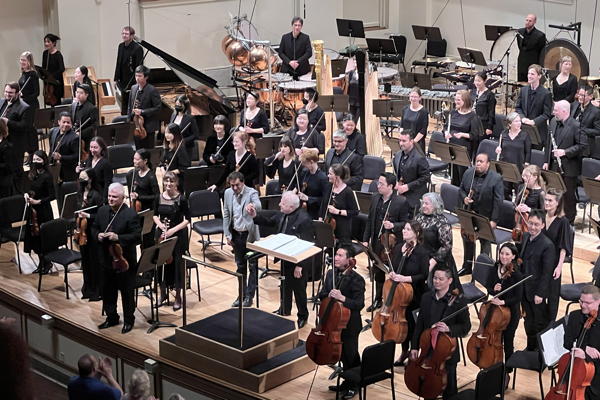
Sunday afternoon (January 21) Conductor Laureate Leonard Slatkin led the St. Louis Symphony Orchestra (SLSO) in a mostly glorious conclusion to their three-concert series of works celebrating the intersection of classical and what Slatkin calls “vernacular” music—a term he uses for jazz, folk, spirituals, theatre, and popular music in general. Sunday, though, the emphasis was firmly on jazz and its progenitor, ragtime.

[Find out more about the music with my symphony preview.]

The afternoon opened with a literal bang in the form of the cymbal crash that begins “A Joplin Overture” by American composer and critic Paul Turok (1929–2012). Written in 1973 and first played by Slatkin and the SLSO the following year, it’s mostly a series of expansions on themes from “The Entertainer, A Rag Time Two Step" by Scott Joplin (1868–1917) that lead to a brief coda in which a series of Joplin tunes get together for a rousing finale. Turok’s colorful orchestration and somewhat whimsical approach to Joplin’s themes combine to create a work that is, appropriately, entertaining.

Like all but the final work on the program (the ever-popular “Rhapsody in Blue”) this was a piece that was essentially brand new to the orchestra, none of whom were around in 1974. Nevertheless, they played with skill and panache under Slatkin’s knowing direction.

The Aaron Diehl Trio takes a curtain call
L-R: Aaron Diehl, David Wang, Aaron Kimmel

Next was the chamber orchestra version of the 1945 “Zodiac Suite” by pianist/composer Mary Lou Williams (1910–1981). The twelve movements depict both mystical aspects of the constellations and the personalities of the composer’s friends based on their birth signs. 

Originally composed for jazz trio (and recorded in that version by Williams), the suite was arranged for jazz trio and chamber orchestra by Williams with input from composer/arranger Milt Orent (1918–1975), and had its premiere in the format on New Year’s Eve 1945. The performance was poorly rehearsed and got lukewarm reviews, and the work fell into neglect.

Which, based on what we heard Sunday, is a serious injustice. The “Zodiac Suite” is a stunning integration of ideas from both the classical and jazz worlds. The suite is a virtual history of early 20th century music, from boogie-woogie and swing to French Impressionism and even Hollywood film scores. It’s as though Williams took every sound that was in the air for the first half of the century and turned them into her personal musical kaleidoscope.

To pick just a few examples, “Cancer” develops a smoky slow blues over a rolling piano bass line that could have come from Rachmaninoff. “Leo” kicks off with a brassy Hollywood fanfare that gives way to a melting violin solo (neatly done by Concertmaster David Halen) with a lush orchestral backdrop. “Scorpio” uses “exotic” percussion sounds (mallets on the snare drum) and syncopation in a way that seems to anticipate Les Baxter’s 1951 “Quiet Village.” “Capricorn” showcases the winds with Debussy-esque harmonies. And it all wraps up with an elegant jazz waltz in “Pisces.”

With its rich harmonic inventiveness and fine performances by Slatkin, the SLSO musicians, and the Aaron Diehl trio (Diehl on piano with David Wang on bass and Aaron Kimmel on drums), the “Zodiac Suite” was, at least for me, the absolute highlight of a concert in which there was no shortage of wonderful moments. It was warmly received, resulting in a dynamic encore from the Diehl trio, featuring impressive solos by Wang and Kimmel.

There were also plenty of opportunities for members of the orchestra to shine in the work that opened the second half of the concert, the delightfully frivolous score of “Krazy Kat, a Jazz Pantomime” written in 1921 by John Alden Carpenter (1876–1951). Based on the wildly imaginative comic strip of the same name, the 1922 New York premiere of “Krazy Kat” had sets and costumes by the strip’s creator George Herrimann and a scenario based on the strip’s absurd love triangle of the eponymous gender-fluid cat, the brick-tossing mouse Ignatz, and the stolid Offisa Pup, a police dog dedicated to protecting Krazy from Ignatz.

"Krazy Kat" ballet, 1922
Source unknown

There’s not that much jazz in the piece, but there is plenty of cheerful Loony Tunes anarchy. The music changes moods, meters, and styles in rapid series of sonic “jump cuts” that might be a challenge for a lesser orchestra or conductor, but seemed more like a playground for Slatkin and company. The many brief solo bits came off perfectly, with fine stuff from (among others) harpist Megan Stout, piccolo player Ann Choomack, Principal Flute Matthew Rothstein, Nathan Nabb on soprano sax, pianist Peter Henderson, Associate Principal Bassoon Andy Gott, and Associate Principal Trombone Amanda Stewart. Slatkin kept it all running smoothly and didn’t miss a moment of the score’s humor.

The afternoon concluded Gershwin’s massively popular “Rhapsody in Blue” in the 1942 full orchestra version by Ferde Grofé. As Slatkin noted in his introduction, 2024 marks the 100th anniversary of the work’s premiere and the 50th anniversary of the recording by Slatkin and the SLSO as part of their Vox Box of Gershwin’s complete works for orchestra and piano and orchestra. It was not only the first time all of that music had been recorded, but it was also the first of a long series of recordings Slatkin did with the orchestra—recordings that very much helped to raise the SLSO’s profile.

That made it something of a sentimental event for both Slatkin and the audience, so Jeffrey Siegel, who recorded it with the orchestra back in 1974, no doubt seemed a logical choice for the part this time. Sadly, based on what we heard Sunday, this turned out not to be an ideal decision. The piano part of the “Rhapsody” is a testimony to Gershwin’s skill as a keyboard virtuoso and while Siegel was more than up to that challenge fifty years ago (as you can clearly hear in his recording), that no longer appears to be the case.

Slatkin and the orchestra were in top form at least. Principal Clarinet Scott Andrews nailed that famous opening glissando, giving it a real ‘20s jazz feel. Ditto Principal Trumpet Steven Franklin. The saxophone trio Nathan Nabb, Zach Stern, and Joel Vanderheyden (two altos and a tenor, respectively) came through loud and , but at least from our seats all the way on house right, Steven Schenkel’s banjo was swamped. That’s one of the reasons I prefer the jazz band version, but to each their own. The sound was lush and clear in any event, and Slatkin did an excellent job of maintaining the delicate balance between orchestra and soloist.

In his comments earlier in the evening, Slatkin pointed out that this two-week series was mostly about the way jazz made its way into the concert hall in the years running up to “Rhapsody in Blue,” making that work the culmination of the process rather than the beginning of it, as is popularly assumed. The variety of his musical selections and the quality of the performances have made that point admirably, in my view.

This series was also a reminder of what so many of us loved about the “Slatkin Years”: the combination of eclectic and imaginative programming with the deep connection between him and the orchestra. Despite the fact that the 2024 SLSO is a completely different group from the 1974 SLSO, that bond is still there. And Leonard Slatkin remains a St. Louis treasure.

If you missed this concert, never fear: it was recorded and will be broadcast this Saturday, January 27, at 7:30 pm on St. Louis Public Radio and Classic 107.3 and will be available for streaming for a limited time at the SLSO web site.

Next from the SLSO: Music Director Stéphane Denève returns to conduct the SLSO and actor Ken Page in Poulenc’s ballet “Les animaux modèles” (“The Model Animals”), Roussel’s ballet “Le Festin de l’araignée” (“The Spider’s Feast”), and Prokofiev’s “Peter and the Wolf.” In an interesting change-up, Prokofiev’s work will be performed without the usual narration but with Suzie Templeton’s animated 2006 film, while the Poulenc will be performed with Page reading contemporary translations of the La Fontaine fables that inspired the composer.  Performances will be Saturday at 7:30 pm and Sunday at 3 pm (January 27 and 28) at the Stifel Theater downtown.

This article originally appeared at 88.1 KDHX, where Chuck Lavazzi is the senior performing arts critic.

Thursday, January 18, 2024

Symphony Preview: The SLSO goes Krazy for Gershwin (among others)

This Saturday and Sunday (January 20 and 21) St. Louis Symphony Orchestra (SLSO) Conductor Laureate Leonard Slatkin concludes his two-week, four-concert series with the ensemble he led from 1979 to 1996. Both concerts are at the Touhill Performing Arts Center. Here’s what to expect.

[Preview Sunday's music with the SLSO's Spotify playlist.]

Slatkin and the SLSO Youth Orchestra
Photo: Dilip Vishwanat

On Saturday at 7:30 pm, Slatkin conducts a joint concert by members of the SLSO and the St. Louis Symphony Youth Orchestra—a group he founded back in 1970. That makes it an event with a special meaning for him. “For me,” he said in a recent interview, “it will be one of those moments where I hope I don’t lose it just because I see people on stage who could be my grandchildren.”

The program consists of three audience favorites that need very little introduction. It begins with the “Academic Festival” Overture by Johannes Brahms (1833–1897), written in 1880 as a tribute to the University of Breslau which had just awarded him an honorary degree.

Not that it was strictly voluntary, mind you. Brahms had intended to send a nice “thank you” note but Bernhard Scholz, Director of Music in Breslau, insisted on an actual composition for the solemn occasion. The composer’s ironic response was a complex piece scored for a huge orchestra and consisting mostly of a fantasy on student drinking songs, concluding with a majestic setting of “Gaudeamus igitur” (“So let us rejoice,” preferably with a stein of beer). We don’t often think of Brahms as a jolly fellow, but the “Academic Festival” Overture just overflows with good cheer. Prosit!

Next, it’s “A Lincoln Portrait” by Aaron Copland (1900–1990). Written in a burst of patriotic fervor after the Pearl Harbor attack, it premiered in Cincinnati in 1942 with André Kostelanetz at the podium and local actor William Adams reading the narration. It's stirring stuff, blending Copland's spacious music with Lincoln's inspiring words. Saturday’s narrator is Kevin McBeth, Director of the St. Louis Symphony IN UNISON Chorus.

The concert concludes with a certified rouser: “Francesca Da Rimini: Symphonic Fantasy after Dante,” op. 32, composed in 1876 by Pyotr Ilyich Tchaikovsky (1840–1893). It was inspired by the story from Canto V of Dante’s “Inferno” about Francesca da Rimini (original name Francesca da Polenta), a real noblewoman in 13th-century Italy. Her husband caught her in flagrante delicto with his brother and murdered them both. This being the medieval moral universe, it was Francesca and her lover who ended up in the second circle of hell rather than her homicidal spouse.

Tchaikovsky’s musical evocation of the circle, in which sinners are buffeted about by tempestuous winds, is colorfully dramatic. In “Inferno,” Dante is so moved by Francesca’s story that he falls “as a corpse might fall, to the dead floor of Hell.” Tchaikovsky portrays that in a violent, impassioned coda with multiple brass chords and cymbal crashes echoing the poet’s collapse. It never fails to get applause.

Paul Turok
Photo courtesy of the SLSO

On Sunday at 3 pm, it’s the regular SLSO in the last of three programs examining the influence on the classical canon of what Slatkin calls “vernacular music”—a term he uses for jazz, folk, spirituals, theatre, and popular music in general. Sunday, though, the emphasis is firmly on jazz and its progenitor, ragtime.

The concert opens with “A Joplin Overture” by American composer and critic (!) Paul Turok (1929–2012). Composed in 1973 and first played by Slatkin and the SLSO the following year, this short work (according to Daniels’ Music Online) “appears to be the beginning and ending of Turok's Great Scott!— Orchestral Suite after Scott Joplin, spliced together. Joplin's famous rag The Entertainer is prominent.” I can’t find any recordings of either work anywhere, so I’ll just have to take their word for it.

Grove Online describes Turok’s music as “mainly conservative, characterized by accessible, memorable themes, a restrained but expressive use of dissonance, and a masterful handling of tone color and sonority.” Sounds like a good match for St. Louis’s own King of Ragtime.

Next, it’s music by a composer with impeccable jazz credentials, Mary Lou Williams (1910–1981). A highly regarded pianist, arranger, and composer, Williams was something of a keyboard prodigy. Encouraged by her stepfather Fletcher Burley, she became proficient enough by the age of 12 to start sitting in with local bands and even touring on the segregated TOBA vaudeville circuit.  TOBA officially stood for Theatre Owners Booking Association, but blues singer Gertrude “Ma” Rainey more accurately called it Tough on Black Asses due to lower salaries and less desirable theatres.

Mary Lou Williams
by William P. Gottlieb 
Public Domain

That was all in the past when she started work on her “Zodiac Suite” in 1942, however. Williams had moved on to the Big Time, appearing as a headliner at Barney Josephson’s Café Society in Greenwich Village, recording exclusively for Moe Asch’s Asch label, and, by the time the suite had its first performance in 1945, hosting “Mary Lou Williams’ Piano Workshop” on AM jazz station WNEW. She would later retire from performing and concentrate on composing religious works before returning to the secular jazz scene with her 1975 album “Zoning.” In 1977 she became artist-in-residence at Duke University, a position she held until her death.

All twelve movements of the “Zodiac Suite” depict mystical aspects of the constellations, reflecting Williams’s interest in astrology. Eleven of them also reflect the personalities of the composer’s contemporary jazz musician friends based on their birth signs.  Ten of the eleven movements we’ll hear Sunday are portraits of: Billie Holiday and tenor saxophonist Ben Webster (“Aires”), Duke Ellington (“Taurus”), trumpeter Shorty Baker ("Gemini"), alto saxophonist Lem Davis (“Cancer”), jazz legends Art Tatum, Dizzy Gillespie, Bud Powell, Thelonious Monk, Charlie Parker and John Coltrane ("Libra"), trombonist Vic Dickenson (“Leo”),  Ethel Waters (“Scorpio”), pianist Eddie Heywood (“Sagittarius”), dancer/choreographer Pearl Primus and trumpeter Frankie Newton (“Capricorn”), and Eartha Kitt and singer/guitarist/civil rights advocate Josh White (“Aquarius”).

“Virgo” is apparently just Virgo.

Originally composed for the traditional jazz trio of piano, bass, and drums, the suite was expanded by Williams in 1946 to include a chamber orchestra and more closely integrate contemporary jazz and classical music, including (according to Linda Dahl’s 1999 biography of Williams) the work of composers like Ellington, Stravinsky, Hindemith, and Bartók. I haven’t been able to find a recording of that version anywhere, but the SLSO Spotify playlist does have the Smithsonian/Folkways 1995 re-issue of the composer’s own 1945 recording for Asch. Pianist Aaron Diehl (who recorded the suite with The Knights last year) will head to jazz trio on Sunday, with David Wong on bass and Aaron Kimmel on drums.

George Herrimann, 1922
By George Herriman - Entre Comics
Public Domain

After intermission, it’s fifteen minutes of frivolity with “Krazy Kat, a Jazz Pantomime” written in 1921 by John Alden Carpenter (1876–1951). Like his contemporary Charles Ives (1874–1954), Carpenter was interested in bringing vernacular sounds into the concert hall. However, he did so in a less radical fashion, writing in a relatively conservative style with strong elements of French Impressionism. Also like Ives, Carpenter had substantial formal training but made his living primarily in the business world—specifically in his father’s Chicago ship chandlery, George B. Carpenter & Co.

Based on the wildly imaginative comic strip of the same name, “Krazy Kat” had sets and costumes by the strip’s creator George Herrimann and a scenario based on the strip’s absurd love triangle of the eponymous gender-fluid cat (sometimes Krazy is male, sometimes female, at the cartoonist’s whim; today it would probably be banned in Florida), the brick-tossing mouse Ignatz, and the stolid Offisa Pup, a police dog dedicated to protecting Krazy from Ignatz. The strip’s visual and linguistic inventiveness, while baffling to many readers, strongly influenced the next generation of cartoonists—most notably Walt Kelly, the creator of “Pogo.”

The music is appropriately cartoonish in a way that will be familiar to admirers of Carl Stalling’s Warner Brothers animation scores, but there isn’t much in it that most of us would now think of as “jazz” aside from the frenetic chase scene near the end. Never mind; it’s all great fun. And this will be the first time it has been heard here since the SLSO played it way back in 1923 under the baton of guest conductor Frederick Fisher.

Sunday’s concert, like the first two in the series, concludes with music of George Gershwin. This time it’s the composer’s first foray into the concert hall, the popular “Rhapsody in Blue.” It was first performed as the finale of "An Experiment in Modern Music," as bandleader Paul Whiteman billed the February 12, 1924, concert by his Palais Royal Orchestra at New York's Aeolian Hall. The “Rhapsody” was the most memorable piece to emerge from Whiteman's experiment although there were some other fun nuggets in it as well. You can hear them on Spotify in a recreation of the entire concert under the baton of Maurice Peress that was released in 1987. 

Commemorative Gershwin stamp, 1973
USPS, Public Domain

With the composer at the piano, that first performance must have been quite an event, especially since Gershwin hadn’t gotten around to writing down the entire solo part. “We can assume,” writes Peress, “that Gershwin improvised, for the score does contain a humorous warning for Whiteman, ‘Wait for the nod…,’ just before the entrance of the lovely slow theme, andantino moderato.”

Although Gershwin would orchestrate his later concert works, it was composer Frede Grofé (best known for his “Grand Canyon Suite”) who did the arrangement for that first concert, tailored specifically for Whiteman’s jazz band. Grofé would later do several orchestrations of the “Rhapsody” the last of which, for full symphony orchestra, was published in 1942, five years after the composer’s death. That was the only arrangement available until 1971, when Samuel Adler and the Berlin Symphony recorded a reconstruction of Whiteman’s original. Peress would later use that as the basis for his own 1987 version.

That said, what we’ll hear Sunday is the 1942 version, as that’s what Slatkin, pianist Jeffrey Siegal (also the soloist this time), and the SLSO used for their 1974 recording. Since then the SLSO has performed both versions and recorded the jazz band original with David Robertson and Kirill Gerstein for Myrios in 2018.  The saxophones and banjo from the original are also there as optional instruments in what Peress calls “the Hollywood Bowl version”; it’s just that some care is necessary to prevent the full orchestra from swamping them. Somehow, I doubt that’s going to be an issue for Slatkin.

The Essentials: Leonard Slatkin conducts the St. Louis Symphony Orchestra, St. Louis Symphony Youth Orchestra, and narrator Kevin McBeth in music by Brahms, Copland, and Tchaikovsky on Saturday, January 20, at 7:30 pm. On Sunday, January 21, at 3 pm Slatkin conducts the orchestra and piano soloist Jeffrey Siegel in Gershwin’s “Rhapsody in Blue” along with music by Paul Turok, Mary Lou Williams, and John Alden Carpenter. Both concerts take place at the Touhill Center on the University of Missouri—St. Louis campus. The Sunday concert will be broadcast on St. Louis Public Radio on Saturday, January 27,  at 7:30 pm.

This article originally appeared at 88.1 KDHX, where Chuck Lavazzi is the senior performing arts critic.

Monday, January 15, 2024

Symphony Review: A hot time in the cold town with Slatkin and the SLSO

Before he started his pre-concert chat with the audience at the St. Louis Symphony Orchestra (SLSO) concert Saturday night (January 13) Conductor Laureate Leonard Slatkin smiled and said, “Look how many of you made it!”

[Find out more about the music with my symphony preview.]

He was referring to the fact that despite a light snowfall and Antarctic wind chill values, the Busch Concert Hall at the Touhill Center was packed (it was officially sold out, but bad weather always results in some no-shows). The audience was rewarded for braving the deep freeze by an impeccably  performed and consistently entertaining program of music from (mostly) the 1920s.

La création du monde

It was second of three concerts demonstrating the influence of what Slatkin calls “vernacular music”—jazz, folk, spirituals, theatre, and popular music in general—on the classical canon. It consisted of three infrequently heard works by European composers inspired by American jazz and dance tunes and was followed by one big whopping hit by an American composer inspired by a visit to Paris. It would have gotten serious points for variety even if it hadn’t been so well done.

It all started with the 1923 ballet “La création du monde” (The Creation of the World) by Darius Milhaud (1892–1974), a work heavily influenced by the composer’s brief infatuation with jazz and ragtime (even though the latter was in its sunset years by then).  With a scenario by Blaise Cendrars based on the poet’s 1922 collection of African folk tales, the ballet featured Picasso-esque sets and costumes by Fernand Léger that looked impressive but were clumsy and awkward for the dancers. Which may explain why “La création du monde” is rarely seen but often heard.

Scored for a small wind ensemble, percussion (including a typical jazz drum kit), and a string quartet with the alto sax replacing the viola, it’s a piece in which every player can be clearly heard. But it’s also one in which quasi-independent instrumental lines often converge into what could, in less skilled hands, turn into mere cacophony. That makes it a bit of a challenge for both the players and the audience.

Section I, with its fast-moving fugue, is a good example. Keeping the individual lines clear here looks tricky in the score, but Slatkin and the musicians kept everything clearly delineated. This is music that requires close attention by the listener, and this neatly balanced performance made that easy. The roster of fine performers included Nathan Nabb on sax, Peter Henderson on piano, Kevin Ritenauer on the drum kit, and Jelena Dirks on oboe.

Ebony Concerto

Parenthetical note: the tune of the oboe’s soulful, blues-drenched solo sounded so much like the one Gershwin wrote for his Concerto in F two years later that I suspect Milhaud’s theme might have been on his mind at the time.

Jazz was certainly on the mind of Igor Stravinsky (1882–1971) in 1945 when he wrote his brief “Ebony Concerto” for clarinetist Woody Herman and his band. It crams a lot of musical variety into its ten minutes without overwhelming the listener with its ingenious mix of 1940’s jazz and the composer’s neoclassicism.

It also defies expectations by using the soloist more as a featured member of the band than as an individual player. There were long stretches in which SLSO Principal Clarinet Scott Andrews was more observer than participant, with prominent musical roles taken over by the large sax section. Still, when Andrews was given the chance to cut loose and strut his stuff, he did so beautifully, showing his wide expressive and dynamic range. I don’t often think of Stravinsky’s neoclassical works as being “fun,” but I can’t think of a better way to describe this one.

Intermission and another stage change brought the “Kleine Dreigroschenmusik” (“Little Threepenny Music”) by Kurt Weill (1900–1950). Scored for a 1920’s dance band with a bandoneon (a conertina much favored by Agentine tango composers) added for a bit of spice, it’s a suite of tunes from Weill and Bertolt Brecht’s 1928 “play with music” “Der Dreigroschenoper” (“The Threepenny Opera”) that the composer put together in 1929 at the request of legendary conductor Otto Klemperer. Without Bertolt Brecht’s pungent lyrics, most of the tunes sound deceptively cheerful, although even without its words, the “Kanonensong” (“Canon Song”) still feels dark and threatening.

Slatkin and the band gave us a performance marked by crisp, precise playing, careful attention to Weill’s small touches of humor, and more outstanding solo work. A tip of the hat is also due to Winnie Cheung on bandoneon. Her instrument is only called for in three of the eight movements, but the obvious joy in her performance was contagious.

Kleine Dreigroschenmusik

When Weill and Brecht were completing work on “Der Dreigroschenoper” George Gershwin (1898–1937) was putting the finishing touches on the work that concluded Saturday night’s show, “An American in Paris.” As someone who loves visiting the City of Light, I have to say that Gershwin did a bang-up job of capturing city's lively sidewalk cafes and bustling boulevards as well as (in the blues-infused central section) the charm of Paris at night.

Slatkin could probably conduct this score blindfolded at this point. His 1974 recording with the SLSO (“that orchestra is all gone now,” he quipped, “but the conductor is still here”) is one of the best you can buy, especially in the digitally remastered version that came out last summer. His performance Saturday night was a perfect balance of lush romanticism and a scrupulous attention to orchestral detail. It was the perfect way to end an evening that was both engaging and revelatory.

As a bonus, we got an encore: an orchestration by Leonard Slatkin’s father Felix (1915–1963), the St. Louis-born violinist and concertmaster for Twentieth Century Fox Studios, of Alfred Newman’s main theme for the 1943 film “The Song of Bernadette.” It features prominent solos for the violin and cello which, on the original soundtrack, were played by Leonard Slatkin’s father and mother (Eleanor Aller). 

Saturday night those parts played with great warmth by concertmaster David Halen and Principal Cello Daniel Lee. Newman’s music was shamelessly moving as only a vintage Hollywood score can be, especially when played this well. The arrangement was reconstructed from the soundtrack (a major accomplishment all by itself) by Leonard Slatkin's wife, composer Cindy McTee.

Finally, here’s a laurel wreath for the stage crew. Saturday’s concert effectively featured four different ensembles: Milhaud’s augmented quartet, Stravinsky’s 1940’s big band (plus harp), Weill’s 1920’s cabaret band, and Gershwin’s big, late Romantic orchestra. That meant three big stage changes with the biggest of the lot (from Weill to Gershwin) taking place while the audience watched. It’s a tribute to their professionalism that these changes all went quickly and smoothly, with the precision of a well-oiled machine.

Next from the SLSO: Leonard Slatkin and the orchestra return to the Touhill for two concerts. Slatkin conducts a joint performance by the orchestra and youth orchestra on Saturday, January 20, at 7:30 pm, with music by Brahms, Copland, and Tchaikovsky. On Sunday, January 21, at 3 pm, Slatkin conducts the orchestra and pianist Jeffrey Siegel in Gershwin’s “Rhapsody in Blue” in a program that also includes John Alden Carpenter’s “Krazy Kat” ballet, Paul Turok’s “A Jopin Overture,” and selections from Mary Lou Willams’s “Zodiac Suite” with guest artists The Aaron Diehl Trio.

This article originally appeared at 88.1 KDHX, where Chuck Lavazzi is the senior performing arts critic.

Thursday, January 11, 2024

Symphony Preview: And (almost) all that jazz

This Saturday (January 13) St. Louis Symphony Orchestra (SLSO) Conductor Laureate Leonard Slatkin presents the second of three concerts demonstrating the influence of what Slatkin calls “vernacular” music—jazz, folk, spirituals, theatre, and popular music in general—on the classical canon. In the first half of Saturday’s concert, the emphasis is on jazz.

[Preview the music with the SLSO's Spotify playlist.]

Darius Milhaud, 1923
By Agence de presse Meurisse
Public Domain

The evening opens the ballet “La création du monde” (The Creation of the World) by Darius Milhaud (1892–1974). A member of that group of somewhat eccentric French anti-Romantic composers known as "les six" (the others were Francis Poulenc, Arthur Honegger, Georges Auric, Germaine Tailleferre, and Louis Durey), Milhaud enjoyed a brief infatuation with jazz that began with a 1920 performance of the Billy Arnold Jazz Band in London and reached its apex during a USA tour two years later when the composer heard jazz bands in Harlem.

“The music I heard was absolutely different from anything I had ever heard before and was a revelation to me” he wrote in his 1953 biography “Notes Without Music.”

Against the beat of the drums the melodic lines crisscrossed in a breathless pattern of broken and twisted rhythms... Its effect on me was so overwhelming that I could not tear myself away… When I went back to France, I never wearied of playing over and over, on a little portable phonograph shaped like a camera. Black Swan records I had purchased in a little shop in Harlem. More than ever I was resolved to use jazz for a chamber work.

“La creation” was the result of that resolution. Upon his return to Paris Milhaud got in touch with Blaise Cendrars, who had published Anthologie nègre (a collection of African folk tales) the year before. Cendrars’s scenario involved “giant gods, trees which impregnate the earth with their seed, leaves transformed into animals, men and girls emerging from the trees and performing a mating dance, until they disperse, leaving a single couple on stage, united in love.” Milhaud’s score, for a band of 19 soloists, makes prominent use of the piano, sax, and percussion.

It went over well enough in jazz-infatuated Paris but, as Svend Brown wrote in program notes for a 2007 performance of the score by the St. Paul Chamber Orchestra, the ballet “was more a chic succès de scandale than a true success. The costumes designed by Fernand Léger (who also created the set) worked magnificently visually, but were hell to dance in—heavy and inflexible, they made it difficult to move freely.”

Woody Herman, 1943
By General Artists Corporation-management 
Public Domain

Which may explain why “La création du monde” is rarely seen but often heard. The small size of the ensemble will be a test of the SLSO’s mettle, but it will also offer an opportunity for many of the section principal players to shine.

Speaking of which, SLSO Principal Clarinet Scott Andrews steps into the spotlight next in the “Ebony Concerto” by Igor Stravinsky (1882–1971). Written in 1945 for Woody Herman and his band The Herd (who premiered it in 1946 at Carnegie Hall), it’s a pithy work that crams a lot of musical variety into its ten minutes without overwhelming the listener. Yes, it’s jazzy, but it’s jazz heard through a heavy Stravinsky filter.

That filter made things a bit challenging for Herman and The Herd. “The piece was extremely difficult and the band struggled mightily,” writes an anonymous author at the Carnegie Hall web site. “After the first rehearsal,” recalls Herman, “we were all so embarrassed [that] we were nearly crying.” Check out the YouTube video of the recording by Pierre Boulez and the Ensemble InterContemporain with its synchronized display of the score to see the kind of thing that made grown men cry.

Fortunately, it all came together at the concert, which also included plenty of The Herd’s popular hits.

Kurt Weill and Lotte Lenya, 1942
By Wide World Photos
Public Domain

Next, we head back to the theatre for the “Kleine Dreigroschenmusik” (“Little Threepenny Music”) by Kurt Weill (1900–1950). Scored for winds and percussion, it’s a suite of tunes from Weill and Bertolt Brecht’s 1928 “play with music” “Der Dreigroschen Oper” (“The Threepenny Opera”) that the composer put together in 1929 at the request of legendary conductor Otto Klemperer. In fact it’s Klemperer who conducts the performance on the SLSO’s Spotify playlist

Without the bitterly satirical lyrics that Brecht wrote for them, Weill’s suite is a mix of a half dozen appealing “ear worms” marinated in the spirit of 1920s popular song and dance and bookended with a dramatic overture and finale. But the suite’s accessibility doesn’t necessarily mean that Weill’s motivation in creating the site was largely mercenary.

Weill might have felt that his music would be more properly appreciated outside of the theatre, where he could use a larger ensemble and rely on the skills of conservatory-trained musicians. Given the success of his theatrical works, it’s easy to lose sight of the fact that he had studied composition with Ferrucio Busoni and wrote extensively for the concert hall before he embraced the stage.

When Weill and Brecht were completing work on “Der Dreigroschen Oper” George Gershwin (1898–1937) was putting the finishing touches on his first major orchestral work, “An American in Paris,” which closes Saturday night’s concert. Begun during a trip to Paris two years earlier, the work is a reminder of just how much solid craftsmanship lurks behind Gershwin’s irresistible tunes.

Gershwin in 1937
Photo: Carl Van Vechten
en.wikipedia.org

In a 1928 interview for Musical America Gershwin described “An American in Paris” as “a rhapsodic ballet” intended “to portray the impressions of an American visitor in Paris, as he strolls about the city, listens to the various street noises, and absorbs the French atmosphere." As someone who has visited Paris several times and who has fallen in love with the City of Light, I’d say he succeeded completely.

The lively opening with its colorful evocation of the city's sidewalk cafes and bustling boulevards (complete with honking taxi horns in the percussion section) is a masterful bit of musical imagery. And the bluesy central section evokes not only the homesickness of the traveler but also the charm of Paris at night.

Plus, Gershwin’s orchestration is a reminder of how far he came in such a short period of time. This is, after all, a guy who went from being a Tin Pan Alley "song plugger" to an accomplished composer and orchestrator in only thirteen years. In another seven years he would write one of the mainstays of twentieth-century American opera, "Porgy and Bess.” Not shabby.

Slatkin and the SLSO recorded “An American in Paris” 50 years ago as part of the orchestra’s multi-LP set of Gershwin’s complete orchestral works for Vox (now available in digitally remastered format on ArchivMusic). Although the SLSO’s playlist for this Saturday’s concert does not feature that recording (opting instead Leonard Bernstein’s sonically dated version from 1959), it is also available on Spotify

The Essentials: Leonard Slatkin conducts the St. Louis Symphony Orchestra and clarinet soloist Scott Andrews in works by Darius Milhaud, Igor Stravinsky, Kurt Weill, and George Gershwin on Saturday, January 13, at 7:30 pm at the Touhill Performing Arts Center on the University of Missouri-St. Louis campus. For more information, visit the SLSO web site.

This article originally appeared at 88.1 KDHX, where Chuck Lavazzi is the senior performing arts critic.

Tuesday, January 09, 2024

Symphony Preview: Mass in the vernacular

This Friday (January 12), St. Louis Symphony Orchestra (SLSO) Conductor Laureate Leonard Slatkin steps up to the podium in the Touhill Center to present the first of a three-concert series that, as he said in a recent interview with yours truly, “focuses on the intersection between vernacular and, for lack of a better term, classical music.”

[Preview the music with the SLSO's Spotify playlist.]

By “vernacular,” he means pretty much anything that isn’t part of the “classical” canon—jazz, folk, spirituals, theatre, and popular music in general. It’s a broad category but, as anyone who has listened to Slatkin’s radio show “The Slatkin Shuffle” knows, his musical interests are nothing if not eclectic.

Antheil and some Ballet Mécanique "noisemakers"
By Unknown author - Unknown Newspaper
Public Domain 

That’s clear from the very beginning of the program Friday morning, January 12, as the orchestra delivers a jolt of sonic caffeine in the form of the 1955 revision of the 1925 “Jazz Symphony” by American composer George Antheil (1900–1959). Episodic and only twelve minutes long, it’s not really a symphony and not, for the most part, especially jazzy. It is, however, raucous, cheerfully vulgar, and often a bit wacky in a way that anticipates the cartoon soundtracks of Carl Stallings.

First performed as part of a 1927 Carnegie Hall concert that included his infamous “Ballet Mécanique” (the 1925 Paris premiere of which caused riots that may or may not have been staged), the “Jazz Symphony” was performed by the Harlem Sinfonietta under W.C. Handy (composer of “The St. Louis Blues”). The performance went over well with both critics and fellow composers like Gershwin and Copland but was overshadowed in the press by equipment failures during “Ballet Mécanique” that turned what might have been a succès de scandale into something more akin to a Marx Brothers movie

But I digress. The slightly tamer 1955 version of the “Jazz Symphony” is still pretty wild and wooly, but if you’d like to hear what the original sounds like it’s available at Spotify.

Composer Jeff Beal

Up next is “Body in Motion,” a violin concerto by Jeff Beal (b. 1963). As this is the work’s world premiere, I have no idea what it will sound like. So the best I can do is to quote the composer, as cited in this weekend’s program notes:

The first image that came to me when developing the materials for this new violin concerto was one of water. I love the way water presents a visual tension between the hypnotic, peaceful, and—in the case of a windy lake or sea—a sense of constant, fluid motion. I began to think of both the orchestra and soloist as active natural forces.

Beal is probably best known for his music for the TV series "House of Cards," but he also has extensive film and more recently, concert credits. Local audiences may recall SLSO’s world premiere of his song cycle “The Paper-Lined Shack” back in 2019. That was also conducted by Slatkin whom Beal (in a 2019 interview with me) descried as “an important mentor in my life.… His parents were very involved with film music, so he's not afraid to reach out to a film composer to write a piece of concert music. That's very special to me.”

More to the point, as far as Friday’s concert goes, is this quote: “I really feel—and I know Leonard feels this way too—that the more we can break down the barriers between "high" art and "low" art and the more we can have the story telling drive what gets played, I think that's the way music is going. I'm not the only one doing this and it's nice that this is starting to happen.”

Duke Ellington, 1973
By Hans Bernhard (Schnobby)
Own work, CC BY-SA 3.0

Another St. Louis premiere is next: “Three Black Kings,” the last composition by the legendary Edward Kennedy "Duke" Ellington (1899–1974). Left uncompleted at the time of his death, the three-movement suite was described by his son Mercer (who finished the work, along with Luther Henderson) as a musical eulogy to Dr. Martin Luther King Jr., who had been assassinated six years earlier. Dr. King is the last of the three titular kings, the first two being “King of the Magi” (specifically Balthazar) and “King Solomon.”

Balthazar’s music is energetic and restless, driven by a four-note xylophone ostinato later taken up by the full orchestra. The prominent role for percussion suggests a kind of primitivism, while the insistent rhythmic drive reminds us of the long journey of the three magi. As the scene shifts to King Solomon, the music becomes more lyrical and romantic, possibly indicating that Ellington was thinking of Solomon’s hundreds of wives and concubines.

Dr. King’s music is marked as “Slow Gospel, 4 beat,” but the 12/8 rhythm gives it an extra bit of swing that makes me think of the choir swaying back and forth at a church service. It rises to heroic heights, which seems only appropriate for one of the more well-known of the far too numerous martyrs to the cause of racial justice in the USA.

“It’s kind of like three little tone poems,” said Slatkin in our interview.  “I've done it now a couple times. Extraordinary man, extraordinary thinker.” Too true.

Friday’s concert concludes, as does each of the three in the series, with the sounds of George Gershwin. That’s partly a nod to Gershwin’s importance in bringing jazz and other vernacular sounds to the concert hall and partly a tribute to the 1974 recording of Gershwin’s complete orchestral works that Slatkin did with the SLSO. Although these have never been out of print, the ArchivMusic reissue from this past June has been remastered in 192kHz / 24-bit high definition. Whether it’s still in the original surround sound format (or quadraphonic, as they called it Back in the Day), I have no idea.

That said, the work you’ll hear Friday wasn’t part of those historic recordings. It’s “Porgy and Bess: A Symphonic Picture,” written in 1942 by Robert Russell Bennett (1894–1981), who is probably best known for the many orchestrations he did for Broadway and Hollywood musicals. It’s relatively faithful to Gershwin’s own orchestrations of what is arguably his masterpiece, but I’m a bit baffled as to why we’re not hearing the suite that was recorded back in 1974: the composer’s own “Porgy and Bess” suite from 1936.

It's always possible that with two local premiers already on the bill and one work (“Three Black Kings”) that hasn’t been heard here in 1995, Bennett’s more familiar music seemed a better bet. In any case, it’s a great lineup. And you can always listen to Slatkin and the SLSO play "Catfish Row" on Spotify.

The Essentials: Leonard Slatkin conducts the St. Louis Symphony Orchestra and violin soloist Kelly Hall-Tompkins in works by George Antheil, Jeff Beal, Duke Ellington, and George Gershwin on Friday, January 12, at 10:30 am at the Touhill Performing Arts Center on the University of Missouri-St. Louis campus. For more information, visit the SLSO web site.

This article originally appeared at 88.1 KDHX, where Chuck Lavazzi is the senior performing arts critic.

Tuesday, April 25, 2023

Symphony Review: Fantasy with a Spanish flair as Slatkin conducts Joshua Roman and the SLSO

When he took the stage last Sunday afternoon (April 23rd), St. Louis Symphony Orchestra (SLSO) Conductor Laureate Leonard Slatkin noted that this would be his last appearance on “this particular version” of the Powell Hall stage. That’s because when the current season ends on May 14th, Powell will be closed for renovation and expansion until 2025, the building’s centennial year. When it reopens, the stage will look pretty much the same, but every aspect of it and the rest of the building will have been upgraded.

[Find out more about the music with my symphony preview.]

For his last appearance in the current version of Powell Hall, Slatkin picked a program that he described, with tongue firmly in cheek, as “very Slatkin-esque; or, as some of you might be saying, ‘oh, no, it’s one of those.’” It got a laugh, but it was also accurate in that the evening consisted of a couple of well-established mainstream works bracketing the local premiere of a contemporary piece. And, as I noted in my preview, all three share some points in common—another quintessential Slatkin touch.

The concert started with a sparkling performance of the lively “España,” composed in 1883 by Emmanuel Chabrier (1841–1894). It’s his most popular piece and even inspired at least two "borrowings": Emil Waldteufel's "España Waltz" in 1886 and the pop song "Hot Diggity (Dog Ziggity Boom)," which was a big hit for Perry Como in 1956.

Mason Bates and Leonard Slatkin

Aside from the “ear worm” status of its tunes, the most striking thing about “España” is the sheer ingenuity of the orchestration. Chabrier tosses the work’s two main themes back and forth among the various sections of the orchestra with breathtaking speed. He also alternates moments of sharply contrasting moods, as when a delicate harp duet (Allegra Lilly and Megan Stout) is repeatedly interrupted by the brass section. The result is something of a musical soccer game with the ball in constant motion.

Needless to say, this calls for both an orchestra and conductor who are, so to speak, fleet of foot. Sunday afternoon we had both, with a crisp, precise, and viscerally exciting performance by Slatkin and the band. Enthusiastic applause followed.

Thematic material got bounced around quite a lot in the next work, the “Anthology of Fantastic Zoology” by Mason Bates (b. 1977). Based on the “Book of Imaginary Beings” by one of the previous century’s premier Spanish-language writers, Jorge Luis Borges, it’s described by the composer as “a kind of psychedelic Carnival of the Animals.”

That’s not a bad analogy. Sure, the animals here are entirely mythical if not downright outré (e.g. the Zaratan, a ginormous sea turtle the size of an island) but that just gives Bates all the more opportunity to show off his genius as an orchestrator as well as his flair for the theatrical. That’s most apparent in the “Sprite” movement, where the short, quicksilver theme leaps from player to player and even to a pair of violins placed far stage right and stage left (they’re supposed to be offstage, but that would have rendered them inaudible at Powell). It’s a bit like Chabrier’s soccer game, but on amphetamines.

The first ten of the work’s eleven movements are an auditory funhouse. Each fantastic animal has its own unique and enticing musical profile, building steadily to “Sirens,” which Bates calls “the lyrical core of the piece.” In it, the not-quite-offstage violins trade a pair of themes which are gradually taken up by the entire orchestra, leading to a massive outpouring of ecstasy. The ecstasy mutates into agony as dissonant intervals are added to the mix until it all becomes a mass of tone clusters à la György Ligeti that represent the all-consuming Zaratan.

Wonderful stuff so far, but for me the work goes off the rails in the finale, “Madrugada” (the legendary “witching hour” between midnight and dawn). Bates describes this movement, in which “the entire work collapses upon itself,” as “sprawling.” I’d describe it as overwritten and discursive. Running over ten minutes (nearly a third of the work’s 30-minute running time), it vitiates much of the energy accumulated up to that point.

Still, it was great fun for the first 20 minutes or so and allowed the musicians of the SLSO to show off their virtuosity. Even without seeing the score, it’s clear to me that “Anthology of Fantastic Zoology” is (ahem) a beast to play and conduct. A special shout-out is due Principal Tympani Shannon Wood, playing ten instruments in what looks like a section of the “drum cage” he built for William Kraft’s Tympani Concerto back in 2016, but everybody in the band had a workout on this one. That included Slatkin, who held this massive structure together masterfully.

Joshua Roman and Leonard Slatkin

This was only my second exposure to a live performance of music by Mason Bates (the first was the world premiere of his opera “The (R)evolution of Steve Jobs” in Santa Fe back in 2017) and I was once again impressed by his originality and his ability to engage the audience without “writing down” to us. His is an eclectic and inventive voice that is very much welcome these days. I hope to see and hear more of his work here in the future. Meanwhile, he's well represented on both YouTube and Spotify for those of you interested in hearing more of that voice.

The concert concluded with another virtuoso orchestral showpiece with Spanish connections, “Don Quixote (Fantastic Variation in a Theme of Knightly Character)” by Richard Strauss (1864–1949). Written at around the same time as Strauss’s “Ein Heldenleben” (“A Hero’s Life”), “Don Quixote” balances the former’s triumph with a mix of comedy and tragedy—so much so that Strauss saw them (according to Grove Online) “as paired works, and suggested that they be performed together.” Given that Strauss notoriously saw himself as the protagonist of “Heldenleben,” I have to wonder if he saw the Don as another side of his personality.

Certainly it’s a sympathetic portrayal of Cervantes’s “knight of the woeful countenance”, with Quixote represented musically by the mellow, resonant tones of the cello. This past weekend’s soloist, Joshua Roman, proved more than equal to the task, clearly connecting with his character’s emotional arc. In an interview for St. Louis Public Radio earlier in the week, Roman talked about the importance of “becoming the Don,” something that could be seen in his face and heard in his playing.

That said, it wasn’t always easy to hear his instrument from our seats upstairs. His tone sounded a bit thin, and he was often swamped by the orchestra. Given that I did not notice these issues when I listened to the broadcast of Saturday’s concert, I’m inclined to chalk it all up to Powell Hall’s acoustics rather than to Roman’s performance.

Backing Roman up were Principal Viola Beth Guterman Chu as the loyal Sancho Panza, assisted by Concertmaster David Halen, Tim Myers on euphonium, and Tzuying Huang on bass clarinet. The give and take between Chu and Roman in “Variation III: Dialogue of the Knight and the Squire” was a pleasure to watch, as the progress of the conversation could be seen and heard in their performances. Chu’s Sancho argues, cajoles, and finally gives in as Roman’s Don remains cheerfully oblivious, head firmly in the clouds.

Next at Powell Hall: Stéphane Denève returns to conduct Gabriela Lena Frank’s “Apu,” Bartók’s Piano Concerto No. 3 (with soloist Piotr Anderszewski), and Stravinsky’s “Le Sacre du Printemps.” Performances are Saturday at 8 pm and Sunday at 3 pm, April 29 and 30.

This article originally appeared at 88.1 KDHX, where Chuck Lavazzi is the senior performing arts critic.

Friday, April 21, 2023

Symphony Preview: Pure imagination

When Conductor Laureate Leonard Slatkin makes one of his regular return visits to the St. Louis Symphony Orchestra podium this weekend (Saturday and Sunday, April 22 and 23), he’ll be conducting a trio of works that have one thing in common that’s obvious and another that might be less apparent.

[Preview the music with the SLSO's Spotify playlist.]

Emmanuel Chabrier in 1882
Public Domain

The obvious link is geographical and linguistic: Spain and the Spanish language. The concerts open with the lively “España,” composed in 1883 by Emmanuel Chabrier (1841–1894) and inspired by an extensive tour of Spain the previous year. Next is the “Anthology of Fantastic Zoology” by Mason Bates (b. 1977), based on the “Book of Imaginary Beings” by one of the previous century’s premier Spanish-language writers, Jorge Luis Borges. Finally, we have another work inspired by Spanish literature, “Don Quixote (Fantastic Variation in a Theme of Knightly Character)” by Richard Strauss (1864–1949).

Less obvious is that all three works share another common thread: fantasy and imagination.  The inhabitants of Borges’s literary zoo are just as unreal as the serio-comic adventures of Miguel de Cervantes’s befuddled "Caballero de la triste figura" ("knight of the woeful countenance"). And while Chabrier’s inspiration was real enough, it was his vivid imagination and command of orchestral color that made his modest work a massive hit with both the public and a wide range of important composers, from Mahler to Manuel de Falla.

If Emmanuel Chabrier’s name is not immediately familiar, by the way, that should not be surprising. He’s a composer who, in my view, has been unjustly neglected. Part of the problem was that, despite his skill as a pianist (Vincent D’Indy ranked him with Liszt and Anton Rubenstein) and taking private lessons in harmony and composition as a young man, Chabrier had no real formal musical training. He was essentially an amateur who, for most of his life, made his living as a civil servant. As a result, his output was limited.

Even so, much of what he did publish is well crafted and appealing. His “Suite Pastorale,” “Marche française,” and “Fête polonaise” deserve more attention, as do his many piano miniatures. And the wildly Wagnerian overture to his opera “Gwendoline” demonstrates that nothing succeeds like excess. In any case, “España” is a true toe-tapper that only a curmudgeon could fail to love. This engaging little work even inspired at least two "borrowings": Emil Waldteufel's "España Waltz" in 1886 and the pop song "Hot Diggity (Dog Ziggity Boom)," which was a bit hit for Perry Como in 1956.

Mason Bates
Photo: Ryan Schude, courtesy of the SLSO

Imagination is practically the middle name of Mason Bates, who says that the “magical intersection between music and technology” is “a central tenet” of his work. A self-described “DJ and curator” as well as a composer, Bates writes music that pushes boundaries while still remaining eminently listenable. His opera “The (R)evolution of Steve Jobs,” which I saw in Santa Fe back in 2017, impressed me with its novel mix of pop, electronic, and traditional sounds. His 2022 “Philharmonia Fantastique” combines live music and film animation to create a contemporary equivalent of Britten’s “Young Person’s Guide to the Orchestra,” giving it a sense of whimsey that’s equally apparent in “Anthology of Fantastic Zoology.”

Bates describes the eleven-movement suite as “a kind of psychedelic Carnival of the Animals” in which “[i]maginative creatures provoke new sounds and instrumentation, with a special focus on spatial possibilities using a variety of soloists” and “a variety of onstage spatial effects.” Sounds intriguing, no? It’s certainly fun to listen to. I’m looking forward to seeing what it looks and sounds like live.

Strauss’s “Don Quixote” also has its share of whimsy and even special effects, such as the use of a wind machine in Variation VII to depict Don Quixote and Sancho Panza’s imaginary “Ride Through the Air” while a pedal point (sustained low note) in the double basses reminds us that they haven’t actually left the ground. Flutter-tonguing in the horns and woodwinds imitates the bleating of sheep in Variation II, in which the Don imagines that the panicked animals are the army of an evil emperor fleeing from his heroic attack. And the inglorious result of the Don’s battle with the windmills in the first variation is comically depicted by a descending harp glissando followed by an undignified thump on the tympani—after which the Don slowly stumbles to his feet (halting motifs in the cello) and tries to regain his dignity.

Richard Strauss, age 24

It is, in fact, the cello that plays the leading role of Don Quixote. His is the titular “theme of knightly character,” although the supporting roles of Sancho Panza and Dulcinea also have their own melodies and instrumental counterparts. Sancho is portrayed mostly by the viola (sometimes assisted by the tenor tuba and bass clarinet) and Dulcinea by the oboe. Both, like the Don, have their own themes, but only Don Quixote has his own solo instrument. This weekend, Don Quixote will be played by the young (b. 1983) Oklahoma-born cellist Joshua Roman who, like Mason Bates, includes “composer and curator” in his self-description. The loyal Sancho will be played by SLSO Principal Viola Beth Guterman Chu.

I could go on, but the best way to get ready for the concert is to listen to the complete program on the SLSOs Spotify playlist. My only quibble is with the version of “Don Quixote” they have chosen, Leonard Bernstein’s 1970 recording with the New Your Philharmonic and soloist Lorne Munroe. It’s not generally considered one of the best. For that, I’d go with Rudolph Kempe’s 1958 recording with the Berlin Philharmonic and cellist Paul Tortelier.

The Essentials: Conductor Laureate Leonard Slatkin leads the St. Louis Symphony Orchestra and cello soloist Joshua Roman in Richard Strauss’s “Don Quixote” along with Chabrier’s “España” and the 2015 “Anthology of Fantastic Zoology” by Mason Bates. Performances are Saturday at 10:30 am and Sunday at 3 pm, April 22 and 23. The Saturday morning concert will be broadcast that night at 8 on St. Lous Public Radio and Classical 107.3.

Tuesday, April 27, 2021

Symphony Review: Spring is a holiday for strings with Leonard Slatkin and the SLSO

Virtuosity both individual and collective was on display in the concert last Friday, April 23, as SLSO Conductor Laureate Leonard Slatkin led the orchestra in works that, as Mr. Slatkin noted in his spoken introduction, are really hard to play: Britten's "Variations on a Theme of Frank Bridge" for string orchestra, Ravel's "Tzigane," and Ginastera's "Variaciones concertantes."

[Find out more about the music with my symphony preview.]

Leonard Slatkin and the SLSO strings

The three works in question have more in common than their technical difficulty, however. All three are also examples of the popular musical form theme and variations, in which a simple theme becomes the basis for increasingly elaborate changes and transformations. They are otherwise three very different pieces, having originated in three different countries and embracing three very different musical styles.

The concert opened with a tribute by the young Benjamin Britten to the life and work of his teacher and mentor Frank Bridge (1879-1941). Written in only three months in 1937 when Britten was just starting to make a name for himself, “Variations” is both a brilliant work of musical architecture and an exciting showpiece for the string ensemble.

Mr. Slatkin and the SLSO strings delivered a wonderfully varied and technically brilliant realization of Britten’s genius Friday night. There were fine individual performances, to be sure, such as Concermaster David Halen’s incisive solo in the acerbically satirical “Bourée classique” fifth variation, but on the whole this was yet another excellent demonstration of the depth of talent in the SLSO string pool. You could hear that the week before in Associate Conductor Stephanie Childress’s killer rendition of Respighi’s “Ancient Airs and Dances,” and you can hear it on-line through May 8th in Music Director Stéphane Denève’s “The Heart of the Matter” digital concert.

This has been, in short, a great spring for strings.

Speaking of great string playing, Assistant Concertmaster Erin Schreiber knocked everyone out with her impassioned and nuanced performance of the next work on the program, Ravel’s "gypsy" pastiche “Tzigane.” Inspired by dazzling bit of Roma-esque improvisation by Hungarian-born classical violinist Jelly d’Arányi, “Tzigane” is rather like Sarasate's "Zigeunerweisen" on steriods. It demands emotional commitment in the long, soulful a cappella opening as well as serious technique in the many virtuoso passages that follow.

Erin Schreiber

Ms. Schreiber has demonstrated her mastery of her instrument many times in the recent chamber music series and she did it once again Friday night. She did it again Friday night, wearing a flowing bright red gown and playing her characteristic dark red violin with fire and finesse. The standing ovation she got was honestly earned and well deserved.

The concluding work, Ginastera’s 1953 "Variaciones concertantes," is essentially a “concerto for orchestra"—a work in which each section of the ensemble gets an opportunity to take the spotlight. The SLSO performed this vital and entertaining piece in 2014, and many of the soloists from back then reprised their excellent work Friday night. That includes (but is not limited to) Andrea Kaplan in the “Playful variation for flute,” Scott Andrews in the “Scherzo for clarinet,” and Beth Guterman Chu in the “Dramatic variation for viola.”

In the “Variation for oboe and bassoon,” Principal Bassoon Andrew Cuneo and oboist Xiomara Mass sounded like a pair of old friends in easy conversation. Allegra Lilly played the main theme with elegance, her harp imitating the “open strings” of a strummed guitar in a duet with the smooth cello of Melissa Brooks, and David Halen once again dashed off the rapid-fire “Perpetual motion” variation with the kind of apparent ease that comes only with serious work.

Mr. Slatkin wove all these strands together into a seamless tonal tapestry that felt perfectly balanced and was capped by an energized run through the final variation based on the malambo, a dance form that originated with Argentine gauchos and which crops up in other works by Ginastera.

Next at Powell Hall: Stéphane Denève returns to conduct Richard Strauss’s “Serenade for Winds” and Mozart’s “Gran partita” serenade Friday at 11:30 am, Saturday at 7:30 pm, and Sunday at 3 pm, May 1-3. Only 300 tickets will be sold for each performance, and strict health protocols will be in place. For more information, visit the SLSO web site.

Meanwhile, the SLSO’s digital concert series continues with on-demand performances of “The Heart of the Matter,” through May 8; and a concert from last fall’s chamber music series featuring works by Debussy, Ravel, and the mightily underrated Germaine Tailleferre through May 22.

This article originally appeared at 88.1 KDHX, where Chuck Lavazzi is the senior performing arts critic.

Tuesday, May 07, 2019

Review: Quintessential Slatkin at the St. Louis Symphony

This article originally appeared at 88.1 KDHX, where Chuck Lavazzi is the senior performing arts critic.

Soprano Hila Plitmann
It's an index of the continuing popularity of St. Louis Symphony Orchestra Conductor Laureate Leonard Slatkin that he got a standing ovation from the crowd as soon as he stepped on to the stage Saturday night (May 4, 2019) for the final performance in a two-week concert series.

[Find out more about the music with my symphony preview.]

Granted, SLSO CEO Marie-Hélène Bernard warmed up the crowd with a laudatory introduction, but the audience didn't need much prompting. Fifty years after his first appearance with the orchestra, Mr. Slatkin--who ended his 17-year tenure as SLSO Music Director back in 1996--is as popular as ever.

Saturday night's concert demonstrated why that's the case. It was a quintessentially Slatkin evening, with an infrequently heard American classic, a world premiere by an American composer, and a highly personal take on a concert hall favorite--exactly the sort of thing that has endeared him to local classical music lovers. It was good to have him back.

The concert began with that infrequently heard American work, the Symphony No. 1 by Samuel Barber. Composed in 1935 and 1936 in Rome, the symphony netted him the American Prix de Rome at the ripe old age of 25. Running around 20 minutes, it's expansive, dramatic music with a wide emotional range.

Composer Jeff Beal
Conducting without a baton, Mr. Slatkin delivered a performance that was a perfect combination of big, dramatic gestures and precise details. The brass section was wonderfully clear and powerful in the first movement, the woodwinds danced through the rapid triplet passages in the second movement with ease, and the increasingly elaborate passacaglia of the finale was a model of clarity. There were fine individual performances here as usual, including the rapid bassoon and tympani duet at the end of the second movement (Andy Gott and Shannon Wood, respectively) and Jelena Dirks's plaintive oboe solo at the top of the final movement.

Next was that world premiere, the song cycle "The Paper Lined Shack" by contemporary American composer Jeff Beal. Best known for his film and television work (mostly notably the series "House of Cards"), Mr. Beal has recently branched out into the concert world. If this piece is any indication, he has a promising future there.

Based on diaries kept by Mr. Beal's great-grandmother Della, the piece reminded me a great deal of "Knoxville: Summer of 1915," written by Samuel Barber in 1947 to a text by novelist James Agee. Both are based on memoirs of family life in the early 20th century--urban middle class in Agee's case and dirt poor rural in the case of Della Beal--and both speak a musical vocabulary that would not have been shocking to audiences a century ago. Mr. Beal's music has a gentle, transparent quality that mirrors the sometimes surprisingly poetic text.

I'm not sure, though, that Mr. Beal writes that well for the human voice. I know he had input from the soloist, soprano Hila Plitmann, in developing the work, but even so the vocal line seems to lie too high a bit too often, and while Ms. Plitmann was in good voice generally, she did not always sound comfortable singing softly at the top of her range.

Still, it was a compelling performance, and a convincingly acted one. Ms. Plitmann made good theatrical use of the stage, entering far right on her first song, "Carefree Girl," and gradually working her way center to finish the cycle sitting at Mr. Slatkin's feet on the podium, as Della speaks directly to her children. I thought she perfectly captured Della's progression from carefree childhood to devastating personal losses in adulthood and, finally, poetic acceptance of her lot in life. The final two songs, "Our Garden" and "My Heart," were especially touching in their evocation of the contrast between the deaths of Della's mother and husband and the life of her garden. "The garden looked the same," Della wrote, "but everything had changed."

Leonard Slatkin
Photo by Nico Rodamel
The concert concluded with Tchaikovsky's popular Symphony No. 6, whose title, "Pathétique," is an example of what the French call a faux ami--a "false friend" that appears to be an English cognate but isn't. So while it looks like it should mean "pathetic", it is more property translated as "moving, touching, or poignant." The dark and dramatic first movement and, in particular, the despairing finale will move the most stony heart, and the absurdly rousing Allegro molto vivace third movement inevitably provokes applause.

Conducting without a score, Mr. Slatkin delivered a riveting, highly personal performance filled with subtle little touches that made it unlike any other performance of the work I have heard. The opening phrases in the bassoons, for example, were hushed and anguished. The first movement coda moved at a deliberate pace that made it feel like a candlelight procession. The tympani ostinato in the central section of the second movement had palpable tension. Small alterations in tempo added nuance to the boisterous third movement. And the yearning second theme of the final movement felt especially powerful.

The orchestra played beautifully, as always. Notable performances were turned in by bassoonists Andrew Cuneo and Felicia Foland, Scott Andrews on clarinet, and Tzuying Huang on bass clarinet. Thomas Jöstlein's horns acquitted themselves very well, and their muted notes in the finale had a truly threatening rasp. The strings had great depth and power, as they so often do.

The final measures faded out in despair, as they should, and would have been followed by a few seconds of silence if some members of the audience had not insisted on bursting into applause before Mr. Slatkin had lowered his arms. You really need a few seconds to exhale at the end of this piece, and Mr. Slatkin was trying to give it to us. As my wife remarked on the way out, people need to remember that the conductor leads the audience as well as the orchestra.

Next at Powell Hall: Music Director Designate Stéphane Denève conducts the St. Louis Symphony Orchestra and mezzo-soprano Rinat Shaham in the final concert of the season Friday and Saturday at 8 pm and Sunday at 3 pm, May 10-12. The program consists of "Nyx" by composer/conductor Essa-Pekka Salonen, Ravel's song cycle "Shéhérazade," and the "Symphonie Fantastique" by Berlioz. Performances take place at Powell Hall in Grand Center.