Showing posts with label Mason Bates. Show all posts

Thursday, October 03, 2024

Symphony Review: The SLSO honors musical nomads in the season opener

“A wandering minstrel I,” sings Nanki-Poo as he introduces himself in “The Mikado”; “A thing of shreds and patches.”

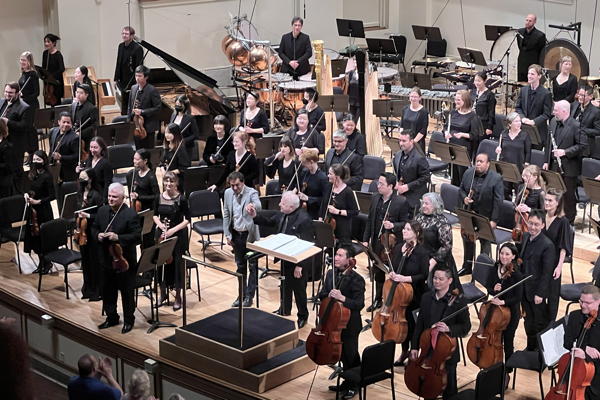
You wouldn’t call the St. Louis Symphony Orchestra “a thing of shreds and patches,” but with Music Director Stéphane Denève at the podium for the opening concert of the season last Sunday they were certainly doing some musical wandering. Certainly the first half of the program paid considerable homage to those famous wanderers, the Roma, with concert standards inspired by Hungarian folk tunes and the “Nomad Concerto” by Mason Bates.

Stéphane Denève
Photo: Dilip Vishwanat

Which is rather appropriate for an orchestra that will continue to lead a nomadic existence until the renovation of Powell Hall is completed next fall.

Things got off to an energetic start with a rousing performance of the “Rákóczi March”, a.k.a. the “Marche hongroise” from Part I of  the 1846 opera/oratorio hybrid “La damnation de Faust” (“The Damnation of Faust”) by Hector Berlioz (1803–1869). It’s the sort of orchestral showpiece that never fails to get an enthusiastic response—which it did.

Up next was another favorite, a set of the “Hungarian Dances by Johannes Brahms (1833–1897). Originally composed for piano duet and published in four sets between 1869 and 1880, the dances were orchestrated by various composers, including Brahms. Denève selected the three that the composer orchestrated (Nos. 1, 3, and 10) and played them attacca—i.e., without pause.

It was a smart choice, highlighting the contrast between the energetic first and tenth dances (marked Allegro molto and Presto, respectively) and the more introspective third (Allegretto). The result was a kind of “mini suite” that showed off both the composer’s orchestration and the virtuosity of the band. I was very taken with the flutes (including Ebonee Thomas, who seemed to be holding down the currently vacant Principal position for this concert) in the Dance No. 1, and the playful oboes and bassoons (under Associate Principals Phil Ross and Andy Gott, respectively) were a delight in Dance No. 3.  

Denève gave the dances the “full Roma” treatment, with just the right touches of rubato evoking the music’s folk origins.

The first half concluded with the “Nomad Concerto” by Mason Bates (b. 1977), composed for and premiered in January 2024 by this weekend’s soloist, violinist Gil Shaham. “Envisioned to showcase the legendary Old World sound of Gil Shaham,” writes Bates at his web site, “the concerto is informed by a diverse range of traveling cultures from Eastern Europe to the Middle East.”

Gil Shaham
Photo: Chris Lee

Running just under 30 minutes, the four-movement concerto is, as promised, an ideal virtuoso vehicle for Shaham. The last time I saw him with SLSO in January 2017 I praised his singing tone and the obvious joy of his playing. That’s still true, but this time I was also impressed by the versatility he displayed in delivering the wide range of sounds Bates has written for him. In the first movement (“Song of the balloon man”) his was wistfully Chaplinesque. He and the orchestra exchanged rapid-fire motifs in the brief “Magician at the bazaar” in a way that summoned up visions of flash paper going off all over the string section.  The third movement (“Desert vision: oasis) used the orchestra’s lower voices to suggest an arid expanse of wilderness, with the violin offering brief relief in the form of a yearning  version of the Jewish folk tune “Ani Ma’amin” (“I believe”).

Shaham and the band really cut loose, though, in the concluding movement, “Le jazz manouche.” Inspired by the sound of the legendary 1930s–1940s jazz combo Quintette du Hot Club de France—especially guitarist Django Reinhardt and violinist Stéphane Grappelli—the score has the soloist and orchestra trading licks the way an actual combo would. Shaham and the first violins seemed to be having an especially good time playing off each other here. Will James on jazz percussion and Peter Henderson on piano added considerably to the period atmosphere.

As much as I loved Shaham’s performance, though, I found it difficult to become involved with Bates’s score.  It felt more like a quasi-Impressionist collection of motifs that suggested but never really achieved the status of themes. It reminded me a bit of Debussy, except without the melodies and harmonic infrastructure.

The concert concluded with the Big Event, Berlioz’s splendiferous 1830 “Symphonie Fantastique.” Denève and the orchestra played this wildly hallucinatory work (Leonard Bernstein once dubbed it "the first psychedelic symphony in history”) back in 2019, as the closer of his last concert as Music Director Designate (he became the official MD that fall). At the time I described Denève’s interpretation as consistently engrossing, filled with interesting details (something that would prove to be a hallmark of his work on the podium) and concluding with a downright hair-raising final two movements. I’m repeating myself here because all of that still applies to what we experienced last Sunday.

The St. Louis Symphony Orchestra season continues October 4th and 6th at the Touhill Performing Arts Center; check out my preview for more information or head over to the SLSO web site.

This article originally appeared at 88.1 KDHX, where Chuck Lavazzi is the senior performing arts critic.

Wednesday, September 25, 2024

Symphony Preview: Mix and match

Back in the days when I was still doing a weekly show at KDHX, I loved to put together different and often seemingly unrelated songs into sets designed to highlight the relationships among them.  St. Louis Symphony Orchestra Music Director Stéphane Denève often takes a similar approach to his programming, zooming in on connections that aren’t obvious at first glance. Or at first hearing, as the case may be.

[Preview the music with my Spotify playlist.]

Berlioz in 1832
Painting by Émile Signol

You’ll witness and exceptionally fine example of this in concerts that open the new SLSO season this weekend (Friday and Sunday, September 27 and 29). The first half opens with the “Marche hongroise” (“Hungarian March”) from Part I of  the 1846 opera/oratorio hybrid “La damnation de Faust” (“The Damnation of Faust”) by Hector Berlioz (1803–1869). In the context of the full work (performed so splendidly by the SLSO in 2023), the sound of the Hungarian army tramping off to war gives Faust the opportunity to compare the enthusiasm of the soldiers with his own indifference to worldly joys. “Et quel feu dans leurs yeux,” he muses. “Tout cœur frémit à leur chant de victoire ; Le mien seul reste froid, insensible à la gloire.” (“And what fire burns in their eyes! Every heart throbs to their song of victory; Only mine remains cold, insensitive to glory.”)

Played more often as an instrumental excerpt, as it will be this weekend, it’s a rousing piece that shows off the composer’s flair for colorful orchestration. It doesn’t sound particularly Hungarian, but it’s so much fun that it hardly matters. And Berlioz wasn’t really interested in cultural fidelity anyway.

Brahms c. 1872
Photographer unknown
Public Domain

More authentically Hungarian are the 21 “Hungarian Dances” by Johannes Brahms. Based mostly on Hungarian folk tunes, the dances were originally composed for piano duet and published in four sets between 1869 and 1880. They were then orchestrated by various composers, including Brahms. This weekend we’ll hear the only ones orchestrated by the composer himself: No. 1 in G minor, No. 3 in F major, and No. 10 F major (E major in the original piano version).

As George S. Bozarth and Walter Frisch write in Grove Online, Brahms was first “exposed to the style hongrois, a blending of Hungarian musical gestures and gypsy performing style…when Hungarian political refugees on their way to the USA passed through Hamburg after the suppression of the revolutions of 1848.” Which makes the local premiere of the “Nomad Concerto” by Mason Bates a logical way to conclude the first half of the program.

Composed for and premiered in January 2024 by this weekend’s soloist, violinist Gil Shaham (brother-in-law of former SLSO Music Director David Robertson), this four-movement work, as the composer writes at his web site, “explores the mysterious and soulful music of the wanderer”:

Envisioned to showcase the legendary Old World sound of Gil Shaham, the concerto is informed by a diverse range of traveling cultures from Eastern Europe to the Middle East.  In the same way that nomadic musics have continually reimagined themselves, the many styles informing the concerto are swirled together into a unique soundworld.

The ”Nomad Concerto” is too new to be available on the usual streaming sources, including YouTube, so I’m unable to offer my own impressions of the work. That said, Peter Dobrin, reviewing the world premiere for The Philadelphia Inquirer, wrote that “Bates in this new piece once again proves a composer unusually commanding of atmosphere and emotion.” So you now know as much about it as I do.

This won’t be the first appearance of a Mason Bates work on an SLSO program, though. His 2015 “Anthology of Fantastic Zoology” got its impressive local debut by the band under the baton of Leonard Slatkin in 2023. As I wrote back then “his is an eclectic and inventive voice that is very much welcome these days. I hope to see and hear more of his work here in the future.” It looks like I got my wish.

Mason Bates
Photo: Ryan Schude, courtesy of the SLSO

After intermission it’s back to Berlioz with his splendiferous 1830 “Symphonie Fantastique.” I have always loved it to pieces, despite the rather unsavory story of its origins (tl;dr: it’s the result of the composer’s amatory pursuit of the Irish Shakespearean actress Harriet Smithson in a manner that would get him a restraining order these days, if not an actual prosecution). Maestro Denève conducted a bang-up reading of this work in May 2019 so I admit to looking forward to his latest thoughts on the matter.

The Essentials: Stéphane Denève conducts the St. Louis Symphony Orchestra and violinist Gil Shaham in the St. Louis premiere of the “Nomad Concerto” by Mason Bates. The concert includes Berlioz’s “Hungarian Marche” from “The Damnation of Faust” and the “Symphonie Fantastique, as well as three “Hungarian Dances by Brahms. Performances are Friday at 7:30 pm and Sunday at 3 pm, September 25 and 27, at the Stifel Theatre downtown.

On Saturday, September 26, at 8 pm Mason Bates, in his alter ego of DJ Masonic, joins St. Louis DJ Alexis Tucci for “Symphonie Electronique.” Described as “a genre-defying electronic dance music party with SLSO musicians and the audience,” “Symphonie Electronique” takes place at The Hawthorn nightclub on Washington Avenue downtown.

Tuesday, April 25, 2023

Symphony Review: Fantasy with a Spanish flair as Slatkin conducts Joshua Roman and the SLSO

When he took the stage last Sunday afternoon (April 23rd), St. Louis Symphony Orchestra (SLSO) Conductor Laureate Leonard Slatkin noted that this would be his last appearance on “this particular version” of the Powell Hall stage. That’s because when the current season ends on May 14th, Powell will be closed for renovation and expansion until 2025, the building’s centennial year. When it reopens, the stage will look pretty much the same, but every aspect of it and the rest of the building will have been upgraded.

[Find out more about the music with my symphony preview.]

For his last appearance in the current version of Powell Hall, Slatkin picked a program that he described, with tongue firmly in cheek, as “very Slatkin-esque; or, as some of you might be saying, ‘oh, no, it’s one of those.’” It got a laugh, but it was also accurate in that the evening consisted of a couple of well-established mainstream works bracketing the local premiere of a contemporary piece. And, as I noted in my preview, all three share some points in common—another quintessential Slatkin touch.

The concert started with a sparkling performance of the lively “España,” composed in 1883 by Emmanuel Chabrier (1841–1894). It’s his most popular piece and even inspired at least two "borrowings": Emil Waldteufel's "España Waltz" in 1886 and the pop song "Hot Diggity (Dog Ziggity Boom)," which was a big hit for Perry Como in 1956.

Mason Bates and Leonard Slatkin

Aside from the “ear worm” status of its tunes, the most striking thing about “España” is the sheer ingenuity of the orchestration. Chabrier tosses the work’s two main themes back and forth among the various sections of the orchestra with breathtaking speed. He also alternates moments of sharply contrasting moods, as when a delicate harp duet (Allegra Lilly and Megan Stout) is repeatedly interrupted by the brass section. The result is something of a musical soccer game with the ball in constant motion.

Needless to say, this calls for both an orchestra and conductor who are, so to speak, fleet of foot. Sunday afternoon we had both, with a crisp, precise, and viscerally exciting performance by Slatkin and the band. Enthusiastic applause followed.

Thematic material got bounced around quite a lot in the next work, the “Anthology of Fantastic Zoology” by Mason Bates (b. 1977). Based on the “Book of Imaginary Beings” by one of the previous century’s premier Spanish-language writers, Jorge Luis Borges, it’s described by the composer as “a kind of psychedelic Carnival of the Animals.”

That’s not a bad analogy. Sure, the animals here are entirely mythical if not downright outré (e.g. the Zaratan, a ginormous sea turtle the size of an island) but that just gives Bates all the more opportunity to show off his genius as an orchestrator as well as his flair for the theatrical. That’s most apparent in the “Sprite” movement, where the short, quicksilver theme leaps from player to player and even to a pair of violins placed far stage right and stage left (they’re supposed to be offstage, but that would have rendered them inaudible at Powell). It’s a bit like Chabrier’s soccer game, but on amphetamines.

The first ten of the work’s eleven movements are an auditory funhouse. Each fantastic animal has its own unique and enticing musical profile, building steadily to “Sirens,” which Bates calls “the lyrical core of the piece.” In it, the not-quite-offstage violins trade a pair of themes which are gradually taken up by the entire orchestra, leading to a massive outpouring of ecstasy. The ecstasy mutates into agony as dissonant intervals are added to the mix until it all becomes a mass of tone clusters à la György Ligeti that represent the all-consuming Zaratan.

Wonderful stuff so far, but for me the work goes off the rails in the finale, “Madrugada” (the legendary “witching hour” between midnight and dawn). Bates describes this movement, in which “the entire work collapses upon itself,” as “sprawling.” I’d describe it as overwritten and discursive. Running over ten minutes (nearly a third of the work’s 30-minute running time), it vitiates much of the energy accumulated up to that point.

Still, it was great fun for the first 20 minutes or so and allowed the musicians of the SLSO to show off their virtuosity. Even without seeing the score, it’s clear to me that “Anthology of Fantastic Zoology” is (ahem) a beast to play and conduct. A special shout-out is due Principal Tympani Shannon Wood, playing ten instruments in what looks like a section of the “drum cage” he built for William Kraft’s Tympani Concerto back in 2016, but everybody in the band had a workout on this one. That included Slatkin, who held this massive structure together masterfully.

Joshua Roman and Leonard Slatkin

This was only my second exposure to a live performance of music by Mason Bates (the first was the world premiere of his opera “The (R)evolution of Steve Jobs” in Santa Fe back in 2017) and I was once again impressed by his originality and his ability to engage the audience without “writing down” to us. His is an eclectic and inventive voice that is very much welcome these days. I hope to see and hear more of his work here in the future. Meanwhile, he's well represented on both YouTube and Spotify for those of you interested in hearing more of that voice.

The concert concluded with another virtuoso orchestral showpiece with Spanish connections, “Don Quixote (Fantastic Variation in a Theme of Knightly Character)” by Richard Strauss (1864–1949). Written at around the same time as Strauss’s “Ein Heldenleben” (“A Hero’s Life”), “Don Quixote” balances the former’s triumph with a mix of comedy and tragedy—so much so that Strauss saw them (according to Grove Online) “as paired works, and suggested that they be performed together.” Given that Strauss notoriously saw himself as the protagonist of “Heldenleben,” I have to wonder if he saw the Don as another side of his personality.

Certainly it’s a sympathetic portrayal of Cervantes’s “knight of the woeful countenance”, with Quixote represented musically by the mellow, resonant tones of the cello. This past weekend’s soloist, Joshua Roman, proved more than equal to the task, clearly connecting with his character’s emotional arc. In an interview for St. Louis Public Radio earlier in the week, Roman talked about the importance of “becoming the Don,” something that could be seen in his face and heard in his playing.

That said, it wasn’t always easy to hear his instrument from our seats upstairs. His tone sounded a bit thin, and he was often swamped by the orchestra. Given that I did not notice these issues when I listened to the broadcast of Saturday’s concert, I’m inclined to chalk it all up to Powell Hall’s acoustics rather than to Roman’s performance.

Backing Roman up were Principal Viola Beth Guterman Chu as the loyal Sancho Panza, assisted by Concertmaster David Halen, Tim Myers on euphonium, and Tzuying Huang on bass clarinet. The give and take between Chu and Roman in “Variation III: Dialogue of the Knight and the Squire” was a pleasure to watch, as the progress of the conversation could be seen and heard in their performances. Chu’s Sancho argues, cajoles, and finally gives in as Roman’s Don remains cheerfully oblivious, head firmly in the clouds.

Next at Powell Hall: Stéphane Denève returns to conduct Gabriela Lena Frank’s “Apu,” Bartók’s Piano Concerto No. 3 (with soloist Piotr Anderszewski), and Stravinsky’s “Le Sacre du Printemps.” Performances are Saturday at 8 pm and Sunday at 3 pm, April 29 and 30.

This article originally appeared at 88.1 KDHX, where Chuck Lavazzi is the senior performing arts critic.