Showing posts with label cabaret review. Show all posts

Tuesday, May 14, 2024

Cabaret Review: John Lloyd Young proves there's life after "Jersey Boys" at the Blue Strawberry

Zoom zoom zoom zoom
The world is in a mess
With politics and taxes
And people grinding axes
There's no happiness — George and Ira Gershwin, “Slap That Bass”

So sings Fred Astaire in the 1937 film “Shall We Dance?”. Lyricist Ira Gershwin’s solution is to “Slap that bass / Slap it till it’s dizzy.” But if he were still alive and if he’d been in St. Louis last Wednesday and Thursday (May 8 and 9), I think he might have added: “or just see John Lloyd Young at the Blue Strawberry.” Because anyone who didn’t emerge from that show with a smile on their face is a candidate for the curmudgeon hall of fame.

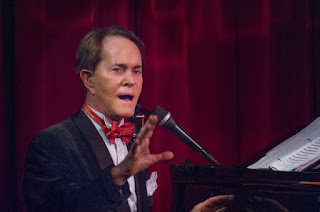
John Lloyd Young and David Duncan
at the Blue Strawberry

With a powerful high baritone that zooms up seamlessly into supernatural falsetto and a blitzkrieg charm that would do credit to the great Gene Kelly, the Tony Award-winning star of “Jersey Boys” is the kind of magnetic performer who wins the audience over the moment the light hits him.  By the time he finished his opening set of the 1966 Lou Christie hit “Lightning Strikes” and “My Prayer” (a hit for The Platters in 1956, although the song was written 30 years earlier) he had the entire house on his side.

He kept them there right to the end with a lively mix of songs and stories. Numbers that were big in the 1950s and 1960s predominated, as you might expect. That included “In the Still of the Night” (written in 1956 by Fred Parris for his group The Five Satins), Harry Noble’s “Hold Me, Thrill Me, Kiss Me” in a rendition inspired by Mel Carter’s 1965 recording (although Karen Chandler first charted with it in 1952), and even a bit of classic Broadway with “I Have Dreamed” from Rodgers and Hammerstein’s 1951 “The King and I.” But he also ventured into the 1970s with Paul McCartney’s 1970 “Maybe I’m Amazed” and Albert Hammond and Mike Hazlewood’s “The Air That I Breathe,” which was a hit for The Hollies in 1974.

Young also ventured out into the audience for some good old show biz mingling. Not everyone can pull that off, but Young’s entire stage presence is so open and approachable that it all felt perfectly natural. He even invited the audience to sing along on some of the hits, and while attempts to match his high notes were doomed from the beginning, a good time was still had by all.

Mixed in with all this were some anecdotes about his unorthodox entry into Broadway stardom, his work as a cultural ambassador for the Obama administration, and a tribute to his musical hero Roy Orbison—complete with shades and a killer performance of “Only the Lonely.” There are some exceptional cabaret talents out there who tend to tell you more than you want to know about their personal lives, but John Lloyd Young is not, happily, one of them.

Oh, yeah: he also did a few numbers from “Jersey Boys.”

Impeccably backing Young up on the piano was David Duncan. He was a sympathetic accompanist, and his frequent solo breaks were powerful stuff.

John Lloyd Young played the Blue Strawberry Showroom and Lounge Wednesday and Thursday, May 8 and 9. It wasn’t his first visit to our town, and judging from the size and enthusiasm of the crowd, I expect it won’t be his last. To find out where he’s appearing now, check out his web site. Meanwhile, live entertainment continues at the Blue Strawberry, with details available at their web site.

Finally: for an in-depth interview with Young, including a look at his many other talents, check out Chuck's Culture Channel on YouTube.

This article originally appeared at 88.1 KDHX, where Chuck Lavazzi is the senior performing arts critic.

Monday, April 29, 2024

Cabaret Review: Melissa Errico happens to like Stephen Sondheim

Melissa Errico 

“I happen to like New York,” wrote Cole Porter in 1930. “I like the sight and the sound and even the stink of it / I happen to like New York.” The late musical theatre legend Stephen Sondheim (a great admirer of Porter) apparently agreed, for while he owned a home in Connecticut, he essentially lived his entire life within a 20-block radius of his New York City home.

[Check out my interview with Melissa Errico on YouTube.]

At The Blue Strawberry last week (April 26 and 27) Melissa Errico (another musical theatre legend) peppered her new showcase of the songs of Stephen Sondheim with that and other fascinating biographical bits.   Along with the equally legendary Tedd Firth (her music director), she gave the audience a heaping helping of Sondheim, with (by my count) eighteen songs spanning most of the composer’s long and productive career. That included a nicely balanced set of tunes from Errico and Firth’s latest CD, “Sondheim in the City” which was released back in February.

The evening opened with the earliest all-Sondheim song in the set: the rousing “Everybody Says Don’t” from “Anyone Can Whistle” (1964). It was a perfect way to introduce us to Errico’s big, expressive voice. Her dynamic range and vocal control were impressive, allowing her to move from a purr to a roar as needed. Her sparkling blue dress—chosen to honor her first appearance at The Blue Strawberry—was the ideal visual equivalent to her effervescent stage persona.

Her long-time collaborator Firth supported her every inch of the way, with imaginative arrangements that encompassed a wide range of styles from classical to jazz, all delivered with the impressive virtuosity I have come to expect from him over the years.

 Next was a quietly confident version of “Not While I’m Around” from “Sweeney Todd” (1979). It its original context, the song is about the Mrs. Lovett and the slow-witted Toby making promises to each other they don’t fully understand and won’t be able to keep. In Errico’s hands, it became a less ambiguous and more openly moving declaration of familial love. Either way, it’s all there in the music and lyrics; one just needs to shift perspective a bit.

The contrast of moods set the stage admirably for a show that was all about Sondheim’s masterful use of ambiguity and contradiction. “Small World” (from “Gypsy,” 1959, music by Jule Styne), in this context, is all about Rose’s affection for and manipulation of the long-suffering Herbie, while the following number—“Loving You” (from “Passion,” 1994)—shows how easily romantic love can coexist with creepy obsession.

Errico’s interpretation leaned towards the “romantic love” end of the spectrum, but the subtext of creepiness was there as well. Firth’s arrangement included a volcanically Romantic solo break (Rachmaninoff would have approved of it) that could also be taken either way. It was, again, a matter of perspective.

And so it went for around 90 minutes, with anecdotes drawn from both Errico’s and Sondheim’s lives segueing neatly from one great song to another. It was a musical biography of both Errico and Sondheim as well as an entertaining night of cabaret guaranteed to gladden the hearts of musical theatre lovers in general and Sondheim fanatics (“Sondheimaniacs”?) in particular—a group in which I would unapologetically include myself.

That said, the between-song patter, well-chosen and informative as it was, sometimes became a bit discursive. In a few cases, it all became a bit of “inside baseball,” dwelling at length on technical aspects of lyric construction and performance practice that would have been a better fit for a master class. I found this stuff fascinating, mind you, but I’m not sure that this was a majority view.

Still, that’s a minor quibble, which is why it’s here at the end of the review. Errico and Firth are masters of their craft just as Sondheim was of his. The combination was a match made in musical theatre heaven. This might have been their first appearance on a local cabaret stage, but I hope many more will follow.

Meanwhile, you can listen to most of her extensive discography on Spotify and check out her videos (including her enlightening “Sixty-Second Sondhiem” series) on YouTube. Information about upcoming shows at The Blue Strawberry can be found on their web site.

This article originally appeared at 88.1 KDHX, where Chuck Lavazzi is the senior performing arts critic.

Tuesday, April 26, 2022

Cabaret Review: Prime Prine: Marissa Mulder's John Prine tribute is a reminder of his importance

I never thought of myself as a fan of the late singer/songwriter John Prine, but Marissa Mulder’s “Souvenirs,” a Prine tribute show that played The Blue Strawberry April 21 and 22, showed that I was wrong.

It turns out that I have admired Prine’s songs for years. It’s just that my mind’s ear hears many of them in voices as diverse as those of John Denver (“Paradise”) and Bette Midler (“Hello in There”). Which just shows how influential Prine was even when he wasn’t singing.

Marissa Mulder at The Blue Strawberry

So I was surprised at the high percentage of the evening’s 16 songs that I not only knew but loved, especially in Mulder’s winning, country-inflected performances. When I saw Mulder’s Tom Waits show back in 2014, I was impressed by how Mulder magically metamorphosed into the battered, world-weary, ironic narrator who lurks in all of Waits's lyrics. This time around, she morphed into a fresh-faced folk singer who might have just come from a busking gig in a subway station, complete with a bit of the rural twang that you can hear in Prine’s own voice.

Back then, I called it a startling act of theatrical legerdemain. It was less startling this time partly because I was prepared for it and partly because the transformation was less radical since Mulder is, as Stephen Holden has written, an “engagingly sunny” performer by nature. Still, it shows theatrical smarts and an understanding of the importance of completely internalizing the lyric of a song—a fundamental skill for any cabaret artist.

With Jon Weber on piano and St. Louis’s own Brian Clark on guitar, Mulder delivered a solid evening of droll gems like “Illegal Smile,” “In Spite of Ourselves,” and “Dear Abby,” as well as sniffle-inducing sentimental numbers such as “Hello in There” and “I Remember Everything.”  In between, we got little biographical bits about Prine and the origins of the songs—most of which were news to me, and which were fascinating in their own right.

I never knew, for example, that “Your Flag Decal Won’t Get You into Heaven Anymore” (a song which is still sadly relevant) and “Hello in There” were both inspired Prine’s experiences as a mail carrier. Or that the titular town of “Paradise” was a real place the songwriter had visited as a child before (as the lyric goes) “Mr. Peabody’s coal company” did, indeed, wipe it out of existence in pursuit of a buck. And I certainly had no idea that he played the last song he ever wrote, “I Remember Everything,” at his first-ever Paris concert on February 13, 2020.

The show was a sellout and the crowd loved him, but the trip proved fatal for Prine, who was diagnosed with COVID-19 when he returned home. He died on April 7th.

Musically, Prine’s songs follow a fairly rigid pattern—verse followed by multiple refrains—but Mulder, Weber, and Clark all brought enough variety to their performances so that the evening rarely felt repetitious. Clark had some fine solos and provided sensitive accompaniment for the rueful “Speed of the Sound of Loneliness.” Weber’s sparing use of the "slip note" piano style associated with "Nashville sound" architect Floyd Cramer added to the folksy atmosphere.

Thanks to Jim Dolan for bringing Marissa Mulder back to town. I missed her Lennon/McCartney show here, so it was good to see her in action again. To find out when she’s coming to your town, check out her web site. For information on what’s coming up at The Blue Strawberry, check theirs.

This article originally appeared at 88.1 KDHX, where Chuck Lavazzi is the senior performing arts critic.

Friday, December 03, 2021

Cabaret Review: We still get a kick out of Steve Ross

Thanksgiving weekend (November 26 and 27), Jim Dolan’s Blue Strawberry nightclub gave cabaret lovers something to be thankful for: two nights of the legendary cabaret singer and pianist Steve Ross. I was there for the packed Friday night house, and (to quote one of Ross’s favorite songwriters, Noël Coward), “I couldn’t have liked it more.”

Steve Ross

Ross has a long and happy relationship with St. Louis, going back to the early days of the Grandel Cabaret Series, where I first saw him two decades ago. Debonair, witty, and charismatic, Ross never fails to get straight to the heart of every song, whether it’s an obscure comic gem like Milton Ager and Jack Yellen’s “Hungry Women” (introduced by Eddie Cantor in his 1928 musical Whoopee!); a sentimental standard like Ralph Rainger and Leo Robin’s “Thanks for the Memory” (Bob Hope’s theme song, which he introduced with frequent co-star Shirley Ross in The Big Broadcast of 1938); or the smoky, late-night regret of the Kingston Trio hit “Scotch and Soda”. 

Without fail, Ross makes certain that you not only hear but actually listen to the lyrics – an essential skill for the cabaret artist. An evening with Steve Ross is an object lesson in why cabaret is such a vibrant art form.

Much of Ross’s latest show, Back on the Town, was likely familiar to fans. Many of his favorite songwriters were represented, including Coward, Cole Porter, the Gershwins (“George and his lovely wife Ira,” as a misinformed DJ is supposed to have said in the 1950s), Irving Berlin, and of course, the newly-departed Stephen Sondheim. The latter was represented only by “Send in the Clowns” (from A Little Night Music) but what a lovely performance it was.

There were some songs that were new to me as well—a reminder that Ross knows well how to assemble a show that mixes audience favorites with possible future favorites. In that category I’d include “My Circle of Friends” from the 2008 album Hallways by Carol Hall (best known for her musical The Best Little Whorehouse in Texas), with its sweetly sentimental thoughts on what Tales of the City's Anna Madrigal called one’s “logical family,” and “This Moment,” written by John Wallowitch and Bertram Ross for the autobiographical 1999 film of the same name. As someone with more years behind him than ahead, the lyric struck me as especially powerful: “It takes a life to realize / What life is all about / And life is all about this moment.”

And, happily, there were numbers by immortal French singer/songwriters like Charles Trenet (“La Mer,” done very much in the Trenet style) and Charles Aznavour (“Le Temps,” with English lyrics by Gene Lees). There was also, happily, Ross’s trademark instrumental medley of Edith Piaf favorites—always a hit with us fans. The Francophile feast included a song he co-wrote with Barry Day, “Whenever I Think of Paris.” It’s a wistful love letter to a city I adore as much as he obviously does.

Another notable item was Cole Porter’s popular “Anything Goes” with some new lyrics by screenwriter Joe Keenan. They were witty, to be sure, but I’m not sure all of Porter’s originals seem really need a rewrite to make them relevant: “The world has gone mad today / And good's bad today, / And black's white today, / And day's night today.” To say nothing of:

Just think of those shocks you've got
And those knocks you got
And those blues you got
From that news you got
And those pains you got
(If any brains you've got)
From those little radios.

Change that last line to, say, “From those angry talk shows” or “From social media prose” and everything old is new again.

“But I digress” – Tom Lehrer.

So, yeah, it was another charming and entertaining evening with one of cabaret’s leading lights. Thanks to Jim Dolan and the Blue Strawberry for bringing Steve Ross to town once again. Long may his light shine. Here in St. Louis, we still get a kick out of him.


Wednesday, October 20, 2021

Cabaret Review: Ari Axelrod throws a party for Jewish Broadway

Ari Axelrod is, as I have noted in the past, tremendously talented. His singing voice, which comfortably occupies the middle ground between a tenor and a baritone, has a solid range along with a head voice and falsetto that are impressively clear and well-integrated. He’s a fine actor as well, so fully internalizing the lyrics of his songs that he sometimes seems to be making them up on the spot.

[Watch my YouTube interview with Ari Axelrod]

Ari Axelrod

His “Celebrating Jewish Broadway” show—the opener for the New Jewish Theatre’s 24th season last Saturday and Sunday (October 16 and 17)— revealed that he’s also a theatre historian and political activist, plays both the congas and the recorder, and does a graceful hora. At this point, I would not be surprised if he could also leap tall buildings in a single bound.  

To anyone who loves musical theatre, of course, the phrase “Jewish Broadway” could justifiably be seen as redundant, given how many of America’s greatest songwriters and composers have been Jewish. Consider this partial list (all of whom were represented in the show): Irving Berlin, Stephen Sondheim, Jerry Herman, Stephen Schwartz, Leonard Bernstein, George and Ira Gershwin, Jason Robert Brown, and of course, the three generations of the Rodgers family: Richard, his daughter Mary Rodgers Guettel, and his grandson Adam Guettel. Axelrod sang them all and illustrated their ties to Jewish musical traditions.

“Celebrating Jewish Broadway” opened with an upbeat and welcoming pair of classics: “Something’s Coming” from Bernstein and Sondheim’s “West Side Story” and “Miracle of Miracles” from Bock and Harnick’s “Fiddler on the Roof.” These allowed Axelrod to deliver his first historical tidbit: “Fiddler” was not the first Broadway show to deal with explicitly Jewish themes. Said distinction goes to Jerry Herman’s 1961 “Milk and Honey”.

That bit of Broadway history then provided a natural segue to a very funny bit about the hoops Axelrod had to jump through to audition for a revival of Herman’s show (which is how we learned about the recorder and the hora). Which, in turn, led to a pair of songs from the show, neither of which I had heard before and which I loved: “Shalom” and “I Will Follow You.”

And so it went, with songs and stories tightly and logically integrated into a seamless dramatic whole that ran a bit over 90 minutes. Which is, perhaps, a bit long for a one-act cabaret evening, but Axelrod was so damn entertaining and the story he told so compelling that I, for one, am willing to give him a pass on that.

Ari Axelrod at the JCC

The selections from “Milk and Honey” and a couple of other rarities such as singer/songwriter Daniel Cainer’s moving “God Knows Where” not withstanding, most of the numbers in Axelrod’s set list were fairly familiar Broadway and off-Broadway standards. What made them special was the way he made each one his own, sometimes in ways that changed or transcended their original meanings.

Stephen Schwartz’s “Corner of the Sky” (from “Pippin”) is a good example. Within the context of the show, it reflects the title character’s need to find his place in the world as well as his inflated notion of his own potential. Axelrod’s performance emphasized the first meaning by preceding it with an anecdote about how the late Neal Richardson, one of his instructors at Webster Conservatory, advised him on how to deal with the sense of not belonging that stemmed from being a Jew in a largely non-Jewish institution. “Don’t hide the things that make you different,” he advised, “decorate them.”

This simple bit of wisdom not only transformed the song, but it also made the lyrics resonate with many of us who have, at one time or another, felt like outsiders.

Another example was Sondheim’s “Another Hundred People” from “Company.” In the context of the show, it’s a love letter to NYC that nevertheless includes Sondheim’s characteristic ambiguity, describing the Big Apple as “a city of strangers”:

And they’ll find each other
In the crowded streets and the guarded park
Past the rusty fountains and the dusty trees
With the battered barks
And they' walk together
Past the postered walls with the crude remarks

Axelrod’s love for the place is unambiguous, though, and in his hands the ambiguity dissolves into unfettered joy. The result is Sondheim with the spirit of Cole Porter’s “I Happen to Like New York” or the late Rick Jensen’s “Miss Manhattan.”

Carrie Smith and Ari Axelrod in "Cool"
from West Side Story

Of course, a highly personalized show like this one requires highly personalized arrangements. It was, I think, cabaret legend Lina Koutrakos (the original director of the show) who once described the difference between mere sheet music and a custom arrangement as analogous the difference between off-the-rack clothing and custom tailoring. Axelrod’s arrangements fit perfectly, courtesy of his original Music Director Mike Stapleton, and were played with great skill by Carrie Smith at the piano. The communication between Smith and Axelrod was impressive, given that they were farther apart than is usually the case with cabaret shows and had had minimal rehearsal time.

I could go on, but you get the idea. “Celebrating Jewish Broadway” was, of course, clearly pitched at a Jewish audience, which meant that some of the cultural references had no real emotional resonance for me. It didn’t detract from my appreciation of the performance, but it did sometimes make me feel like an outsider.

Which, of course, I was. So perhaps that’s only fair.

Ari Axelrod’s “Celebrating Jewish Broadway” was both consistently entertaining and enlightening—a welcome beginning to NJTs new season. You can learn more about the latter at their web site and find out what Ari Axelrod is doing next at his. His career is only just beginning and promises to be a stellar one.

Wednesday, September 29, 2021

Cabaret Review: Deano's back and Dean's got him

When I reviewed Dean Christopher’s Dean Martin tribute show, “Everybody Loves Somebody Some Time,” at the Blue Strawberry last March, I described it as “rock-solid entertainment.” Christopher brought it back to the Strawberry last Friday (September 24th) and, after seeing it again, I’m of no mind to change that assessment.

Dean Christopher as Dean Martin sings "Houston"
Photo by Chuck Lavazzi

The show was, for one thing, largely unchanged from last year. With one notable exception (see below) the song list was exactly the same. Christopher still has Martin's vocal quality and loose-limbed drunk act down pat. Pianist and music director Joe Dreyer is still the perfect musical and comic foil in his role as Kermit "Ken" Lane, who was the real Martin's pianist and music director on "The Dean Martin Show"—a fact which will surprise nobody who has seen Joe’s own cabaret act with his wife Rosemary.

In short, everything about “Everybody Loves Somebody Some Time” that made it so much fun last March was still true this past Friday. So rather than repeat all praise I heaped on it back then, I’ll just refer you back to that original review. Same songs, same great fun.

Instead, let’s talk about what was different, focusing on that addition to the song list. The response from the audience, many of whom were clearly regular followers of Christopher’s show, was enthusiastic as usual—so much so, in this case, that Christopher broke with tradition by performing an actual encore.

And not just any encore. It was the 1967 Bob Thiele (a.k.a. “George Douglas“ and George David Weiss hit “What a Wonderful World.” Unlike the rest of numbers in the evening, “What a Wonderful World” was never recorded by Dean Martin.  But it was an international hit for Louis Armstrong—the first of the four (count ‘em, four) singers that Christopher impersonated with great success while singing it (the other three were Frank Sinatra, Sammy Davis Jr., and of course, Martin himself).

Dean Christopher and Joe Dreyer
Photo by Chuck Lavazzi

That was impressive enough. What made it even more so was the fact that the encore was entirely unplanned. Dreyer gave Christopher a good key (E-flat) and Christopher just took off with it while Dreyer improvised the accompaniment. Christopher does something similar in his “Rat Pack Christmas" show in which he sings “The Twelve Days of Christmas” as a dozen different Hollywood personalities, but that’s scripted in advance. This was purely off the cuff, which is really rather amazing.

The only fly in the ointment was the wireless body mic the Strawberry had provided, which insisted on dropping in and out at random intervals during the evening. It’s the sort of thing that will throw even the most seasoned performer off his stride and while Christopher coped with it gracefully (and in character, no less), it did cause the energy to drop at times while the sound tech tried, without much success, to fix the problem.

To quote a lyric from one of Martin’s hits, “ain’t that a hole in the boat?” Fortunately, the S.S. Dean Martin Christopher appears to be as unsinkable as Molly Brown and a fine time was had by all.

Dean Christopher returns to St. Louis this November and December at The Sheldon Concert Hall with his not-to-be-missed “Rat Pack” show; see his web site for details.

Cabaret, jazz, and other music events continue at The Blue Strawberry on North Boyle. Currently the club requires proof of vaccination and masking, except when eating or drinking, and tables are spaced far enough apart to inspire confidence. For more information, visit the Blue Strawberry web site.

This article originally appeared at 88.1 KDHX, where Chuck Lavazzi is the senior performing arts critic.

Tuesday, September 21, 2021

Cabaret Review: Emily Skinner's return to The Blue Strawberry is cause for celebration

When I reviewed Emily Skinner's last appearance at The Blue Strawberry in January 2020, I described it as "a show that did everything right and nothing wrong…it was simply nonpareil."  Having seen her new show, "A Broad with a Broad, Broad Mind,” at the Strawberry last Friday (September 17th), I’m tempted to just file the serial numbers off last year’s review and plagiarize it.

Emily Skinner

Because, despite a Plague Year of enforced idleness, Skinner and her pianist, music director, and long-time friend John Fischer were just as brilliant as they were last January. Skinner still has a powerful and versatile voice that she can use to belt or purr as the material demands. Her acting skills, honed from years on the musical theatre stage (she most recently appeared here as Matron "Mama" Morton in "Chicago" at The Muny in August), remain impressive. And her choice of material was just as wide-ranging and artfully assembled.

That’s not to say there weren’t differences this time around. Inspired by Skinner’s experience as a performer who couldn't perform for over a year, "A Broad with a Broad, Broad Mind” was both more bawdy and more reflective in places than her "Broadway My Way" show last year. And this time around, Fischer got a chance to sing with her, most notably and hilariously in “Schadenfreude” (from “Avenue Q”). Here, and in many other moments during the evening, their rapport and easy camaraderie made their work together a joy to behold.

The placement of “Schadenfreude” in the show also demonstrated the meticulousness with which the set list has been assembled. It followed hard upon a beautifully tender rendition of Billy Barnes’ "(Have I Stayed) Too Long at the Fair," with its rueful reflection on what happens when the music stops and the piper has rendered his invoice. The opening lines of “Schadenfreude”—“Right now you are down and out and feeling really crappy / And when I see how sad you are it sort of makes me happy”—offered a perfect way to make an abrupt transition back to comedy that also made dramatic sense. It was smart and it worked.

There were many other wonderful moments like this in the unfailingly entertaining package that is "A Broad with a Broad, Broad Mind.” There were so many, in fact, that I will limit myself to highlighting just a few that I found particularly delightful.

Let’s start with the opening and closing numbers by Sir Elton John: “The Bitch is Back” and “Thank You for Being a Friend.” Performed with unabashedly campy joy, complete with silly eyeglasses, they were the perfect bookends for the show. There was also more fun than you can shake a stick at (“if that’s your idea of a good time,” to quote Groucho) in Skinner’s “Stumble Along” (from “The Drowsy Chaperone”), which she introduced by noting that “in the last ten years I have played three raging alcoholics. And I don’t even drink.”

John Fischer and Emily Skinner channel
Sir Elton

I loved the simple tenderness of Fred Rogers’ “It’s You I Like” (introduced on “Mr. Rogers’ Neighborhood” in 1984) and the perfect combination of lubriciousness and regret in Rodgers and Hart’s “Bewitched” (a.k.a. “Bewitched, Bothered and Bewildered”) from “Pal Joey.” Skinner used the suggestive lyrics from the 1940 original (“horizontally speaking, he’s at his very best”) along with a few I didn’t recognize, possibly from one of the revivals. In any case, it lived up to her advance billing as her “favorite sexy standard.”

And speaking of sex, let us rejoice that Skinner once again gave us a Mae West song, done in a way that perfectly captured West’s style and vocal delivery. This time it was West’s pointed attack on censorship “That’s All Brother, That’s All.” West's original recording of it is a treasured part of my LP collection

Wrapping everything up was Susan Werner’s “May I Suggest,” with its inspiring reminder that “this is the best part of your life.”  Skinner introduced it as “something for you to consider in your week ahead,” but I’d broaden that to say it’s something consider every day that remains to you. As Walt Kelly’s Porkypine once noted, "The best break anybody ever gets is in bein' alive in the first place. An' you don't unnerstan' what a perfect deal it is until you realizes that you ain't gone be stuck with it forever, either."

I called Emily Skinner’s appearance here last year a "knockout". So was this. Thanks to Jim Dolan for bringing her back again.

Cabaret, jazz, and other music events continue at The Blue Strawberry on North Boyle. Currently the club requires proof of vaccination and masking, except when eating or drinking, and tables are spaced far enough apart to inspire confidence. For more information, visit the Blue Strawberry web site. For information on Emily Skinner's upcoming appearances, check out her web site.

This article originally appeared at 88.1 KDHX, where Chuck Lavazzi is the senior performing arts critic.

Friday, January 01, 2021

Review: Katie McGrath's latest show combines country heart with urban smarts

Since she moved to the Big Apple and became a cabaret star, our own “trusty and well-beloved” Katie McGrath has been making regular pilgrimages back home to perform for local friends and fans. The pandemic cancelled plans to bring “Friends in Low Places,” her latest show, to Jim Dolan’s Blue Strawberry club, but it takes more than a virus to stop the intrepid Ms. McGrath. And so the Strawberry made the show available as a live webcast on the day after Christmas.

Katie McGrath
Broadcast from Ms. McGrath’s Manhattan apartment with music director (and well-known singer/songwriter) Rick Jensen at the piano, “Friends in Low Places” was a tribute to the many country artists from whom Ms. McGrath has drawn inspiration and consolation during her life. It’s not a genre that has ever held much interest for me, but her complete investment in every lyric and her magnetic stage presence and vocal polish made even the occasionally banal sentiments of some of these songs compelling. She’s a performer who can spin anything into gold and invariably does.

“Who I Am,” the title track from a 2000 album by Jessica Andrews, opened the show with a strong assertion of self-awareness and connection with friends and family: “My momma's still my biggest fan / Sometimes I'm clueless and I'm clumsy / But I've got friends who love me / And they know just where I stand.” In Ms. McGrath’s skilled hands, it became a powerful personal anthem and set the intimate, warm, and often witty tone for the evening.

It was also a reminder that Ms. McGrath is a master of the sub-genre I have come to think of as "This is My Life" cabaret, in which the song choices and the patter linking them draw heavily on details of the performer's personal history. Unlike some who dip so deeply into that well that they risk drowning the audience, Ms. McGrath and her director, cabaret legend Lina Koutrakos, are far too good at what they do to commit such an error. However intimate and revealing some of her stories were, they always served as perfect introductions to the songs that followed, often giving them a depth they might not have in other hands.

So, for example, Garth Brooks and Kent Blazy’s “If Tomorrow Never Comes” radiated a moving mix of sincerity and heartbreak, while the 1969 Elvis Presley hit “Suspicious Minds” (originally recorded by its author Mark James the previous year), sung as a duet with Mr. Jensen, had a dramatic force that transcended its origins.

There were genuinely funny moments as well, such as Brad Paisley’s “Me Neither,” with its droll description of fumbling attempts at bar pickup lines. It was the opening song in a set inspired by first-hand experience with what Ms. McGrath, recalling her years living in Dallas, described as “natives in their traditional ensembles practicing their mating rituals in Ft. Worth.” From that comic start, the music moved on to more serious emotional engagement with Hank Cochran and Dean Dillon’s “The Chair” (recorded by George Strait in 1985) before finally bringing us to a genuine cri de coeur with Billy Joel’s “Shameless,” which became a No. 1 hit for Garth Brooks.

Comedy, romance, and something approaching self-abasement in one three-song set. That, my friends, is cabaret.

Mr. Jensen’s elegant and well-tailored arrangements contributed greatly to the success of the evening, as did Ms. Koutrakos’s sure direction and Chet Whye Jr.’s sharp videography.

Unfortunately, the sound was not up to the level of either the video or the performances. Tinny, bass-shy, and sometimes distorted, it did real injustice to the rich lower register of Ms. McGrath’s voice and the power of Mr. Jensen’s pianism. It rendered the show nearly unlistenable at times, which is a pity, to say the least. Technology, alas, is not foolproof.

Indeed, the negative impact of factors beyond the control of the show’s creators highlighted the kinds of issues cabaret faces during an uncontrolled pandemic. On the one hand, it’s an intimate form of performance that can easily be broadcast from one’s own home. On the other hand, that intimacy is at its most effective when the performer and the audience are in close proximity and the connection between them is palpable.

Cabaret’s ideal venue is a small club like The Blue Strawberry. Unfortunately, a small space is also the ideal venue for the spread of the coronavirus. There are measures clubs can take to sharply reduce the risk of that spread (and the Strawberry has apparently taken all of them), but even so, many artists and audience members see the game as not being worth the candle.

All of which may explain why, for me, the most effective moment in the entire evening came at the end, with a song written by Ms. McGrath and Mr. Jensen. “George and Greta” is inspired by a famous Life Magazine photograph taken by Alfred Eisenstaedt during a V-J Day celebration in Times Square. In it, according to the original caption, “a white-clad girl clutches her purse and skirt as an uninhibited sailor plants his lips squarely on hers." George Mendoza and Greta Zimmer Friedman later claimed to be the couple in question, and while both claims have been disputed, it’s plenty good enough for a song title.

Today, of course, such a display of spontaneous intimacy between strangers would be insane. The song is a nostalgic and moving look back at a time when we could shake hands instead of touching elbows, when we could embrace those whom we loved but with whom we didn’t live, and when, to quote one of Ms. McGrath’s lyrics, we could “hold hands and sway / In a packed cabaret.” It’s a reminder of what (and whom) we lost this past year due to the spread of a virus that was enabled by a combination of incompetent (if not outright malicious) government and social media that actively encouraged the denial of reality and the spread of misinformation.

It made me sad and angry at the same time. I loved it.

Writing this review required some reflection on my part (another point in the show’s favor), which is why it’s being published on New Year’s Eve. As we put 2020 behind us, let us hope 2021 starts us on a path towards a world in which “George and Greta,” like the photo that inspired it, can become a valuable historical artifact. And in which we can see artists like Katie McGrath, Rick Jensen, and Lina Koutrakos in person once again. Meanwhile, virtual hugs and a happy 2021 to all.

This article originally appeared at 88.1 KDHX, where Chuck Lavazzi is the senior performing arts critic.

Tuesday, December 22, 2020

Cabaret review: Christmas and all that jazz with Debby Lennon and the Carolbeth True Trio

Last December local singer/actress/educator Debby Lennon brought a delightful jazz-inflected holiday show to the Blue Strawberry. The revised version she performed at Jim Dolan’s Central West End club on December 12th featured less of her and more of local jazz legend Carolbeth True’s band, but it was still the same “tasty holiday treat” I enjoyed so much last year.

“I’ll Be Home for Christmas (due to COVID-19 Restrictions)” was performed live and via streaming video, which is how I saw it. Unfortunately, technical issues at the club cut off the first four songs of Ms. Lennon's opening five-song set, so this review is based on what transpired after that. In any case, the show was, once again, an excellent showcase for Ms. Lennon’s flawless, clear vocals and for her on-stage persona, which was as effervescent as a glass of seasonal Champagne. She had clearly won the audience over early in the show and from there on it was smooth sailing.

Debby Lennon

With a heavy emphasis on Great American Songbook tunes, her set list was much the same as last year’s, and it was delivered, once again, with a mix of vocal excellence and compelling sincerity.

Her “Have Yourself a Merry Little Christmas” was a touching elegy for her late mother, and “all the people we miss tonight” gave the lyric’s wish that “someday soon we all will be together” added poignancy. A cheerful dash through the witty lyrical underbrush of  Irving Taylor, Dudley Brooks, and Hal Stanley’s “(Everybody’s Waitin’ for) the Man With the Bag” (first charted by Kay Starr back in 1950) was more fun than a barrel of elves, as was her take on the manic version of "Jingle Bells" Jack Gold and Marty Paich created for Barbara Streisand's 1967 "A Christmas Album.” And her “Santa Baby” was nicely lubricious but with more of a sense of swing than Eartha Kitt’s legendary 1953 original. Credit Ms. True for that, along with the tight contemporary jazz sound of the whole evening.

In fact, the evening was as much a showcase for pianist/arranger Carolbeth True and her band as it was for Ms. Lennon. They had two great solo sets, the first of which combined an upbeat and bluesy take on “God Rest Ye Merry, Gentlemen” with a Latin-flavored version of “It Came Upon a Midnight Clear.” That level of innovation and creativity could be heard in their longer second set of seasonal tunes towards the end of the evening, which included stylish solos by Glenn Smith on bass and David True on percussion in a celebratory “Feliz Navidad.”

Their work got an enthusiastic reception from both the audience and Ms. Lennon when she took the stage afterwards. “That was fabulous,” she declared joyfully. “I hope it feels as good out there as it does to be up here with these marvelous musicians.” Judging by the applause, I’d say that was a safe bet.

The Debby Lennon/Carolbeth True Christmas show took place at Jim Dolan’s Blue Strawberry Showroom and Lounge, where a mix of jazz, pop, and soul acts continue into the new year. The club is operating under a "COVID careful" arrangement with restricted indoor capacity and other precautions. Many of the shows are also available via live streaming video. Check the web site for details.

This article originally appeared at 88.1 KDHX, where Chuck Lavazzi is the senior performing arts critic.

Wednesday, November 18, 2020

Cabaret Review: Steve Brammeier's warmly nostalgic "68: Then and Now" returns to the Blue Strawberry

“Nostalgia,” someone once quipped, “is like a grammar lesson: you find the present tense and the past perfect.” Steve Brammeier’s show “68: Then and Now” may not find the past perfect, but it certainly does find it worth recalling fondly. A warm and cuddly evening’s entertainment was the result.

Presented at The Blue Strawberry on October 23 live and via video stream (which is how I saw it), “68: Then and Now” was a whimsical look back at the songs and pop culture of 1968. It began in a blackout with a short mashup of late 1960s commercial jingles played over the sound system. Then a pin spot came up stage left on Mr. Brammeier for Dylan’s iconic “The Times They Are a-Changin’” from 1964. Music director Rick Jensen’s arrangement and Mr. Brammeier’s singing built to a powerful close as the lights came up full for that final verse about the new world many of us thought we were building.

L-R: Rick Jensen and Steve Brammeier
It was a solid opening number that allowed Mr. Brammeier, who graduated high school here in St. Louis in 1968, to segue into a short monologue about how the songs of the late 1960s—and especially those from that pivotal year of 1968—shaped his life and the lives of so many others of his (and my) generation. It’s a theme that effectively knits together an hour or so of tunes both serious and silly from (mostly) 1968.

It’s a fun and diverse set list, interspersed with autobiographical bits that set the scene effectively and having impressive narrative economy. Unlike some “this is my life” cabaret shows, “68: Then and Now” never assumes that you find the singer’s life as interesting as they do.

A good example of his approach was his version of Shirley Bassey’s 1968 hit “The Joker,” from Anthony Newley’s 1964 musical “The Roar of the Greasepaint—The Smell of the Crowd.” Before he gets to the final verse, Mr. Brammeier recalled how he heard about the assassination of JFK in 1963. His parents were Republicans and so he often dissed the President to his classmates.  When his teacher stopped the class to inform everyone that JFK had died, the girl next to him turned to him and said, “I hate you.” Which brings him to that last verse:

There's always a joker, that's a rule
But fate deals the hand and I see
The joker is me

It gave the song a poignant personal element, which is one of the cornerstones of cabaret. It also allowed him to move seamlessly to Dick Holler’s “Abraham, Martin, and John.” The moving tribute to JFK, Bobby Kennedy, Abraham Lincoln, and Martin Luther King Jr. was originally recorded by Dion in, yes, 1968.

But let me not create the impression that the show didn’t have its fair share of smiles and laughs. “I don’t know anyone who doesn’t have the music of their childhood embedded in their bones,” Mr. Brammeier observed. “What were the lessons we got from the lyrics of 1968?” The answer turned out to be what he calls the “Bubble Gum Medley” of some of the more superficial songs of 1968 or thereabouts: “Yummy, Yummy, Yummy” (The Ohio Express); “Mony, Mony” (Tommy James and the Shondells)”; Hello I Love You” (The Doors);  “Judy in Disguise (With Glasses)” (John Fred and His Playboy Band, 1967) ;“Good Vibrations” (The Beach Boys, 1966); and another Tommy James hit, “Crimson and Clover” (complete with a spot-on parody of the electronically processed vocal wobble of the original).

There were also songs that were just fun without necessarily being funny, like Hugh Masekela’s “Grazing in the Grass” (with the 1969 lyrics by Harry Elston) and Joni Michell’s “Chelsea Morning” with its rich urban images. Mr. Brammeier introduced that one with memories of the many trips he and his partner Hugh have taken to the Big Apple.  “One day” he recalled, “I got up at dawn and just walked around the city, feeling peaceful, autonomous, and whole.” Sounds good to me.

Steve Brammeier’s voice is one well-suited to these songs. He has a light baritone with a rough-hewn touch that reminded me of some of the notable folk-rock singer/songwriters of the 1960s, such as Gordon Lightfoot. Rick Jensen’s arrangements were, not surprisingly, a perfect match. The fine, sure hand of director Lina Koutrakos (a cabaret legend in her own right) could be seen in the expert pacing and overall shape of the show.

Every cabaret needs a big finish. This one had the medley of “Age of Aquarius” and “Let the Sun Shine In,” made popular by The Fifth Dimension in 1969, complete with an audience sing-along. Because, let’s face it, most of us remember the lyrics. Enough of them, anyway. Rick Jensen’s power-chord arrangement kept everything upbeat and energetic.

The obligatory encore that followed—a sensitive performance of Lennon and McCartney’s 1965 “In My Life”—was prefaced by a positive message that brought ’68 up to ’20: “We thought 1968 was crazy, Mr. Brammeier said, “and we got through it. We will get through this. Hang on.”

I missed Steve Brammeier’s “68: Then and Now” when he premiered it two years ago (when he was, in fact, 68) so I’m glad I finally got to see this charming and nostalgic bit of time travel. The performance took place at Jim Dolan’s Blue Strawberry Showroom and Lounge, where a mix of jazz, pop, and soul acts continue through December. The next scheduled cabaret performance is Katie McGrath’s “Garth and Friends in Low Places” on December 26th. Check the web site for details.

This article originally appeared at 88.1 KDHX, where Chuck Lavazzi is the senior performing arts critic.

Wednesday, November 04, 2020

Cabaret Review: Ken Haller returns to the Blue Strawberry and year older and even a bit wiser

The pandemic has all but shut down the local cabaret scene. The one exception has been Jim Dolan's Blue Strawberry nightclub, although even there a "new normal" is very much in force with reduced capacity, mandatory masking, and other precautions, including (for some events) a reduced-price ticket for a live video stream of the evening's show.

Nick Valdez and Ken Haller
That, in fact, is how I saw the return engagement of Ken Haller's 2019 show "When I'm 65" on Hallowe'en (which is also Mr. Haller's birthday). Retitled "When I'm 66," the new version is so nearly identical to the original that I'm going to refer you to my review of that one for the stuff that remained unchanged. One of those things that remained unchanged, happily, was the varied and neatly balanced song list, blended with just enough patter to let us know why the list made sense. The result, once again, was a perfect mix of the mirthful and the moving.

That said, there were some small differences this time around. To begin with,  Nick Valdez replaced Mr. Haller's original music director, Marty Fox. Last year I was impressed by the close rapport of the Haller/Fox team. I'm happy to say that I saw much the same close collaboration in the Haller/Valdez team-up.

There were also a few tweaks here and there in the patter and the song list. The most significant change was in the moving and powerful segment on love and loss built around Mr. Haller's reminiscences of the first great love of his life, Bob Corsico, and the lessons he took from that relationship. The original set segued from William Finn's "Heart and Music" (from "A New Brain") into "I Could Write a Book" from Rodgers and Hart's "Pal Joey." It worked well enough, but this time it led instead to Harold Arlen's "If I Only Had a Heart" (from "The Wizard of Oz"). It was a somewhat more powerful and risky choice, and gave the set—already the emotional heart of the show—even more punch this time around.

Mr. Haller's encore was the same as last year—James Taylor's "Shower the People" done as a sing-along. But right now, in the middle of a pandemic and with a torrent of hatred pouring from the White House, the refrain feels even more urgent than it did a year ago:
Shower the people you love with love
Show them the way you feel
Things are gonna be much better if you only will
If we only could.

There were a few fluffed lyrics here and there (an occupational hazard of the cabaret artist), and Mr. Haller's normally sturdy voice had a bit of a ragged edge brought on by an allergy attack and the drying effect antihistamines have on the throat and nasal passages. As a lifetime allergy sufferer myself, I can relate. These were minor distractions, though, which is why I have left them for the end of the review.

Ken Haller's wise and witty "When I'm 66" played for one night only, but shows continue at the Blue Strawberry on North Boyle into the new year. Visit the web site for more information.

This article originally appeared at 88.1 KDHX, where Chuck Lavazzi is the senior performing arts critic.

Wednesday, October 28, 2020

Cabaret Review: John McDaniel's new show shines light in the darkness

By now, local cabaret fans have gotten pretty familiar with singer, songwriter, and musical director John McDaniel. He is the very model of a modern local boy who made good. From his days doing musical theatre at Kirkwood High School in suburban St. Louis, he has gone on to make a major name for himself on Broadway and television.

Mr. McDaniel has taken to making regular return visits to his home town on or around the holidays, and they have always been welcome. Reviewing his Yuletide appearance at The Blue Strawberry last December, I praised his eclectic set list, his engaging stage presence, and the lively life anecdotes that he used to knit it all together.

John McDaniel at the Blue Strawberry
After seeing the live webcast of his show "Home for the Holidays (...does Halloween count?)" at the Strawberry last night (Sunday, October 25), I'm happy to report that nothing has changed.  Or at last nothing about Mr. McDaniel's massive talent and happy rapport with the audience has changed. He's still the same charming and entertaining fellow he was when I first saw him at the old Cabaret at Savor venue in 2007, even if there's more gray in his hair and mustache.

The world we're all living in is another matter.

It seems that while we were all enjoying that Christmas show last year, a virus was starting to pop up in China that would infect over 43 million people and kill 1.15 million (so far) world-wide. The impact of SARS-CoV-2 has been felt everywhere, but perhaps most keenly in the performing arts, which rely heavily on the ability to get a bunch of strangers together in an enclosed space—an ideal environment for the spread of an airborne virus.

The result is that most of 2020 has been a difficult time for both performing artists and the organizations that present them. That, combined with the madness that seems to have infected our national political leadership, provided a serious undercurrent to this consistently entertaining and very engaging show.

Certainly it had an impact on the song choices. There was a new McDaniel original titled (I think) "I Just Want to See Your House" that was inspired by many hours spent on Zoom conference calls. "I wrote this in quarantine," he quipped, "because I had time." Another original was the openly political "Vote Like Your Life Depends on It," which took what I always thought was a somewhat ungainly (if inspiring) phrase and actually made a memorable melody out of it. There must not have been that many Trump supporters in the house that night, because the audience response sounded enthusiastic. Or maybe they were just good sports.

Perhaps the most profound reflection of our current political scene, though, came in the form of a pair of songs from "Sticks and Stones," a show Mr. McDaniel wrote with lyricist/librettist Scott Logsdon. It adapts the Biblical story of David and his triumph over Goliath to address the issue of teen bullying—a problem which has become much worse since a bully took up part-time residence in the White House. Originally planned for a live performance this past July, it became instead a live webcast offered October 16th through 20th as part of National Bullying Prevention Month.

"You're Everything," a song sung to David by his mother, expressed sentiments that many parents have no doubt shared with their own children when they have been victims of bullying: "You must be strong, although it isn't easy / And although you're down, they haven't won the fight / When hope seems lost, it's harder to remember / That though it's dark, there always will be light." It was a lovely and touching thing, as was the other number "Choose to Be Kind." It's the show's finale, and the opening stanza felt particularly relevant right now: "When you're mean, what joy can you find? / Choose to be kind." Truer words have never been sung.

There were plenty of other emotionally powerful moments in the evening. His moving rendition of Kenny Asher and Paul Williams's "You and Me Against the World" was a fine tribute to the late Helen Reddy, with whom Mr. McDaniel worked in 2014. I also thought his opening medley of Jason Robert Brown's "Hope" and Melissa Manchester's "Come in From the Rain" worked exceptionally well. His encore—the whimsically melancholy "I Wish You a Waltz," from the often-revised but never successful 1978 musical "Ballroom"—was thing of beauty as well.

John McDaniel
Photo by Steve Ullathorne

That's not to say that the evening was all that solemn, on the whole. Mr. McDaniel is far too skillful a performer to present anything other than a well-balanced program, and there were plenty of chuckles to go with the more moving stuff.  That included Rodgers and Hart's classic "list" song "Manhattan" (composed for the 1925 revue "Garrick Gaieties") with all four brilliant and witty choruses, the ingenious "Rhode Island is Famous for You" from the 1948 Dietz and Schwartz show "Inside USA" (in which each state got its own number), and "Plenty of Pennsylvania" (from the 1955 show "Plain and Fancy").

His Hallowe'en-specific re-write of the old Perry Como hit "Home for the Holidays" was tremendous fun. And there were also songs that were fun without being funny, like Elton John's "Mona Lisas and Mad Hatters" from "Honky Chateau," the 1972 album that was his first big hit in the USA.

Mr. McDaniel preceded that encore by thanking the physically distanced but enthusiastic audience for being there. "I'm been doing shows in my living room for eight months," he wryly observed. "As you finish the song, you imagine people clapping." So being in front of a live audience was "pretty awesome."

So were you, John. We hope to see you back here again in 2021, if not before.

Shows continue at The Blue Strawberry, which is operating under a "COVID careful" arrangement. That includes mandatory masking, restricted indoor capacity, and other precautions. Many of the shows, like Mr. McDaniels's, are also offered as live Internet streams—a real plus for those of us who are still not entirely comfortable with many public performance venues. If what I saw last night is any indication, the live stream is the next best thing to being there. Check their web site for details.

This article originally appeared at 88.1 KDHX, where Chuck Lavazzi is the senior performing arts critic.

Sunday, March 08, 2020

Review: Memories are made of this

When I reviewed Dean Christopher's "Rat-Pack Christmas" show at the Blue Strawberry in December, I called it "90 minutes of rock-solid, raucous entertainment." The Dean Martin tribute show he did at that same venue last night (Friday, March 6) was shorter and less raucous but, yeah, still rock-solid entertainment.

Mr. Christopher is, as I noted back in December, a powerful singer and an amazingly talented impressionist. In that show he captured the stage personas of the core members of the Rat Pack as well as other period celebs, but for me his Dean Martin was the pick of the litter.

Dean Christopher
Photo by Chuck Lavazzi
Mr. Christopher looks nothing like the late singer/actor, but he has Martin's vocal quality and loose-limbed drunk act down pat. It took very little suspension of disbelief to accept him in the role Friday night, and the audience quickly began to respond as though he were Martin in the flesh. That's a neat bit of theatrical prestidigitation.

Mr. Christopher started the show in character, entering from behind the set (a large striped couch and the inevitable drinks table) introducing himself as Dean Martin and his pianist/music director Joe Dreyer as Kermit "Ken" Lane, who was the real Martin's pianist and music director on "The Dean Martin Show." He then quickly dropped out of character to talk about how he became fascinated with Dean Martin as a kid, listening to Martin's songs on the radio and watching his NBC TV show, which ran for nine seasons starting in 1965. "I didn't just like Dean Martin," he said, "I really wanted to BE Dean Martin."

Then he took out his one constant prop (a fake cigarette) and, in the blink of an eye (or swallow of "Jack Daniels" from the drinks table) he did, in fact, become Dean Martin. And credibly stayed that way for the next hour and fifteen minutes.

Dean Christopher and Joe Dreyer
Photo by Chuck Lavazzi
Personally, I always wanted to be Fred Astaire, but I can identify. I'm only a few years older than Mr. Christopher (Small World Department: we even went to the same high school) and I watched that show as religiously as he did. I grew up, after all, in an Italian-American family (my grandma's ravioli was to die for) where it was a weekly ritual. Regardless of what you might think of the rest of the "Rat Pack," I'd say that if you have any fond memories of ol' Deano, this would be your kind of show.

The show is jam-packed with Martin's hits and misses, including a trademark bit from Martin's TV nightclub act in which he'd start a familiar song and then turn it into a parody ("After you've gone / Who'll do the dishes?") in an effort to make his pianist crack up. Equally hilarious was a medley that turned classic tunes into paeans to alcohol ("Every time it rains it rains / Bourbon from heaven").

The hits included everything you'd expect: "Memories Are Made of This" (Martin's first number 1 single), "You Belong to Me" (first recorded in 1952 by Joni James), "Return to Me" (a big hit for him in the USA and Europe in 1968), Lee Hazlewood's "Houston" (the countrified hit from 1965) and, of course, "Everybody Loves Somebody," the theme song of Martin's TV show and the single that knocked The Beatles' "Hard Day's Night" out of the Billboard's #1 slot in 1964. They were all done with impeccable musicianship and in perfect Dean Martin style. An homage rather than a parody.

Dean Christopher and Joe Dreyer do Rio Bravo
Photo by Chuck Lavazzi
There were some audience participation numbers as well, like "That's Amore" and "Volare," both of which gave Mr. Christopher an opportunity to display his ability to work the crowd and ad lib in character (which he did throughout the evening). At one point, for example, he noticed a group at a table off to stage right in what had to be "limited view" seats. He joked with them about having the "cheap seats" and then made a gag out of looking back to the right periodically and asking Mr. Dreyer "are they still there?"

Through all of this, Joe Dreyer was a cheerful and elegant presence at the baby grand. Mr. Dreyer is a familiar figure on the local theatre and cabaret scene and has even done the occasional show himself with his wife, the singer Rosemary Watts-Dreyer. His arrangements were a perfect fit for Mr. Christopher, either as himself or as Martin. His voice blended well with Mr. Christopher's in a re-creation of the scene in the 1959 film "Rio Bravo," in which Martin sang "My Rifle, My Pony, and Me" in harmony with Ricky Nelson.

Judging from the SRO crowd at the Blue Strawberry, this is unlikely to be the last time you'll see Dean Christopher on that stage. When he returns, I'd say early ticket purchases are essential. Meanwhile, for information on upcoming shows at Jim Dolan's classy Blue Strawberry, visit their web site.

This article originally appeared at 88.1 KDHX, where Chuck Lavazzi is the senior performing arts critic.

Monday, February 24, 2020

Review: The marvelous Ms. Karel

I have always said that performers with theatre backgrounds often come up with the best cabaret acts, if only because they are comfortable with the story-telling basis of the form. Anyone who attended recent shows at the Blue Strawberry by Emily Skinner or our own Anna Blair saw evidence of that.

Photo by Chuck Lavazzi
More evidence was available last Thursday (February 20) when singer/actress Katie Karel made the trip from her hometown of Kansas City, Missouri, (yes, Donald, there IS a KCMO) to present her new show "How Lucky Can You Get?" at the Blue Strawberry. She played a prominent role in the critically praised Max and Louie Productions presentation of Paula Vogel's "Indecent" here last year, so she's not stranger to St. Louis audiences. But it was her debut locally as a cabaret artist and an auspicious one it was.

The evening was a bit rough in spots (as one might expect from something that is clearly a work in progress) and should probably be trimmed down to the more traditional one-act cabaret format, but it was still immensely entertaining and served as a fine showcase for Ms. Karel's considerable vocal and thespian strengths, as well as her skill as a stand-up comic in much of her between-song patter. Indeed, her resemblance to the character Rachel Brosnan plays in the Amazon series "The Amazing Mrs. Maisel" was sometimes eerie-and that was a good thing.

Consisting mostly of musical theatre songs, the show got off to a flying start with "Everybody Says Don't" (from Sondheim's rarely seen "Anyone Can Whistle") that quickly established her power as a singer and her ability to communicate the heart of a lyric. The remainder of the evening was spent paying tribute to some of the great women vocalists of the Broadway stage, linked by just enough autobiography to establish why each song was meaningful without falling off the "too much information" cliff.

So, for example, she proceeded her sunny take on "A Cockeyed Optimist" (from "South Pacific") by noting that "in order to do what I do, you have to have a sunny disposition." Combined with her bright yellow dress and matching shoes, that performance truly lit up the stage. Towards the end of the show, the revelation that Ms. Karel had recently fought cancer and led into a lovely rendition of "A Dream is a Wish Your Heart Makes" (from the 1950 Disney version of "Cinderella") followed by a rousing audience participation version of Kander and Ebb's title song for the musical "Cabaret."

The standing ovation that followed was both inevitable and well earned.

There were so many highlights in this bright, engaging show that I can't list them all here. Personally, I was quite impressed by the pair of Sondheim numbers that opened the second half of the show: the title song from "Sunday in the Park With George" followed by that ultimate torch song "Losing My Mind" (from "Follies"). "All you have to do with Sondheim," Ms. Karel shrewdly observed, "is what's on the page." I couldn't agree more. As with a Shakespeare play, the best thing you can do is not get in the way of the author.

Photo by Chuck Lavazzi
Patsy Cline fans got a big treat in the second half, as well, with a medley of five numbers associated with the country music legend, ending with a soulful version of "Lovesick Blues" (a hit single for Hank Williams in 1948 but actually dating back to the 1922 musical "Oh, Ernest") that showed off her vocal flexibility. Ms. Karel has played the late Country star in "Always...Patsy Cline" in the past (and will again this year) even though her voice, with its classic, 1930s-style rapid vibrato, doesn't sound much like Cline's. Since she had the attitude and the emotion right, though, that hardly mattered.

At the piano, music director Ron McGowan provided a solid musical foundation, and his arrangements fitted Ms. Karel's style as much as her striking dress did. It's one of cabaret's little ironies that really good music directors will sometime go unnoticed precisely because their work is so well tailored to the soloist. Hence the need now and then for us critic types to draw attention to it.

Katie Karel's one-night stand here is over, of course, but with any luck we'll have the opportunity to see more of her skill as a singer, actor, and comic in the future. Meanwhile, cabaret, jazz, and even the occasional rock act continue to take the stage at The Blue Strawberry on North Boyle in the Central West End. Check out their web site for a complete schedule.

Monday, January 20, 2020

Review: Anna Blair's sweet and funny Patsy Cline tribute is always Anna Blair

"Some people come into our lives, leave footprints on our hearts, and we are never the same." The quote is usually attributed to composer Franz Schubert, but it could just as well have been the theme for Anna Blair's new cabaret show "Always...Anna Blair" at the Blue Strawberry Thursday night (January 16).

This article originally appeared at 88.1 KDHX, where Chuck Lavazzi is the senior performing arts critic.

Anna Blair and her band
Ms. Blair has been appearing for many years as a Patsy Cline impersonator as well as an independent actor/singer, so it's not surprising that songs associated with the late country star figured prominently in her show. But, as Ms. Blair noted, this wasn't an impersonation evening. "Tonight," she declared, "I want to sing her songs the way that I want to sing them." That meant using her own voice, which remains a strong instrument with an impressive tessitura that served the material well.

Ms. Blair's appealing stage presence and strong sense of humor served the music well also. A lot of Cline's hits are about the footprints on the heart being made by hobnail boots, which could get cloyingly sentimental without the wry sensibility Ms. Blair brought to them.

Perhaps the best example of that was a version of Willie Nelson's "Crazy" with new lyrics by Ms. Blair and her director Dan Kelly. It turned that weepy lament of unrequited love into a hilariously snarky commentary on that subspecies of American man who suddenly reverts to the age of 15 when he hits age 50 ("You're crazy / Crazy for buying that sports car").

I was also much taken with a revision of Stanley Lebowski and Herb Newman's "The Wayward Wind" (a No. 1 hit for Gogi Grant in 1956) that changed the sex of the character "born to wander" from male to female, so that "I'm now alone with a broken heart" became "he's now alone with a broken heart." That made it a song about both female empowerment and a reflection of Ms. Blair's love of travel. "Not all who wander are lost," she reminded us in her introductory patter.

Anna Blair
There were also country classics that were just great fun all on their own. Ms. Blair opened the show with one of them: V.F. Stewart's bouncy "Come On In," sung as Ms. Blair entered from the back of the house, bidding a cheerful hello to the audience as she made her way to the stage. Howard Greenfield and Neil Sedaka's "Stupid Cupid" (sung by Cline on stage but not issued on records until after her premature death in 1963 at the age of 30) got a spirited comic treatment that offered a nice contrast to (in Ms. Blair's words) "the 'love is not fair' part of the show."

That's not to say that we didn't get the requisite number of "he cut out my heart and stomped on it" numbers, but Ms. Blair's heartfelt delivery and obvious emotional connection to the lyrics prevented them from becoming maudlin. In fact, old-fashioned weepers like "Sweet Dreams" (a big hit for songwriter Don Gibson in 1955 and later for Patsy Cline) and Hank Cochran and Harlan Howard's "I Fall to Pieces" (Cline's first No. 1 hit on the Country charts) felt more moving to me in Ms. Blair's performances than the original versions ever did.

Maybe that's just because I have never been a country music fan. Or maybe it's because Ms. Blair's voice and acting skills just make them mesmerizing.

I'd also like to put in a few words about Ms. Blair's excellent use of patter, those small monologs that performers use to set up their songs. While Ms. Blair was up front about the autobiographical intent of some of her song choices, she did so in ways that touched lightly on her own rich life experience without giving the audience too much information. She consistently gave us just enough background to make her subtext clear without putting big flashing lights on it. Singers doing a "this is my life" cabaret far too often fall into that trap. She didn't even come close to it.

Throughout the evening, her backup band provided solid accompaniment with the requisite country twang. Ms. Blair's long-time artistic collaborator, pianist Royal Robbins, led the combo, which included guitarists Michael Amoroso and Bronson Hundley. Ms. Robbins' playing had a nice touch of that "slip note" style associated with "Nashville sound" architect Floyd Cramer. The band sounded a bit under-rehearsed at times, but not distractingly so.

Bottom line: I don't even like Patsy Cline that much, but I really enjoyed this sweet, funny, and touching evening, as did the capacity crowd. Ms. Blair has been an important figure on the local theatre scene for many years now, and a raft of familiar performers (and even a few of my fellow critics) showed up to join the rest of the audience in welcoming her long overdue return to the cabaret stage.

I have known Ms. Blair for quite some time myself, going back to when we both appeared in a production of the musical "Smoke on the Mountain" a couple of decades ago, but it was pretty clear from the audience response that you didn't need to know her to love her latest show.

"Always...Anna Blair" played the Blue Strawberry on January 16th. Information on upcoming shows at The Blue Strawberry, St. Louis's only dedicated bar/restaurant/cabaret showroom, is available at their web site.