Showing posts with label chuck lavazzi. Show all posts

Wednesday, January 08, 2025

Symphony Preview: New worlds, new sounds

The regular concert season of the St. Louis Symphony Orchestra (SLSO)  resumes on this Friday and Saturday (January 10 and 11) as Opera Theatre’s Principal Conductor Daniela Candillari leads the orchestra in music by Dvořák and Samuel Barber, along with the world premiere of the Accordion Concerto by composer and multi-instrumentalist Nina Shekhar with Hanzhi Wang as the soloist.  The fact that this program is accurately titled “American sounds” tells you a lot about our nation's musical diversity.

[Preview the music with my Spotify playlist.]

The concerts open with the “School for Scandal,” composed by Samuel Barber (1910–1981) at the ripe old age of 21 (and finally performed two years later), when the composer was still a student at the Curtis Institute. Along with his 1935 “Music for a Scene from Shelley,” the overture established his reputation as an exponent of music that was “distinctive and modern but not experimental.”

Samuel Barber, photographed by
Carl Van Vechten, 1944
Public Domain

If you’re not familiar with the 1777 Sheridan comedy that inspired the music, fear not; the overture is an entertaining mix of sprightly and romantic themes that’s perfectly capable of standing on its own. Barber described it as “a musical reflection of the play’s spirit,” which is a mix of social satire, romantic misfires, and mistaken identities typical of late 18th-century British comedies. The Encyclopedia Britannica has a plot summary for those interested.

Next, it’s the world premiere of the Accordion Concerto by contemporary American composer Nina Shekhar (b. 1995). Commissioned for accordionist (and this weekend’s soloist) Hanzhi Wang by Young Concert Artists and The St. Louis Symphony Orchestra, the work runs around 23 minutes. “Writing this concerto,” says the composer, “was an exciting opportunity to learn more about this amazing instrument and allow its unique sound world and extensive technical capability to enrich my own musical vocabulary.”

To me, that vocabulary looks fairly rich already. Her official biography describes her as “a composer and multimedia artist who explores the intersection of identity, vulnerability, love, and laughter to create bold and intensely personal works.” A quick glance at her past projects reveals an artist with a wide range of interests and a willingness to embrace unorthodox techniques.

To pick just one example, her “Mad Libs,” commissioned by the Los Angeles Philharmonic Youth Orchestra, adapts the “fill in the blanks” format of the vintage party game of the same name. The performers were given short stories and musical settings that contain “blanks.”  The students then filled in the story blanks with words of their choosing and came up with sounds that represented those words. 

Nina Shekhar
Photo: Shervin Laniez

Closer to home, her “Turn Your Feet Around” (2021), written for the new music group Alarm Will Sound and the Mizzou International Composers Festival (where the group is the ensemble in residence), deconstructs Gloria Estefan’s “Get on Your Feet.” Check out the video and don’t let yourself be fooled by the unexpected uses of silence.

Closing the concerts is the Symphony No. 9 in E minor, op. 95, (“From the New World”) by Antonín Dvořák. The Czech master wrote it during a visit to America in the early 1890s, and while he never explicitly quotes any American folk material, there's still something about this music that strongly suggests America. From the flute theme in the first movement that seems to echo "Swing Low, Sweet Chariot," to the second movement Largo that has (at least for me) always evoked the majestic solitude of the plains (Dvořák said he wrote it after reading Longfellow's "Hiawatha"), to the "bluesy" flatted seventh chords of the finale, Dvořák "New World" symphony just shouts "USA"—even if it does so with a strong Czech accent.

Some critics have complained about the symphony's structural weaknesses and its episodic nature.  In an essay published posthumously in "The Symphony" (Penguin Books, 1967), English composer/conductor Julius Harrison noted that the work "has come in for considerable criticism as being mainly a succession of enchanting and virile tunes…presided over or helped out by a strongly rhythmic phrase bundled into each movement whenever Dvořák found himself wondering how best to proceed."

Anton and Anna Dvořák in London, 1886
en.wikipedia.org

I beg to differ. As conductor Joshua Wallerstein pointed out in the episode of his “Sticky Notes” podcast dedicated to the Ninth, that “strongly rhythmic phrase” is not just something tossed in whenever Dvorak wasn’t sure what to do. In combination with the pentatonic scale on which it’s based, it is in fact the tiny acorn from which the mighty oak of the symphony grows. It's embedded in every single melodic idea (starting with the main theme of the first movement) and is the major unifying factor of the symphony. “[T]his piece is not only a heavily traditional symphony,” observes Wallerstein, “it’s practically through composed from its very first notes.”

Dvořák gets more respect than he used to these days. As a long-time fan of his music, I’m happy to see that.

P.S. This week’s playlist doesn’t have the Shekhar concerto since but it does have fine recordings of the Barber and Dvořák, both by the SLSO conducted by Leonard Slatkin.

The Essentials: Daniela Candillari conducts the St. Louis Symphony Orchestra Friday at 10:30 am and Saturday at 7:30 pm, January 10 and 11. The program consists of Samuel Barber’s “The School for Scandal” Overture, the world premiere of Nina Shekhar’s Accordion Concerto with soloist Hanzhi Wang, and the Symphony No. 9 in E minor, Op. 95 (“From the New World”). Performances take place at the Touhill Performing Arts Center on the University of Missouri St. Louis campus. The Saturday concert will be broadcast live on St. Louis Public Radio and Classic 107.3

UPDATE Friday, January 10th: Due to the cancellation of the Friday morning concert, a second performance has been added on Saturday the 11th at 10:30 am. Details at the SLSO web site.. Check the web site for details.

This article originally appeared at 88.1 KDHX, where Chuck Lavazzi is the senior performing arts critic.

Monday, January 06, 2025

Symphony Review: The SLSO lights up the new year

The annual New Year’s Eve concert by the St. Louis Symphony Orchestra (SLSO) has always been a festive occasion and this year was no exception. Indeed, the mix of elegance and entertainment former SLSO Assistant Conductor Stephanie Childress brought was particularly welcome for many of us who view the coming few years with more than a little apprehension. As it says in John 1:5, “the light shineth in the darkness, and the darkness comprehended it not.”

[Find out more about the music with my symphony preview.]

This year the theme was “dance music from around the world,” and while that description turned out to be a bit of a stretch, the results spoke for themselves. The important thing is that the evening was bright, balanced, and good-humored—everything, in short, that it needed to be.

Steven Franklin
Photo courtesy of the SLSO

There were certainly more than enough dance-inspired pieces. The concert opened with a lively yet nuanced “Slavonic Dance No. 1” by Dvořák and was followed by the sparkling overture to Tchaikovsky’s “Nutcracker” ballet with (to quote Mr. Gilbert) “gaily tripping, lightly skipping” playing in the upper woodwinds.

Next was Anna Clyne’s 2013 “Masquerade,” a raucously cheerful work that felt like an exponentially more sophisticated take on the ground covered in Ketelby’s “Bank Holiday (‘appy ‘amstead).” It’s a wild sonic mashup that demands (and got) precise playing by the orchestra.

Clyne is one of those composers who can be profound OR playful as her whimsy takes her—an enviable skill, to say the least. Her music has often been heard at the SLSO, which will present the world premiere of her multi-media work “PALETTE” on Valentine’s Day weekend.

SLSO Principal Trumpet Steven Franklin and Principal Trombone Jonathan Randazzo were the soloists in a 2024 orchestral expansion of Joseph Turrin’s 2000 “Fandango” for trumpet, trombone, and concert bands. There’s flashy stuff here (close harmony and tricky double-tonguing, just for starters) that was played with a brilliance matching the soloists’ sequined tuxedos. Indeed, this is the first time I can recall a soloist’s wardrobe getting applause before the music even starts. Very New Year’s Eve, that.

Samuel Coleridge-Taylor’s orchestration of his kitschy solo piano bonbon “Valse de la Reine” (“The Queen’s Waltz”) offered a charming, easy-on-the-ears interlude between “Fandango” and the rousing Act I closer, Walton’s sweeping, patriotic “Crown Imperial (Coronation March).”

Composed for the coronation of King George VI in 1937, the piece is very much in the “Pomp and Circumstance” tradition with a fast opening tune and a broad, ceremonial march that makes its first appearance in the trio and returns in the big, all-stops-out coda. I first encountered this piece in the Frederick Fennell/Eastman Wind Ensemble Mercury recording of W. J. Duthoit’s band arrangement back in the 1960s and was impressed by the difficulty of some of the wind writing, particularly for the horns. The SLSO horn section got a richly deserved ovation for their performance Tuesday night.

The second half opened with "Danse Baccanale” from Camille Saint-Saëns’s 1876 opera “Samson et Dalila.” It opens quietly enough with a melismatic  oboe solo, sinuously delivered by Jelena Dirks, before moving quickly to the dance proper. It all builds to an appropriately orgiastic finale marked “Di piú in piú animato” (“more and more animated”), which conductors often interpret as “as fast as is humanly possible.” Certainly that’s what Childress gave us in this performance and while it was thrilling, it also felt as though it was all in danger of going off the rails at times. It never did, of course, but it made for a wild ride.

Jonathan Randazzo
Photo courtesy of the SLSO

Next was a bit of pure frivolity not listed in the program and introduced by Childress (accurately, IMO) as “the gooey butter cake of American light music”: Leroy Anderson’s “The Typewriter.” It is, as far as I know, the only work out there for typewriter and orchestra. The soloists (one for the typewriter and one for the bell) are usually members of the percussion section but this time both roles were taken by none other than Childress herself.

A gutsy move, that, considering (silly as this may sound) the difficulty of the typewriter part. It’s mostly eighth notes with an Allegro vivace tempo marking, and there are points at which both the typewriter and bell have to be hit simultaneously. That didn’t always happen at this concert, but it was all such good fun that nobody (including me) really cared. As Childress wryly commented afterwards, this was proof that the SLSO could play some pieces without a conductor.

A more lyrical interlude followed with the bluesy “Lonely Town” movement from Bernstein’s “On the Town,” featuring the wistful muted trumpet of (I think) Michael Walk, followed by the mandatory Strauss waltz. Not the well-worn “Blue Danube” this time but rather slightly less famous (but no less infectious) “Frülingsstimmen” (“Voices of Spring”). The latter got a properly Viennese treatment, complete with that slight accent on the second beat, from Childress and the band.

Bringing the official program to a satisfying close were four movements from the 2004 “Carmen Symphony” by noted conductor/composer José Serebrier. Childress said that she wanted to include something operatic because it was opera that introduced her to SLSO Music Director Stéphane Denève—undoubtedly an event worth celebrating for both them and us.

More of a suite than a symphony, Serebrier’s score makes minimal changes in Bizet’s original. Mostly, he has assigned the original vocal lines to instruments in the same ranges. Escamillo’s “Toreador,” for example, is assigned to the trombone and the horns, who played with properly heroic swagger. The selections from the suite concluded with the fiery “Gypsy Dance” from Bizet’s Act II. Like Saint-Saëns’s “Baccanale,” it’s a real crowd pleaser that cranks up the speed and volume in its final moments.

This being New Year’s Eve, of course, the end of the printed program wasn’t the end of the show. Childress and the orchestra returned for Kabalevsky’s “Saber Dance” and, as always, the sing-along of “Auld Lang Syne.”

As she did the last time she conducted the SLSO New Year’s Eve concert back in 2022, Stephanie Childress impressed with her easy-going stage presence and impeccable musical taste. I hope we will see and hear more of her here in the coming years.

The regular concert season resumes on this Friday and Saturday (January 10 and 11) as Opera Theatre’s Principal Conductor Daniela Candillari leads the orchestra in music by Dvořák and Samuel Barber, along with the world premiere of the Accordion Concerto by composer and multi-instrumentalist Nina Shekhar with Hanzhi Wang as the soloist. Check out the SLSO web site for details.

This article originally appeared at 88.1 KDHX, where Chuck Lavazzi is the senior performing arts critic.

Friday, December 27, 2024

Symphony Preview: 'Tis the season, part 4: Year of the Dragon

Special St. Louis Symphony Orchestra (SLSO) holiday programming continues this weekend (Saturday and Sunday, December 28 and 29)

Scott Terrell
Photo courtesy of the SLSO

Saturday at 7 pm and Sunday at 2 pm, Scott Terrell conducts the SLSO in “How to Train Your Dragon in Concert.” The orchestra will play John Powell’s Oscar®-nominated score for the 2010 DreamWorks animated film while the movie plays in HD on the big screen at the Stifel Center. Based on the 2003 novel of the same name by British author Cressida Cowell, “How to Train Your Dragon” spawned two additional full-length animated films, five shorts and, coming next year, a live-action remake of the original.

Powell’s composing credits include popular animated films such as “Shrek,” “Kung-Fu Panda,” and “Chicken Run.” His sources of inspiration for the epic sound of “How to Train Your Dragon” include Celtic folk music and the massive sound canvases of Jean Sibelius and other Scandinavian composers. Powell is a prolific music producer as well. His company, 5 Cat Studios, specializes in soundtrack music and classical and contemporary concert works.

John Powell
johnpowellmusic.com

Terrell, who has conducted the SLSO in the past, is an educator as well as a performer. He holds the Virginia Martin Howard Chair at the Louisiana State University School of Music, where he is Associate Professor of Orchestral Studies. He’s also active in the world of opera, having conducted for Kentucky Opera, Hong Kong Opera, and Arizona Opera. Earlier in his career, Terrell was chosen as a fellowship conductor for the inaugural season of the American Academy of Conducting at the Aspen Music Festival, where he participated in classes with, among many others, former SLSO Music Directors David Robertson and Leonard Slatkin.

Finally, a few works about the author of the original novel would seem to be in order, since writers whose works become the basis for major movies sometimes fade into the background, the experience of J.K. Rowling notwithstanding.

To begin with, let’s give the author her full title: the Hon. Cressida Cowell, MBE (Most Excellent Order of the British Empire), FRSL (Fellow of the Royal Society of Literature). She’s an ambassador for the National Literacy Trust and the Reading Agency, a Trustee of World Book Day, and a founder patron of the Children’s Media Foundation. Born Cressida Hare in 1966 in London, Cowell is the daughter of Michael Hare, 2nd Viscount Blakenham and the niece-in-law of U.S. Supreme Court Justice Stephen Breyer. Her husband, Simon Cowell, is the former director and interim CEO of the International Save the Children Alliance.

Cressida Cowell
www.cressidacowell.co.uk

She spent her summers on the islands of the Inner Hebrides, just off the west coast of Scotland, and it was there that her talents as a writer and artist became apparent. Recalling that aspect of her childhood in a New York Times article in 2000, she writes:

The island had no roads or electricity—just a storm-blown, windy wilderness of sea birds and heather. My family and I would be dropped off like castaways on the island by a local boatman for the summer holidays and picked up again weeks later. While we were staying on the island, we had no way of contacting the outside world.

Because there wasn’t any electricity, the house was lit by candlelight. Without a telephone or a television, I spent a lot of time drawing and writing stories. In the evenings, my father told me and my siblings tales of the Vikings who invaded the island 1,200 years before, of the quarrelsome ancient British tribes who fought one another, and of dragons who were supposed to live in the caves in the cliffs of the island.

The rest, as the cliché goes, is history—and a prolific literary career. In addition to her dozen “How to Train Your Dragon” books, her publications include the series “The Wizards” (five books), “Treetop Twins Adventures” (twelve), “Treetop Twins Wilderness Adventures (another dozen), “Tiny Detectives” (thirteen), “Emily Brown” (five), and fourteen other “one of” books. As of the current Wikipedia article, anyway. The bottom line is that she is a force majeure in children’s lit with multiple projects running simultaneously.

Cowell is also an environmentalist who is concerned that too few children today have the opportunity to explore the natural world. “What might that mean,” she asks, “for their future creativity and their relationship to the natural world? As we face the threat of the climate crisis and the slow destruction of habitats around the world, we must give children the opportunity to interact with nature in a ‘wild’ way, so that they learn to preserve the natural world around us.”

Granted, those ideas aren’t central to this weekend’s film, but it’s worth having them in the back of your mind as you marvel at the imaginative animation and luxuriate in the exciting score.

SLSO holiday concerts conclude on Tuesday, December 31, with the annual New Year’s Eve Celebration. More on that in my next preview.

Monday, July 01, 2024

Review: Opera Theatre's 2024 Center Stage concert is a fitting tribute to the company's founder

Tuesday night (June 25th) Opera Theatre of St. Louis presented the ninth edition of its justly celebrated “Center Stage” concert.  I was looking forward to this year’s annual showcase of opera and musical theatre selections for two reasons.

[Watch my interviews with Patricia Racette. and Daniela Candillari on Chuck's Culture Channel]

First, the performances by the young singers from the Richard Gaddes Festival Artists and Gerdine Young Artists programs have been consistently excellent since I started attending these concerts in 2019.

David Wolfe
Photo: Eric Woolsey

Second (and every bit as important) is the fact that they are backed up by the full St. Louis Symphony Orchestra (SLSO). In the past, the orchestra has worked under a series of guest conductors. That changed in 2022 when OTSL appointed their first-ever Principal Conductor, Daniela Candillari—thereby providing a continuity of musical leadership that is cause for applause.

I was not disappointed. Once again, the evening was immensely entertaining, with a wide variety of music and excellent performances all the way around.

Working in the limited space in front of the nearly 80-piece orchestra on the Loretto-Hilton stage, directors Ian Silverman, Olivia Gacka, and James Robinson, and Artistic Director of Young Artist Programs Patricia Racette, provided enough staging for dramatic context while still maintaining a brisk pace.

L-R: Madeleine Lyon, Brad Bickhardt
Photo: Eric Woolsey

Rather than go into details on every number (which would tax both your patience and my memory) I’m going to concentrate on what were, for me, the more notable moments (your mileage may vary). For inquiring minds who want to know, you’ll find the complete program below.

The evening got off to an energetic start with, appropriately enough, a Prologue—specifically the one from “Pagliacci” as baritone David Wolfe, in the role of the clown Tonio, took the stage to welcome the audience. It was a funny, captivating performance.

Wolfe’s Tonio stood in stark contrast with his dark and vengeful Rigoletto in the Act III quartet from the Verdi opera of the same name.  Soprano Laura Santamaria was a tragic Gilda, the naive daughter of Rigoletto who remains smitten by the Duke (played with cynical assurance by tenor Brad Bickhardt) even as she and her father, concealed in the shadows, watch him seduce Maddalena, sister of the assassin Sparafucile. Mezzo Madeleine Lyon was a cheerfully flirtatious Maddalena.

L-R: Elijah English, Luke Elmer
Photo: Eric Woolsey

This has been a good season for countertenors, as Luke Elmer and Elijah English demonstrated in “Hark! How the Songsters of the Grove” from the masque “Timon of Athens” by Henry Purcell. The song demands (and got) virtuoso close harmony as the singers mimicked birdsong, accompanied by flutes and harpsichord. The harpsichord was virtual (Peter Henderson on the synthesizer), the flutes were real (Matthew Roitstein, Andrea Kaplan, and Jennifer Nitchman), and the results were delightful.

Soprano Jouelle Roberson was Cio-Cio-San (a.k.a. Butterfly) and mezzo Michelle Mariposa her long-suffering friend Suzuki in “Il cannone del porto,” from Act II of Puccini’s “Madama Butterfly”. It’s the scene in which the two adorn the house with flowers in anticipation of the feckless Pinkerton’s long-awaited return. It’s one of the more heartbreaking moments in opera, delivered with all the tragedy one would wish. Cio-Cio-San is one of the most tragic and sometimes most annoying characters in 19th century Italian opera. Roberson let us see the pure tragedy.

L-R: Michelle Mariposa, Jouelle Roberson
Photo: Eric Woolsey

The course of true love runs more smoothly in Act II of Richard Strauss’s “Arabella” as the wealthy Mandryka (baritone Titus Muzi III), smitten with the title character (soprano Kathleen O’Mara), tells her of a custom in his country in which a woman offers her fiancé a glass of water as a love token—to which the equally smitten Arabella happily agrees. Muzi and O’Mara—this year’s Gaddes Festival Artists—sang this lush, rapturous music beautifully.

Wrapping up the first half of the evening was the Act III finale of Offenbach’s “Les contes d’Hoffmann.” Tenor David Eatmon was the foolishly passionate Hoffman, so entranced by the courtesan Giulietta (soprano Chase Sanders) that he lets her steal his reflection, much to the delight of the evil Dr. Dapertutto (a menacing performance by bass-baritone Justin Ramm-Damron). Hoffman’s friend Nicklausse (Lyon), the appropriately named Schlemil (bass-baritone Jared Werlein), and the dwarf Pitichinaccio (tenor Hakeem Henderson) look on helplessly as the music rises to a powerful climax, with the soloists and chorus singing their hearts out.

L-R: Jared Werelein, Justin Ramm-Damron, 
Chase Sanders, Devin Eatmon, Madeleine Lyon,
Hakeem Henderson
Photo: Eric Woolsey

It was a thrilling moment, just as Offenbach intended.

Candillari and the orchestra kicked off the second half of the concert with a sizzling reading of the overture from the operetta “Gräfin Mariza” (“Countess Mariza”) by Hungarian-born Emmerich Kálmán (1882–1953), one of the many composers who kept the flame of classic Viennese operetta burning well into the early 20th century. They’re all mostly forgotten these days, at least in the English-speaking world, but this lively batch of tunes, in which the csárdás plays a prominent role, is a reminder of why they were so popular in their day.

Violetta’s death scene from “La traviata” is one of Verdi’s great tear jerkers. It begins with Alfredo (tenor Brad Bickhardt) pleading with Violetta (soprano Jennifer Kreider) to leave Paris (“Parigi, o cara”), unaware of just how close she is to death. Verdi’s music is aware, though, as Violetta’s rising and falling vocal line contrasts with Alfredo’s impassioned legato. Bickhardt and Kreider squeezed every bit of pathos out of this, under the masterful direction of Racette.

L-R: Patrick Wilhelm, Georgia Belmont
Photo: Eric Woolsey

Comic relief followed in the “Duo de la mouche” (“The Fly Duet”) from Offenbach’s satirical “Orphée aux enfes” (“Orpheus in the Underworld”). Eurydice, in this version, is seduced by Jupiter, who is disguised as a fly so that he can slip through the keyhole into her boudoir. It’s quite an accomplishment since, when he isn’t addressing the audience in asides, his disguise limits his dialogue to buzzing (“Zi-zi-zi”). Soprano Georgia Belmont was the easily-persuaded Eurydice and baritone Patrick Wilhelm was Jupiter, attired in a fancifully silly fly costume. Hilarity ensued, along with some great singing (and buzzing).

Racette also directed the showpiece “Carceleras” ("The Prisoners' Song") from the zarzuela “Las hijas del Zebedeo” (“The Daughters of Zebedeo) by Ruperto Chapí (1851–1909), Spanish master of the form (he wrote 15, plus a few operas). The title notwithstanding, this spicy and quintessentially Spanish number is all about Luisa (mezzo Gabriela Linares) enumerating the outstanding qualities of her lover Arturo. Linares delivered a scintillating performance, complete with some nice dance moves.

Gabriela Linares
Photo: Eric Woolsey

Not all operatic finales are tragic, as demonstrated by the trio “Marie Thérese! Hab’ mir’s gelobt” (“Marie Thérese! I have promised myself”) which begins the last scene of Strauss’s “Der Rosenkavalier”. In it, the Marschallin (O’Mara) realizes that the time has finally come to release her teenage lover Octavian (Mariposa), the titular Cavalier of the Rose, from his promises so he can marry his true love Sophie (Belmont). This trio, along with the duet for Sophie and Octavian that follows, constitutes one of the most sublime examples of writing for women’s voices in all of opera. All three performers did it full justice; brave!

L-R: Kathleen O'Mara, Michelle Mariposa,
Georgia Belmong
Photo: Eric Woolsey

The concert closed, as it always does, with some numbers from Broadway musicals. This time, though, there was an additional (and delightful) surprise—two Gilbert and Sullivan patter songs. Jared Werlein and baritone Joseph O’Shea dashed the tongue-twister lyrics of “When I Go Out of Door” from “Patience” with impressive precision while throwing in a Vaudeville-style dance duet. Titus Muzi III returned, this time with the full ensemble, for a hilarious “I Am the Very Model of a Modern Major General.” Director James Robinson included a bit added for Joseph Papp’s 1980 Public Theatre production in which the conductor dares the Major General to repeat the final chorus “really fast.” Which, needless to say, Muzi did, with panache.

From Broadway, we had a first-rate “Fugue for Tinhorns” from “Guys and Dolls” and an equally fine “Together Wherever We Go” from “Gypsy” with mezzo Sophia Baete and a commanding Mama Rose. The pick of the litter, though, was “Make Our Garden Grow,” the harmonically rich finale from Bernstein’s often-revised 1956 musical-cum-operetta “Candide”—and also the finale of the concert.

L-R: Joseph O'Shea, Jared Werelein
Photo: Eric Woolsey

Musically, this is Bernstein at his most ecstatic, growing from a simple duet for Candide (tenor Levi Adkins) and Cunegonde (Belmont) into an overwhelming wall of vocal harmony (including a killer a cappella interlude) with just enough contrapuntal and harmonic complexity to give it a bit of spice. I could not have asked for a better way to close this stunning showcase of young operatic talent. Congratulations to everyone involved, including any singers I have missed. You were all terrific, trust me. I just wish this annual event could run for more than one night.

While we’re on the topic, a footnote regarding OTSL’s Young Artist Programs is perhaps in order.

The full company in the Candide finale
Photo: Eric Woolsey

Gerdine Young Artists is an intensive nine-week professional development program for rising young singers that includes master classes, extensive vocal coaching, and performances in both the OTSL chorus and supporting roles in the festival season.

Admission is highly selective. This season only 28 of over 1100 applicants who submitted video auditions made it into the program. Add in the two performers who were admitted to the Gaddes Festival Artists program—an honor reserved for “exceptionally remarkable young singers”—and you have quite the all-star lineup.

This year’s Gaddes Festival singers were baritone Titus Muzi III and soprano Kathleen O’Mara. If you saw Muzi in this year’s “La Bohème” or last year’s “Tosca” or O’Mara’s Lucia (from “Lucia di Lammermoor”) or Marguerite (from “Faust”) at least year’s concert, I think you’ll agree that they fully deserve to be called “exceptionally remarkable”.

Christine Brewer
Photo: Eric Woolsey

The Gaddes Festival Artists program was named after OTSL’s founder Richard Gaddes, who died last December at the age of 81. This year’s concert, as a result, included fond remembrances of Gaddes from OTSL General Manager Andrew Jorgensen, Artistic Director James Robinson, and celebrated OTSL alumna Christine Brewer. As part of her tribute Brewer and pianist Kirt Pavitt gave us a moving performance of the 1934 song “When I Have Sung My Songs” by Ernest Charles (1895–1984), which Gaddes had requested she sing, as a memorial.

Added to the 22 other musical numbers, the tributes to Gaddes made this one of the longer programs, but only a die-hard curmudgeon (which I am not) could object to such heartfelt sentiments about the man who made OTSL possible. Besides there was, as usual, so much musical variety and so many strong performances that it hardly mattered.

The Opera Theatre season is over now, but the 2025 season has already been announced. Check the OTSL web site for details.


This article originally appeared at 88.1 KDHX, where Chuck Lavazzi is the senior performing arts critic.

Sunday, July 23, 2023

Bravo! Vail Episode 4: These moments

[Being the fourth and last in a series of dispatches from the 2023 Bravo! Vail Music Festival, attended by yours truly as part of a delegation from the Music Critics Association of North America (MCANA)]

For the MCANA collective the final day at Bravo! Vail (Friday July 14th) began at 12:30 pm with a session with composer Anna Clyne, whose “This Moment” had its world premiere that night by the Philadelphia Orchestra conducted by Yannick Nézet-Séguin. Unofficial activities started much earlier as the early risers in our group (i.e., not me) decided to take the scenic gondola ride to the top of Vail Mountain. At a little over 10,000 ft. (a good 2K above Vail) both the air and the views are rarefied and well worth the ticket price, as I would discover later in the day. One of our number actually walked up (there are multiple hiking trails for the more adventurous), but then he’s considerably younger than the rest of us.

Anna Clyne and Anne-Marie McDermott
Photo courtesy Bravo! Vail

In any case, we were all present and accounted for as we met with our official Vail PR contact (the priceless Managing Director of 8VA Music Consultancy Patricia Price, about whom I simply cannot say enough good things) for a brief but informative chat with Clyne.

Allow me to digress for a moment and state that I have been an admirer of Clyne’s music since 2012, when I first heard her “Within Her Arms” performed by David Robertson and the St. Louis Symphony Orchestra with choreography by the Hubbard Street Dance Theatre of Chicago. At the time I described it as “somewhat mysterious music, which at times seemed to harken back to Vaughn Williams or even Thomas Tallis.”

It was only later, as the SLSO began to perform Clyne’s music more frequently under current Music Director Stéphane Denève, that I realized what I was actually hearing was what Clyne described in our session as “layering,” a technique that involves combining instruments with contrasting timbres to achieve new and unusual sounds. “You might have an oboe playing a melody, but I’ll double that with both vibraphone and low clarinet,” she offered as an example. She’s in good company: Ravel (among others) was known to do the same thing (several times in “Bolero,” to pick an obvious example), although mostly as a “special effect” rather than a core compositional approach.

She put that to good use in “This Moment,” which was composed with its status as a “curtain raiser” for the evening’s performance of Mozart’s Requiem in mind. The title was inspired by a quote from the late Zen master Thich Nhat Hanh, who died last year at the age of 95: “This moment is full of wonder” (a sentiment which takes on more meaning the older I become). There are also quotes from the “Requiem: one from the “Kyrie eleison” and one from the “Lacrimosa.”

View from Vail Mountain
Photo by Chuck Lavazzi

That last one is especially poignant, since it was while dictating this movement to his pupil Franz Xaver Süssmayr that Mozart breathed his last. “And his life ended,” writes Jane Glover in “Mozart’s Women,” on an unresolved dominant chord.” Or, as Clyne said (paraphrasing Thich Nhat Hanh), “Yesterday’s tears are tomorrow’s rain”.

The conversation then went on to other topics such as working with Nézet-Séguin (“He really understands the spirit of my music”), the ways in which earlier generations of women composers and conductors have paved the way for Clyne and others (she cited Marin Alsop as a mentor; both have a strong Chicago connection), and upcoming projects with The Augmented Orchestra and the New York-based boundary-smashing ensemble The Knights.

Her final takeaway for those attending the evening’s concert? Approach new music with an open mind.

Which I did, but first it was time to play a bit of hooky and spend the rest of the afternoon hiking on Vail Mountain with my more outdoorsy wife, Sherry. She had gone up in the gondola the day before, spent a couple of hours climbing about, and came back enthusing about the gondola ride. Since this was our last day in town, I decided it was time to do something touristy, so up we went. At the top we grabbed a couple of hiking sticks courtesy of the Gondola One folks and spent the next hour or so accumulating “zone minutes” on our Fitbits.

I wore the wrong shoes, the wrong clothes, and brought a tote bag for our water bottles instead of the travel backpack I had packed specifically for excursions like this one, but it was worth it for the view.

L-R: Rosa Feloa, Jennifer Johnson Cano,
Issachah Savage, Kyle Ketelsen
Photo courtesy Bravo! Vail

A change of wardrobe, a light dinner, and it was off to the Ford Amphitheatre for our final concert: Clyne’s “This Moment” and Mozart’s Requiem  K. 626. True to her description of the work earlier that day, “This Moment” was the ideal opener for the Mozart. The quotes from the Requiem, while unmistakable, were also clearly delivered in Clyne’s own unique language. There was lamentation and conflict in the music but also, in the final analysis, a comforting sense of peace. “This Moment” is, indeed, “full of wonders.”

Then it was time for the Requiem itself.  It’s usually heard in Süssmayr’s completion—a choice which has not been without its critics over the years, including me. At least two other completions were done in the early 19th century and several musicologists have produced their own over the last four or five decades.

Nézet-Séguin opted for a 1971 edition by German violinist and musicologist Franz Beyer (1922–2018). Beyer used Süssmayr as a point of departure but cleaned up some of what Julliard’s Robert Levin called Süssmayr’s “infelicities” in the orchestration. “Franz Beyer took the Requiem to the dry cleaners and took the spots out,” said Levin. “He made it more transparent and simplified it.”

It had been a little over a year since I had seen a performance of the Mozart Requiem and that was in the more resonant environment of Powell Hall in St. Louis. The covered portion of the Ford has a markedly dryer sound, which makes instrumental details that much easier to hear, but it seemed to me that Beyer did, indeed, clarify the sound and, in his words, “color it with the hues of Mozart’s own palette.” The trombone solo in “Tuba mirum,” for example, was as clear as I have ever heard it.

How much of that was the work of Beyer vs. Nézet-Séguin, the Philadelphians, and the Colorado Symphony Orchestra Chorus, I can’t say, but this performance of the Requiem was certainly a stunner as far as I was concerned. It was dramatic, emotionally powerful, and just all-around compelling.

Choral director Duain Wolfe, Yannick
Nézet-Séguin, Philadelphia Orhcestra
and Colorado Symphony Orchestra Chorus 
Photo courtesy Bravo! Vail

For an amateur chorus, the CSO singers acquitted themselves extraordinarily well, even if they were (as a fellow critic pointed out) a bit shy in the tenor department. It helped that they were placed at the back of the orchestra on unusually high risers (the feet of the singers in the back row were literally above the heads of the those in the first) which enabled them to project with force and clarity. Vocal lines were impressively clear, even in fugal sections like the “Kyrie.”

The solo quartet consisted of soprano Rosa Feloa, mezzo Jennifer Johnson Cano (who sang the Requiem in St. Louis last year), tenor Issachah Savage, and bass-baritone Kyle Ketelsen. They were placed on risers downstage right, just behind the violins, which provided useful sonic separation from both the chorus and the orchestra. All four singers were impressive vocally, with Cano and Ketelsen showing the most dramatic engagement with the text.

The band, of course, played with the consummate skill that I had come to expect from them over the last few days. For his part, Nézet-Séguin’s substantial operatic experience was apparent in his ability to draw out the human drama in Mozart’s music without compromising the religious sincerity behind it.

And so the musical side of our visit to Vail came to an end. Most of our group retired to the patio at La Cucina, one of the two restaurants at our hotel (the exceptionally comfortable Lodge at Vail), for snacks, drinks, post-concert discussions, and friendly farewells. Some of us knew each other from previous MCANA events while some of us were meeting for the first time. We all got to know each other better during the week and were all better for having done so.     

“The soil of our mind,” wrote Thich Nhat Hanh,  “contains many seeds, positive and negative. We are the gardeners who identify, water, and cultivate the best seeds.” Four days of Bravo! Vail left us with a packet of Music and Friendship seeds. They’re always the best.

This article originally appeared at 88.1 KDHX, where Chuck Lavazzi is the senior performing arts critic.

Friday, December 03, 2021

Cabaret Review: We still get a kick out of Steve Ross

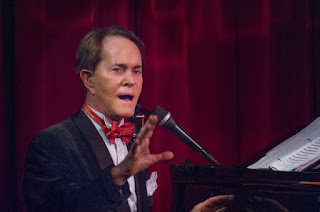
Thanksgiving weekend (November 26 and 27), Jim Dolan’s Blue Strawberry nightclub gave cabaret lovers something to be thankful for: two nights of the legendary cabaret singer and pianist Steve Ross. I was there for the packed Friday night house, and (to quote one of Ross’s favorite songwriters, Noël Coward), “I couldn’t have liked it more.”

Steve Ross

Ross has a long and happy relationship with St. Louis, going back to the early days of the Grandel Cabaret Series, where I first saw him two decades ago. Debonair, witty, and charismatic, Ross never fails to get straight to the heart of every song, whether it’s an obscure comic gem like Milton Ager and Jack Yellen’s “Hungry Women” (introduced by Eddie Cantor in his 1928 musical Whoopee!); a sentimental standard like Ralph Rainger and Leo Robin’s “Thanks for the Memory” (Bob Hope’s theme song, which he introduced with frequent co-star Shirley Ross in The Big Broadcast of 1938); or the smoky, late-night regret of the Kingston Trio hit “Scotch and Soda”. 

Without fail, Ross makes certain that you not only hear but actually listen to the lyrics – an essential skill for the cabaret artist. An evening with Steve Ross is an object lesson in why cabaret is such a vibrant art form.

Much of Ross’s latest show, Back on the Town, was likely familiar to fans. Many of his favorite songwriters were represented, including Coward, Cole Porter, the Gershwins (“George and his lovely wife Ira,” as a misinformed DJ is supposed to have said in the 1950s), Irving Berlin, and of course, the newly-departed Stephen Sondheim. The latter was represented only by “Send in the Clowns” (from A Little Night Music) but what a lovely performance it was.

There were some songs that were new to me as well—a reminder that Ross knows well how to assemble a show that mixes audience favorites with possible future favorites. In that category I’d include “My Circle of Friends” from the 2008 album Hallways by Carol Hall (best known for her musical The Best Little Whorehouse in Texas), with its sweetly sentimental thoughts on what Tales of the City's Anna Madrigal called one’s “logical family,” and “This Moment,” written by John Wallowitch and Bertram Ross for the autobiographical 1999 film of the same name. As someone with more years behind him than ahead, the lyric struck me as especially powerful: “It takes a life to realize / What life is all about / And life is all about this moment.”

And, happily, there were numbers by immortal French singer/songwriters like Charles Trenet (“La Mer,” done very much in the Trenet style) and Charles Aznavour (“Le Temps,” with English lyrics by Gene Lees). There was also, happily, Ross’s trademark instrumental medley of Edith Piaf favorites—always a hit with us fans. The Francophile feast included a song he co-wrote with Barry Day, “Whenever I Think of Paris.” It’s a wistful love letter to a city I adore as much as he obviously does.

Another notable item was Cole Porter’s popular “Anything Goes” with some new lyrics by screenwriter Joe Keenan. They were witty, to be sure, but I’m not sure all of Porter’s originals seem really need a rewrite to make them relevant: “The world has gone mad today / And good's bad today, / And black's white today, / And day's night today.” To say nothing of:

Just think of those shocks you've got
And those knocks you got
And those blues you got
From that news you got
And those pains you got
(If any brains you've got)
From those little radios.

Change that last line to, say, “From those angry talk shows” or “From social media prose” and everything old is new again.

“But I digress” – Tom Lehrer.

So, yeah, it was another charming and entertaining evening with one of cabaret’s leading lights. Thanks to Jim Dolan and the Blue Strawberry for bringing Steve Ross to town once again. Long may his light shine. Here in St. Louis, we still get a kick out of him.


Thursday, December 02, 2021

Symphony Preview: Nicholas McGegan on a box of Bachs and other Baroque notes

This weekend, December 3-5, Nicholas McGegan returns to Powell Hall for a program of music by JS Bach and his less-famous son CPE Bach. I talked with McGegan via Zoom on November 18th. Here’s a somewhat condensed transcript of that conversation. The complete video interview is available on Chuck’s Culture Channel on YouTube.

[Preview the music with my commercial-free Spotify playlist.]

L-R: Nicholas McGegan and Chuck Lavazzi

Chuck Lavazzi (CL): On December 3rd through 5th, you will be here with the St Louis Symphony Orchestra (SLSO) performing music by a pair of Bachs. The famous Johann Sebastian and one of his many musical sons Carl Philipp Emanuel. And since that's the upcoming event, let's talk a little bit about both of those guys. And I'd like to start with CPE Bach because he was a remarkable character and is probably not that well known to a lot of concertgoers.

Nicholas McGegan (NM): No, he's not. I think if his name was not Bach he might, in a way, be just as well known. There's no reason why he should be under his father's shadow, as it were. He's a wonderful composer in his own right. In terms of the kind of music he wrote and when he lived, he's kind of between two periods a little bit. He's not exactly what we think of as Baroque music, which is what, obviously, Johann Sebastian wrote. And he's not quite classical. He's an in-betweeny, if you like. Some people call it Rococo. But that makes it sound like mice in China, that it's all very pretty and stuff. His music is very daring, full of surprises. Sometimes very hard-driven. But also full of Empfindsamkeit is what the Germans call it, sensibility. It wears its heart on the sleeve, particularly in the slow movements.

CL: The Empfindsamer Stil

NM: Yeah, the sensibility. It's half of the Jane Austen novel. Without the sense. It's the sensibility. And he was much admired by Haydn, particularly, and he lived a really a very long time. He was born in 1714, but he died only four years before Mozart died, in 1788. So he had a long career. He worked for a good many years for King Frederick the Great of Prussia in Berlin, which was very much a full-time job because when the flute playing king wasn't destroying the Austrians and being rather good at the art of war, he seems to have been an extremely good flute player. And he'd certainly played a flute concerto every day of his life if he could. And so his musicians were kept very busy providing the flute concertos, making sure that they didn't have any bits he couldn't play.

CL: Yes, very important . [laughter]

NM: But he must've been really good, and he composed a little bit, too--maybe corrected by one of his lackeys. But then, CP Bach took over from his father in law, Georg Philipp Telemann, as the main Mr. Music Man, if you like, for Hamburg. So he had a very glittering career. He was famous as a keyboard player, but also as a theorist. He wrote a wonderful book on how to play the harpsichord and continuo, playing the harpsichord in the orchestra. And he also wrote a lot of music which is not performed today. He wrote many Passions, just like his father wrote the “St. John Passion” and “St. Matthew Passion.” He had to produce one every year for 20 years. And they're a lot more modest than-- or should we just say - let's be honest - a lot shorter than the Matthew Passion. The Hamburgers maybe were less patient. They only wanted them to last an hour. But he wrote a lot of those. He wrote oratorios. The only thing he never wrote-- just like his dad didn't, he didn't write any opera.

CL: I know he also wrote quite a few symphonies, and we have a couple of them on the program.

MM: He did indeed. First for strings,  then he published much grander ones with lots of wind instruments. And we're doing one of each. We're doing  one of the string symphonies, which was written and dedicated to the Baron van Swieten who was the person who later in life wrote the librettos for Haydn's “Creation” and “Seasons” and was a great lover of what, in those days, they referred to as ancient music. In other words, people like JS Bach. And he was a great friend and supporter of Mozart. His symphonies are extremely, let's say, wild. The one with winds is definitely what's called the sturm und drang, storm and stress style. This is very much away from the sort of comfy elegant music of some of the earlier part of the 18th century, or the slightly pre-classical music of his much younger brother, Johann Christian, who was a great influence on Mozart. This is wild, pushing the boundaries music-- and virtuoso too. You could tell that decaf had not been invented.

CL: Well, coffee houses were very popular back then.

NM: Very popular, but it was the real thing. So you can't get too comfy in his music, and I think that's something that Haydn learned. Just constantly astonish, leading your audience up the garden path; give them something they're not expecting. And it's a terrific style he had. He also is another wonderful link because he had a number of students on the keyboard, two of whom were Mendelssohn's great-aunts. One of the last pieces that CP Bach wrote was a double concerto for Mendelssohn's great-aunts. And the Bach connection goes, obviously, from JS Bach through to his son, CP Bach, and to Wilhelm Friedemann, another of the sons, and then down through the Levy's and Itzigs, the very wealthy Berlin families who then, in the early 19th century, had Felix and Fanny, the two famous Mendelssohns at the beginning of the 19th century. They got the Bach bug big time, but they got it directly, as it were, through relatives and from Bach's children.

"Bach Carl Philipp Emanuel 1"
by Franz Conrad Löhr (1735–1812)[1]
Staatliche Museen zu Berlin,
Preußischer Kulturbesitz, Gemäldegalerie, M.589.
Licensed under Public Domain
via Wikimedia Commons

CL: This brings up something else that I think you talked about on the SLSO Zoom seminar Wednesday (November 16), is that Bach's music was really not well known after his death, and it tended to disappear for quite a while until it started getting revived by people like Mendelssohn.

NM: Absolutely, I mean, a lot of composers go into that sort of slump, if you like. Vivaldi's another case. If you'd asked Beethoven who Vivaldi was, he probably wouldn't have had the first idea. But Beethoven did know who Bach was because he kept a copy of the 48 Preludes and Fugues by his bed. And he'd studied that. But really, the only composer who kept a good deal of popularity after his death was Handel, but not the operatic Handel, the one that we know and love as much these days, but the oratorio one. And so oratorios like Messiah and so on, continued to be performed, and have continued to be performed up to the present day. But most composers go out of fashion, and I think you can say that that happened to JS Bach big time.

CL: In fact, two of the pieces you're going to play in the second half, the Brandenburg Concertos, just really sat on a shelf for many years.

NM: They did. And I think one of the reasons for this, is that JS Bach, relatively speaking, published very little of his music. It's slightly odd, in the sense that he lived so many years in Leipzig, which really to some extent still is the center of the European book trade. The Leipzig book fair is still a big deal, and it certainly was in Bach's day. If you wanted a book published, or you wanted to find a book, you went to Leipzig, and somebody would have a copy. That's where the publishers exhibited their wares. And so Bach's published works are merely works for the ages. He published organ preludes, he published French Suites, German Suites. These are publishing monuments, not terribly practical. Music that was meant to be played, generally just circulated in manuscript, and that's what happened to the Brandenburgs. Now, first of all, let's get the fact that the Brandenburgs, he didn't write them as Brandenburgs, he wrote them as concertos for next Thursday, wherever he happened to be. The earliest one is Brandenburg 1, some of which dates from 1713 when he was in Weimar. And then he went to the Court of the Prince of Anhalt-Köthen, who being a Calvinist had no organ in his chapel, so there was no sacred music to write. But the prince himself played the viola de gamba, and could even have played in Brandenburg 6, in fact, there's a gamba part. And so what the Brandenburgs really is, is a marketing piece.

CL: A resume, in fact.

NM: A resume. One is that if you wanted to publish anything, or you wanted to get something to look like a finished piece of music, in those days you'd publish them in half dozens, occasionally in dozens. So that you have the Twelve Concertos by Corelli. You have the Six Concertos of Handel, Opus 3. The Twelve Concertos, Opus 6. So to have six Brandenburgs is sort of the standard unit, as it were, to show what you mean. He could have published them, but no one could have played them. They're very, very, very difficult, and need a very fancy orchestra that most people couldn't have afforded in those days. But it is, on the other hand, a resume, as you say. It's his, "This is what I can do. This is some of the wildest concertos that you'll ever hear." Put them in a nice book. Write a lovely preface. A very obsequious preface in French to the Marquess. Dated exactly 300 years ago, incidentally. It's March the 24th. Happens to be Telemann's birthday. Very good reasons for playing them, I think, and sent them off to the marquess who was a close relative of the king of Prussia, not Frederick the great, but his rather eccentric father and apparently put them on the shelf. And that was it. He may have opened the score. He may not have done. He might've received things like this every couple of weeks. Lots of people would like to work for a member of the Royal family and they send in their CV, some saying, "I'm really good as a wine waiter." And some saying, "Oh, I've written some concertos. You might like them." So they sat in the library, and they didn't really get opened. They went through various hands until the middle of the 19th century.

CL:  You talked about how someone might've said, "I'm a great wine waiter." Composers were kind of seen at the time and musicians just as potential employees, probably not much more respectable than a wine waiter really.

NM:  Yes. I mean, he was the boss. But it was quite normal, for example, in 18th century England to put out a wish to have a servant who could be a valet and horn player. There are even pictures of people pretty much doing that because you want to have a really good doorbell, you hired two horn players who would stand. There's even a house in Devon where there are two hooks beside the door for the two horns so that the servants could rush down and go, "Toot, toot, toot," when somebody's carriage arrived to welcome them.

CL: As long as we're talking about these concerti, let's not fail to mention who's going to be playing them the third through the fifth. The viola parts are going to be played by Andrew Francois and Beth Guterman Chu.

NM: . Wonderful members of the St. Louis Symphony. And it's unusual to have concertos for violas. On the other hand, composers themselves loved playing the viola. Bach loved playing the viola. We know that. And Mozart loved playing the viola almost more than the violin. The Sinfonia concertante, for example, he played the viola. So even though the viola doesn't have much of a solo repertoire, it loves being in the ensemble. And I'm sure Bach wrote this for himself to play with a mate because it's definitely very intimate. It's a musician's piece. You can just imagine this. It's the smallest of the Brandenburgs, not really designed for a concert hall at all, more like a drawing room and it's written for six or seven musicians to have a good time.

"Statue of J.S. Bach in Leipzig" by Zarafa
at the English language Wikipedia.
Licensed under CC BY-SA 3.0
via Wikimedia Common

CL: Yeah. Well, in fact, Beth Guterman Chu was talking about how, at least in the second movement, it felt like an intimate conversation among friends.

NM: Oh, sure. And these people, travel wasn't so easy in the 18th century. So if were at the prince's court, you were there most of the time. You'd get to know your colleagues and you're going to get to know them very well until you would want to have music to play in the little ensemble that he had. Bach only had about 10 musicians there. So it's known as an orchestra but it's not what we would think of as an orchestra, more like an expanded chamber group.

CL:  We don't want to also forget Yin Xiong, who is playing the cello part.

NM: The cello part plays with the violas a lot. The gambas sort of sit in the background being super sophisticated. String instruments like the violin, the viola, at lesser extent the cello, were not regarded as aristocrats' instruments. The viola de gamba was the aristocratic instrument. It was played by princes. It was played also by women, the most famous being, I think her name is Madame Henriette, or possibly Madame Victoire. One of the daughters of Louis XV played the viola de gamba. And she has her viola de gamba on a little tuffet, like with muffet because obviously she's got those dresses they used to wear that looked as if they would quite like to be a sofa. It's hard to get a gamba between your knees if that's what you're wearing. But you could play it on a tuffet. And lots of pieces are dedicated to her. There was also in England a famous lady called Anna Ford, who actually played the viola de gamba in public. But the cello was also an aristocratic instrument later on. And, indeed, three or four Princes of Wales, including the present one, have at some time in their lives played the cello. I know that the present one plays the cello because I was at university at the same time as he was. And I actually nearly had to conduct him playing the cello once in an orchestra. Just escaped it. Can you imagine trying to tell a prince he was flat and wanting to keep your head?

CL: Likely an issue there. So this brings me to another thing I wanted to talk about. It's not specifically about this concert. But it's something you brought up yesterday in the call. The whole soundscape surrounding music of this period has changed. I mean, the soundscape of our world has changed in general. In fact, there was an excellent book with that title by R. Murray Schafer that came out in 1993 [https://www.goodreads.com/book/show/585024.The_Soundscape] chronicling how the world has gotten increasingly louder over the past few hundred years. But these were all works intended to be performed in very small rooms for very small audiences. And there are issues, I would think, trying to scale them up for, say a 2,500-seat hall, like Powell Symphony Hall.

NM: Yeah. Certainly, things have changed a lot. It's not only sound, but light has also changed. We've got something called electricity. I think Paris was the first city to get streetlights, had about 50 of them. We can imagine everybody else just wandered around in the dark. We can't imagine that now. Of course, there were many fewer people. And you simply, in the 18th century, couldn't light a concert hall that held 2,500 people. You could light a theatre because you lit the stage. And you lit the individual boxes. But everything else was-- I should think we would think of it as pretty dingy.

So concert halls tended to be pretty small. Can you imagine lighting every single lightbulb individually in Powell Hall, how long that would take? And a candle burns half an hour, constantly needing to be changed. So aristocrat's houses had chambers, the knights' rooms or princes' rooms or ballrooms, but they would hold relatively small number of people. And the great thing about a prince's concert is in order for it to be classy, you want to keep as many people out as you can. You wouldn't want anybody less than an archduchess actually to be listening. It would lower the tone. And even if there was only one prince there and he was the guy paying you, that was enough. You could also be sure that CP Bach working in Berlin JS Bach in Cothen and the Prince Nikolaus Esterhazy for Haydn, these were all people who loved music. And a lot of them played themselves. And so we're talking a very sophisticated audience who would, should we say, get the complications of Bach whether they were actually playing it and had to experience how hard it is to play, or just listening to the intricacies of it. And being up close and personal to something like a Brandenburg really helps you hear just how intricate these pieces are. Orchestra music comes in the later part of the 18th century, but even then Haydn's concert hall is seven or eight hundred. That was considered a large space because they couldn't light anything bigger, and so-- nor could the orchestra see.

So what we think of as a concerto is something like the Tchaikovsky piano concerto. These, though, were concertos because they feature a single or a small group of instruments, in these cases, small groups of instruments, what in the 18th century would have been called concerti grossi, big concertos rather than just one solo, like “The Seasons” of Vivaldi and an audience of maybe 25 people sitting round. It's a very different aural experience. And when you're trying to project that into a space of a couple of thousands, the size of the coliseum in Rome, if you like, you have to do them in a slightly different way. In the same way, as if you were not using a microphone, if you're talking to a small group, you're talking in one way. If you're talking to two and a half thousand people, you're talking in a different way. You're enunciating, you're speaking more slowly, and so on. I've done all the Brandenburgs in Powell Hall and they worked fine, but it would be a very different experience. I always wished that the artist was on stage. Now, funnily enough, the hall where Bach played in the palace in Cothen still survived. We can see how big it was. Architecturally, it was altered in the early 19th century. It's been modernized, but it hasn't been made any bigger. And we don't even know if that was the room they were actually played in. It could have been done in a smaller one. I was quite recently in a palace just north of Berlin, where Frederick the Great lived when he was a young man. And there is a music room, but it was too big--35 feet by 35 or something. He had a much smaller room around the corner where he really liked to play, which is the size of the average living room.

CL: So as a conductor, are there adjustments you have to consciously make? Are ways that you have to think differently about this music because you're performing for such a large group?

NM: Well, one thing you have to do is not to try to aggrandize it so that you sort of sling it to the back of the hall. What you want to do is to encourage the audience maybe to move a couple of inches further towards us, sit on the edge of their chair, and just get used to the intimacy of the music.

CL: Draw the audience in as they sit, as opposed to trying to push the music out.

NM: Yeah. Yeah, I think it would be great if everyone was in theyou first 10 rows, frankly. The harpsichord is the ideal instrument for a small room. If you had a Bösendorfer or a great big Steinway on stage trying to play this, it would just drown everything out. On the other hand, a harpsichord trying to play the Tchaikovsky piano concerto would be extremely silly. First of all, you wouldn't have enough notes. You have no dynamics. And harpsichords are designed for small spaces. So I hope they won't mic the harpsichord to make it artificially loud because, in vast places, it needs to be there as part of the sound, but it's not adding any extra chords or anything like that because Bach's already fully scored. It’s continuo, so. It adds a bit of pep to the rhythm as well.

CL: And we have a harpsichordist, Mark Schuldiner. Have you worked with him before?

NM: Yes. Several times in St Louis, he came down when we were doing, I think it was the Vivaldi “Gloria,” and he actually played the organ. But I also know him from Chicago because one of the things he does besides playing very well-- is he also is an excellent tuner. And I was doing a concert of 17th Century Jewish music from Venice. And there was suddenly Mark providing all the keyboards. So it was great to see him again. So this is the third time I've worked with him. He's terrific. So that will be great fun to see him again. It's just a hop, skip, and a jump down from Chicago with the harpsichord. I don't know if he's bringing his own harpsichord. We'll find out.

CL: Okay. I think that's mostly what I had on my list of things to bring up. I do want to say this. I have seen you many times at Powell Hall and one of the things I always notice, you don't just walk out on stage, you bound out on stage. I mean at one point commented on the fact that you ran out on stage, and you walked up to the podium, and you rubbed your hands together and I said it was like he was saying, "Oh, this is going to be such fun."

NM: Well, it's going to be, I hope. I'm not sure I'm quite the bounder. I don't bound quite as much, but I do a little bit more than I used to because I had a hip replacement, so I can bounce a bit more. I'm not quite the Bugs Bunny me going out there, that that might have been a number of years ago.

I think we should also mention Yin Xiong again. She's going to be playing this remarkable CP Bach cello concerto. It's an unusual piece because there aren't that many concertos for the cello compared to the violin. And CP Bach's ones also are written for several instruments. He would write a concerto which could be played on the cello, on the keyboard, or the flute. The music is essentially the same, he's adapting them perfectly for whichever instrument it is. So he had to write a flute concerto, of course, because the king probably paid him to. But then he said, "Well, why not make it for the cello as well? We've got a mate who plays the cello, and I'm sure he'd love to have this concerto." And then he said, "Well, I'm a great keyboard player. I could play it on the harpsichord." So it gives it a bit more of a shelf life.

I have to say, the one she's playing in A major is my favorite of the three, very sparkly in the last winter, especially, but with a very, very deep, sad, miserable, back to that very sensitive, full of sensibility slow movement, wearing your heart on your sleeve, which of course, as the 18th century goes on, becomes increasingly part of the makeup of how people thought. In Goethe, you've got “The Sorrows of the Young Werther,” which is all about wearing your skin inside out, and feelings, deep feelings. And that's very much something, of course, that CP Bach got from Daddy. The slow movement of Brandenburg 6 is a very deep, beautiful, quiet piece, but he traded on it. And the slow movements of nearly all the pieces that we're playing, the CP Bach pieces, come to that format, and they're really wonderful.

CL: So you can see the seeds of what would eventually become the century of the Romantic sensibility.

NM: Absolutely. And it's not the sort of music that's merely elegant. They had beating hearts, and they loved and lost just as we do.

CL: Yes. We tend to have this artificial image of these stiffly-posed people in wigs and elaborate gowns, and we, yeah, forget that they were just as human as the rest of us.

NM: Yeah. And the ones we're thinking of are only the rich ones. Can you imagine what it'd be like if you're basically living on the street or making one of those dresses by candlelight, working through the night, sewing the silk for something that the queen might wear once.

CL: Yes. It isn't the way it looks in those Hollywood movies from the '50s, but [laughter]--

NM: Yeah, the scarlet pimpernel is not how it was for everybody.

CL: Yes. I always say that I'm glad I was not born before the age of relatively painless dentistry, myself.

NM: Yes. Young, rich, and good teeth is what you needed.

CL: Nic McGegan, thanks for taking some time to talk to me. Once again, you are going to be conducting music by CPE Bach and Johann Sebastian Bach, December 3rd through the 5th at Powell Hall, slso.org for more information. I look forward to seeing you on stage again because you always, as I alluded to earlier, have this tremendous joy and enthusiasm for the music. And you know that that really communicates itself through the audience.

NM: Thank you. I can't wait to come back because I was supposed to have a concert last February, which is of course just when the symphony was not performing, so I missed out on my annual jaunt to St. Louis. But I get to come now, and that's absolutely terrific. Can't wait. And with a live audience too.

This article originally appeared at 88.1 KDHX, where Chuck Lavazzi is the senior performing arts critic.