Showing posts with label great american songbook. Show all posts

Friday, December 03, 2021

Cabaret Review: We still get a kick out of Steve Ross

Thanksgiving weekend (November 26 and 27), Jim Dolan’s Blue Strawberry nightclub gave cabaret lovers something to be thankful for: two nights of the legendary cabaret singer and pianist Steve Ross. I was there for the packed Friday night house, and (to quote one of Ross’s favorite songwriters, Noël Coward), “I couldn’t have liked it more.”
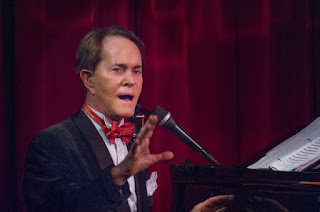
Steve Ross

Ross has a long and happy relationship with St. Louis, going back to the early days of the Grandel Cabaret Series, where I first saw him two decades ago. Debonair, witty, and charismatic, Ross never fails to get straight to the heart of every song, whether it’s an obscure comic gem like Milton Ager and Jack Yellen’s “Hungry Women” (introduced by Eddie Cantor in his 1928 musical Whoopee!); a sentimental standard like Ralph Rainger and Leo Robin’s “Thanks for the Memory” (Bob Hope’s theme song, which he introduced with frequent co-star Shirley Ross in The Big Broadcast of 1938); or the smoky, late-night regret of the Kingston Trio hit “Scotch and Soda”. 

Without fail, Ross makes certain that you not only hear but actually listen to the lyrics – an essential skill for the cabaret artist. An evening with Steve Ross is an object lesson in why cabaret is such a vibrant art form.

Much of Ross’s latest show, Back on the Town, was likely familiar to fans. Many of his favorite songwriters were represented, including Coward, Cole Porter, the Gershwins (“George and his lovely wife Ira,” as a misinformed DJ is supposed to have said in the 1950s), Irving Berlin, and of course, the newly-departed Stephen Sondheim. The latter was represented only by “Send in the Clowns” (from A Little Night Music) but what a lovely performance it was.

There were some songs that were new to me as well—a reminder that Ross knows well how to assemble a show that mixes audience favorites with possible future favorites. In that category I’d include “My Circle of Friends” from the 2008 album Hallways by Carol Hall (best known for her musical The Best Little Whorehouse in Texas), with its sweetly sentimental thoughts on what Tales of the City's Anna Madrigal called one’s “logical family,” and “This Moment,” written by John Wallowitch and Bertram Ross for the autobiographical 1999 film of the same name. As someone with more years behind him than ahead, the lyric struck me as especially powerful: “It takes a life to realize / What life is all about / And life is all about this moment.”

And, happily, there were numbers by immortal French singer/songwriters like Charles Trenet (“La Mer,” done very much in the Trenet style) and Charles Aznavour (“Le Temps,” with English lyrics by Gene Lees). There was also, happily, Ross’s trademark instrumental medley of Edith Piaf favorites—always a hit with us fans. The Francophile feast included a song he co-wrote with Barry Day, “Whenever I Think of Paris.” It’s a wistful love letter to a city I adore as much as he obviously does.

Another notable item was Cole Porter’s popular “Anything Goes” with some new lyrics by screenwriter Joe Keenan. They were witty, to be sure, but I’m not sure all of Porter’s originals seem really need a rewrite to make them relevant: “The world has gone mad today / And good's bad today, / And black's white today, / And day's night today.” To say nothing of:

Just think of those shocks you've got
And those knocks you got
And those blues you got
From that news you got
And those pains you got
(If any brains you've got)
From those little radios.

Change that last line to, say, “From those angry talk shows” or “From social media prose” and everything old is new again.

“But I digress” – Tom Lehrer.

So, yeah, it was another charming and entertaining evening with one of cabaret’s leading lights. Thanks to Jim Dolan and the Blue Strawberry for bringing Steve Ross to town once again. Long may his light shine. Here in St. Louis, we still get a kick out of him.


Wednesday, May 16, 2012

A fine way to treat a Steinway

Who: Michael Feinstein with Sam Kriger and the St. Louis Symphony
What: The Great American Songbook
Where: Powell Symphony Hall
When: May 13, 2012


Share on Google+


"I Won't Send Roses" from Jerry Herman's Broadway at Holiday Bowl (1993)

Michael Feinstein’s appearance with the St. Louis Symphony on Mother’s Day had all the elements of a classic, well-crafted cabaret show. Yes, there was a full orchestra on stage (making it something of a cabaret show on steroids), but Mr. Feinstein connected with the audience as if he were performing at a small club with only his Steinway. There even moments of surprising intimacy—remarkable, given that this was, after all, Powell Hall.

But then Mr. Feinstein is an impressive combination of cabaret artist and musical historian, specializing in what has come to be referred to as the “Great American Songbook” (or, as he jokingly referred to it, “the Rod Stewart Songbook”): the pop and theatre music that dominated American culture from the 1920s into the 1970s. He has this stuff in his blood, singing and playing it as easily as some of us speak. He talks about the songs, their creators, and the performers who introduced them as though they were his friends (a few of them actually were).

The program was pure mainstream songbook, from Berlin’s first hit, “Alexander’s Ragtime Band” (with a slight lyrical alteration to make it less bellicose) to Kander and Ebb’s “New York, New York”. Probably the least familiar numbers were Gershwin’s droll “By Strauss” (from the 1946 revue The Show is On) and Jerry Herman’s “I Won’t Send Roses” (a classic song of ambivalent love from Mack and Mabel, where it was sung by Robert Preston).

The performance of that latter song, by the way, yielded one of the afternoon’s classic cabaret moments. Mr. Feinstein accompanied himself at the piano and everything was flawlessly “in the moment” until the very end, when a bit of modulation went awry and he ended up singing the final note loudly instead of softly as the song clearly requires. Rather than brazen it out, he did what any good cabaret artist should do under the circumstances: he apologized, went back and re-did the ending perfectly.

That aside, the rest of the program was about as polished as anyone could wish. Mr. Feinstein is, of course, a charming performer and an engaging storyteller, liberally sprinkling the show with tidbits on the songs and their creators. He’s a strong singer, with a ringing head voice and smooth falsetto, equally at home belting out a medley of “Luck be a Lady” and “All I Need is the Girl” or crooning the Jerome Kern/Dorothy Fields classic “The Way You Look Tonight” in an arrangement based on the one Jobim did for Sinatra in 1964. He’s also an impressive pianist and got great backing from the symphony musicians under the baton of his music director Sam Kriger.

He’s also a great admirer of the work of George Gershwin (as am I), and even though he didn’t get around to a solid Gershwin set until the end of the second act, it felt like the spirit of the composer was never far away, especially when quotes from the Concerto in F popped up in both a flashy “big band” arrangement of “Brazil” (complete with impressive trombone and trumpet solos) and the bluesy intro to “Alexander’s Ragtime Band” as well. His tribute to Gershwin included the arrangement of “They Can’t Take That Away from Me” used in the 1936 film Swing Time, where it was sung by Fred Astaire. It lost the Oscar that year to “Sweet Leilani”, of all things, but the arrangement was Ira Gershwin’s favorite nevertheless.

Mr. Feinstein concluded the Gershwin segment by asking mothers in the audience to call out the titles of their favorite Gershwin tunes and then improvising a medley based on the requests. I suspect the medley would have ended with “Our Love is Here to Stay” even if nobody had suggested it, though. It was, after all, George Gershwin’s last song and writing the lyric for it pulled Ira out of the depression caused by his brother’s death. You couldn’t ask for a better way to end a tribute to the Gershwins.

Michael Feinstein’s appearance with the symphony was, in short, a very classy and entertaining way to spend the afternoon on Mother’s Day. My mom, who grew up with this music, certainly enjoyed it. Judging from the audience response, she was clearly in the majority.

Post-season activity at Powell Hall continues through June 22nd. Upcoming events include a pops concert featuring Rhapsody in Blue with Sarina Zhang at the keyboard and Ward Stare at the podium on Friday, May 18; a concert by the Youth Orchestra on Sunday, May 20; and Bond and Beyond: 50 Years of 007 on Saturday, June 2. For more information, visit stlsymphony.org.

Complete song list:

Medley: “Luck Be a Lady” (Loesser) / “All I Need is the Girl” (Styne / Sondheim)
“I Concentrate on You” (Porter)
“I Wanna Be Around” (Mercer / Vimmerstedt)
“I Won’t Send Roses” (Herman)
“Brazil” (Barroso)
“The Folks Who Live on the Hill” (Kern / Hammerstein)
“Somewhere” (Bernstein / Sondheim)
“Alexander’s Ragtime Band” (Berlin)
“Once in a Lifetime” (Bricusse / Newley)
“The Way You Look Tonight” (Kern / Fields)
“I Love a Piano” (Berlin)
Medley: “When I Fall in Love” (Young / Heyman) / “My Foolish Heart” (Young / Washington)
“Fascinatin’ Rhythm” (Gershwin)
“They Can’t Take That Away From Me” (Gershwin)
Gershwin medley: “By Strauss” / “I Got Rhythm” / “Someone to Watch Over Me” / “Our Love is Here to Stay”
“For Once in My Life” (Miller / Murden)
“New York, New York” (Kander / Ebb)